An open letter to Rahul Gandhi
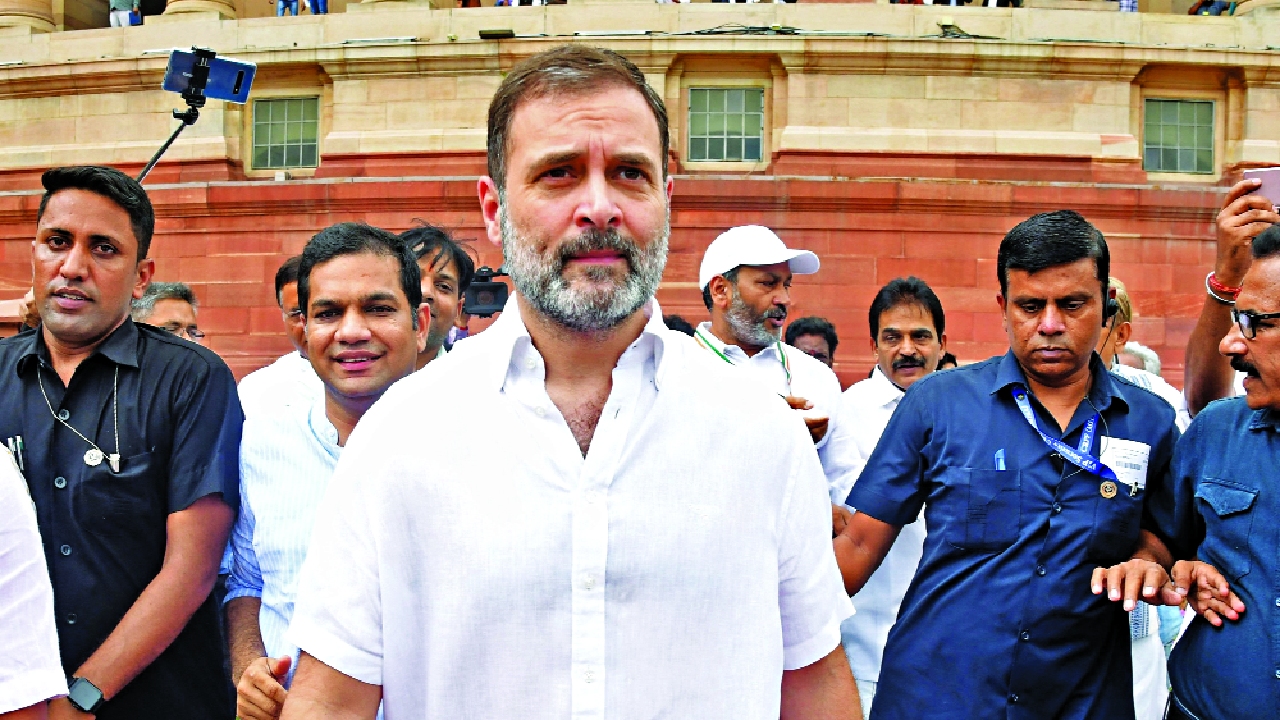
Dear Rahul ji, I write with candour, yet with due regard for the office you occupy as Leader of the Opposition in the Lok Sabha. In any parliamentary democracy, this office is not meant merely to oppose, but to scrutinise rigorously, question the government of the day fearlessly, and do so while safeguarding national interest. A mature democracy requires both — a strong government and a credible opposition. When either falters, democratic balance weakens. Unfortunately, I must say that the dignity of the office has declined since your takeover, due to your conduct and statements that appear impulsive, theatrical, and lacking a solid grounding in facts or historical knowledge. My concern is not limited to a single incident. The pattern predates 2014 and indicates a deeper intellectual attitude-one that is sometimes disconnected from historical realities and national sensitivities.
In 2010, diplomatic cables released by WikiLeaks recorded that you told the US Ambassador that radicalised “Hindu groups” posed a “bigger threat” to India than the Pakistani terror outfit Lashkar-e-Taiba-responsible for the horrific 2008 Mumbai 26/11. This disclosure came when India was still scarred by the Godhra train burning, where fifty-nine pilgrims were burnt alive by jihadists.
Yet, instead of confronting Islamist extremism with clarity, a fake counter-narrative of “saffron terror” was constructed, even casting suspicion on organisations such as the Rashtriya Swayamsevak Sangh. The 2007 affidavit questioning the historicity of Lord Ram further reflected a disturbing intellectual drift. In a continuity of this disposition, you and your family chose to absent yourselves from the historic 2024 Ram Temple Pran-Pratishtha ceremony at Ram Mandir, Ayodhya.
In 2013, the country witnessed an extraordinary spectacle. During Prime Minister Manmohan Singh’s tenure, you publicly dismissed your party-led Cabinet-approved ordinance as “complete nonsense” that should be “torn up and thrown away.” The ordinance had already been cleared by the Cabinet and the Congress leadership. Democracy welcomes dissent; it also demands institutional respect. Where do you get such arrogance? From a sense of entitlement owing to your dynastic roots? More recently, on 13 March last in Lucknow, while commemorating Kanshi Ram’s birth anniversary, you suggested that had Jawaharlal Nehru been alive, Kanshi Ram might have become Chief Minister through the Congress.
The claim surprised many observers-not just because it was speculative, but because it overlooked Kanshi Ram’s political journey and the historic disdain of Congress for dissenting Dalit voices outside its organisational structure. In 1994, I had the opportunity to meet Kanshi Ram several times. Each interaction lasted hours. These meetings were facilitated by a Dalit leader from South India who then served as a minister in the government of P. V. Narasimha Rao and remains associated with your party even today. Kanshi Ram impressed me as a man uniquely dedicated to Dalit empowerment. Unlike many politicians who see power as an end in itself, he viewed political office solely as a tool for social change. Personal ambition did not motivate him. He politely declined an offer to move to Rashtrapati Bhavan, made by Atal Bihari Vajpayee. Ultimately, he trusted his movement to Mayawati, whom he believed could continue the struggle. The analogy you used in your speech-holding a pen vertically to symbolise hierarchy and horizontally to represent equality-was actually Kanshi Ram’s favourite metaphor. I remember him demonstrating it vividly during our conversations.
Invoking Nehru in this context, however, appeared historically misplaced. Kanshi Ram built his politics precisely because he believed the Congress system had failed Dalits. The historical relationship between Congress leadership and Dr BR Ambedkar also deserves reflection. Kanshi Ram regarded Ambedkar as his greatest inspiration. Yet Ambedkar’s political experience with Congress leaders-particularly Nehru-was marked by sharp tensions.
Nehru had no hesitation in awarding himself the Bharat Ratna in 1955. Ambedkar, the chief architect of India’s Constitution, received the same honour only in 1990-thirty-five years later-under the government of V. P. Singh, which was supported from outside by the Bharatiya Janata Party and the Left. Ambedkar’s entry into the first Cabinet of independent India occurred largely because Mahatma Gandhi insisted that the new government must include distinguished non-Congress figures. Thus, Ambedkar served alongside leaders such as Syama Prasad Mukherjee and Sardar Baldev Singh.
The 1952 general election further highlights the relationship. After resigning from the Cabinet, Ambedkar contested from North Bombay. The Congress fielded Narayan Sadoba Kajrolkar against him. Ambedkar lost by around fourteen thousand votes, while over 75,000 ballots were declared invalid. It was probably the first case of vote chori (theft), scandalising independent India in its very first election to the Lok Sabha. Compounding the hostility, Congress and Communist leaders called Ambedkar a “traitor”. Yet such accusations were not entirely novel. Writing to Rajkumari Amrit Kaur on 26 January 1946, Nehru himself remarked that Ambedkar had “allied himself with the British Government against the Congress”.
Savita Ambedkar records in her autobiography that Nehru was “keeping a sharp eye on the constituency” during the 1952 election. According to her account, Nehru, S. K. Patil and Dange were determined to ensure Ambedkar’s defeat. Nehru himself appeared jubilant with the outcome. In a letter to Lady Edwina Mountbatten dated 16 January 1952, he wrote: “In Bombay city and to a larger extent in Bombay province, our success has been far greater than expected. Ambedkar has been dropped out.” Rahulji, please ask yourself: Why was Nehru celebrating Ambedkar’s electoral defeat? I am not implying anything, but I wonder why he was happily sharing the news of Ambedkar’s loss with a woman who was the consort of a colonial ruler responsible for planning and executing India’s partition, and had then left Indian shores for her country. Hopefully, you know the answer.
Ambedkar’s anguish is recorded by his biographer Dhananjay Keer in ‘Dr Babasaheb Ambedkar: Life and Mission’. Ambedkar lamented that Congress leaders routinely branded him a “traitor”. In contrast, Mahatma Gandhi once told him: “I know you are a patriot of sterling worth.”
In this context, your recent demand for the Bharat Ratna for Kanshi Ram raises questions about consistency. When Mayawati made the same request in 2008, the Congress-led UPA government rejected it, arguing that such honours should not be subject to lobbying. Why were you silent then? Today, the same demand, raised by you on the eve of Uttar Pradesh elections, seemingly appears insincere and driven by political opportunism. Kanshi Ram himself had little faith in the Congress. In his 1982 book ‘Chamcha Yug’, he accused the party of cultivating “stooge” Dalit leaders who served its interests rather than empowering the community. Your rhetorical framework often echoes familiar ideological clichés about India’s civilisation. This has repeatedly led to judicial corrections. Your remarks linking the Rashtriya Swayamsevak Sangh to Gandhi’s assassination required clarification in court. The “Chowkidar Chor Hai” episode led to an apology to the Supreme Court. Your statements on Vinayak Damodar Savarkar invited judicial caution.
Criticism is legitimate, and indeed a vibrant democracy’s lifeline. However, undermining the nation while trying to criticise the government, echoing external prejudices, and making baseless accusations against political rivals and ideological opponents fall into a different category. It is irresponsible behaviour unworthy of a credible leader. Your endorsement of foreign criticism describing India as a “dead economy” raised concerns about national disparagement. Your remarks abroad suggesting that “Sikhs may not freely practise their faith in India” were swiftly appropriated by hostile elements. Most alarming was your assertion that your party is fighting not merely the BJP or RSS, but the “Indian State”-a formulation historically invoked by insurgent movements. In 2018, you made an unsubstantiated claim in the Rafale matter, invoking the French President-swiftly contradicted by the French government. In 2017, during the Doklam standoff, you met the Chinese Ambassador, with your party first denying and then admitting the meeting.
During foreign visits, Rahulji, you have expressed concern that Western powers no longer comment on India’s internal affairs and have repeatedly described India as merely a “union of states”-not as a nation. This is less a constitutional observation and more an intellectual stance that diminishes India’s civilisational continuity-a doctrine Gandhiji often emphasised and strived for.
Even recent episodes-such as the conduct of Youth Congress activists at an international forum, followed by your approving remark-suggest a troubling preference for spectacle over seriousness. You have warned that India would “burn” if the BJP returns to power and questioned constitutional stability. After electoral defeats, you and your party have cast doubts on institutions such as the Election Commission. Opposition is legitimate; delegitimising institutions is not.
Your parliamentary conduct has occasionally reinforced perceptions of theatricality-the 2018 embrace of the Prime Minister followed by a wink, or recent public gestures that prioritised superficial optics over substantive politics. Your renewed emphasis on redistribution slogans such as “jitni abaadi, utna haq” raises further concern. History offers a cautionary lesson. Under Indira Gandhi, excessive nationalisation weakened production, fuelled shortages, and culminated in the Indian Emergency. Redistribution without wealth creation destroys the very foundation it seeks to distribute. The test of leadership lies not in applause, but in arguments that withstand scrutiny-historical, judicial, and intellectual.
India deserves an opposition that challenges the government with seriousness-not slogans; with evidence-not conjecture; with statesmanship-not theatrics. As Leader of the Opposition, you have a rare opportunity to elevate national discourse. That responsibility demands intellectual discipline, historical awareness, and an unwavering commitment to the dignity of the Republic. I hope you will reflect — not as a matter of partisan disagreement, but as an appeal to restore seriousness to India’s political conversation.
The writer is an eminent columnist, former Chairman of the Indian Institute of Mass Communication (IIMC), and the author of ‘Tryst with Ayodhya: Decolonisation of India’ and ‘Narrative ka Mayajaal’; views are personal
Leave a Comment
Comments (1)
He is known by the colour he wears saffron .How can he be seperate from the chaddiwalas. So he is repeating the narrative which saffron assoles hold to their heart.people of India know it.