A strong Bharat demands stronger institutions
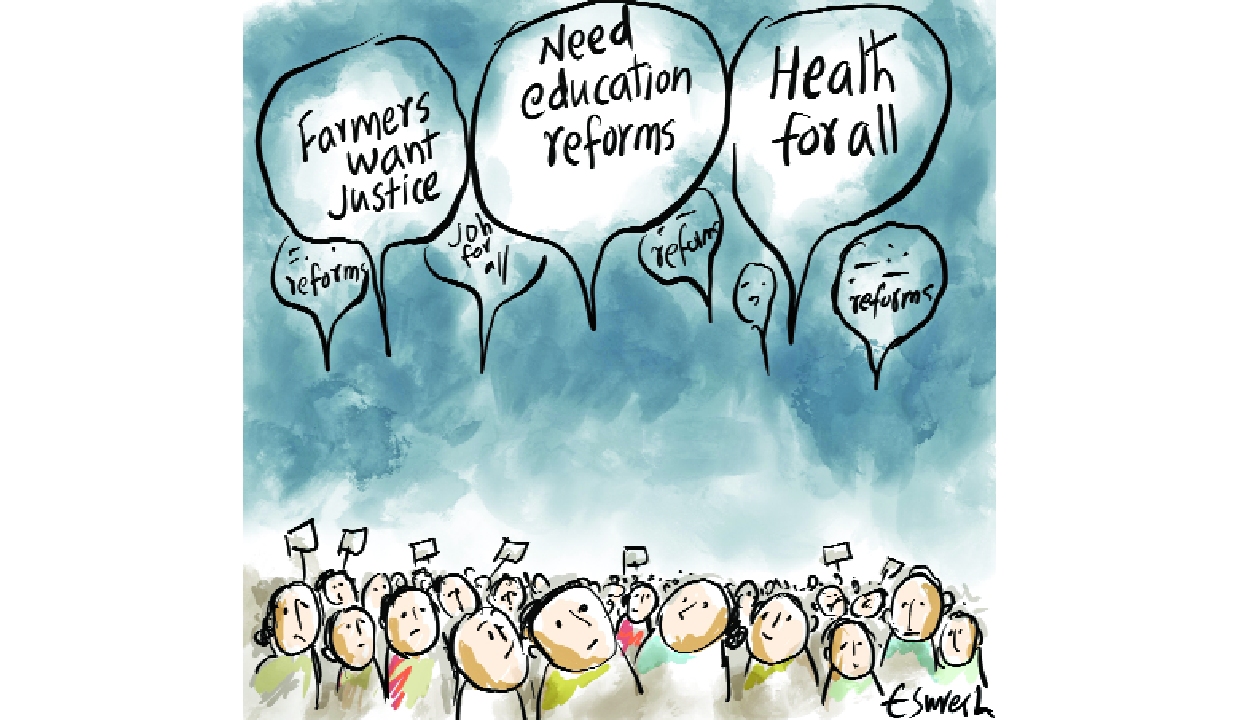
Recent agitations involving farmers and students appear to follow a similar pattern: local grievances rapidly escalate into nationwide movements, amplified by social media and, at times, influenced by domestic and international actors seeking to shape public opinion. As the ruling party has consistently demonstrated a strong ability to win elections, sections of the opposition may increasingly rely on mass mobilisation to challenge the government between electoral cycles, knowing full well that they cannot challenge the current government at the ballot box. However, the government must avoid complacency by responding to genuine public concerns, while the opposition should exercise restraint, ensuring democratic dissent does not spiral into unrest that ultimately harms the nation and all political stakeholders, including the people fanning the fire
India stands at a defining moment in its democratic journey. It is the world’s largest democracy, one of the fastest-growing major economies, and an emerging global power. Yet the true strength of a nation is not measured only by GDP growth, expressways, airports, or digital infrastructure. It is measured by the quality of its institutions and the confidence that ordinary citizens place in them. Today, that confidence is under increasing strain. These challenges are not failures of one government or one political party. They are symptoms of institutional weaknesses that have accumulated over decades and have survived successive administrations of every political persuasion. As Abraham Lincoln wisely observed, “When public institutions fail to deliver efficient services, public frustration inevitably rises.”
India’s police system requires urgent modernization. Across the country, police personnel serve with courage under difficult conditions, yet they often work with inadequate manpower, outdated investigative methods, excessive workloads, limited forensic support, and insufficient technological integration. Citizens frequently perceive investigations as slow, corrupt, and legal processes as cumbersome. Genuine police reforms must focus on professionalism, operational independence, scientific investigation, accountability, and community policing for citizens to view the police as protectors rather than merely law enforcers. Moreover, the lack of reforms has led to police stations in India turning in extortion hubs.
The judiciary remains another pillar requiring comprehensive reform. Justice delayed has become one of India’s greatest institutional challenges. Millions of pending cases undermine confidence in the rule of law, delay economic activity, discourage investment, and impose enormous emotional and financial costs on ordinary litigants. Judicial reforms should include significantly increasing judicial capacity, adopting artificial intelligence for case management, strengthening digital courts, simplifying procedures, expanding mediation, and ensuring that justice is both affordable and timely. As William Gladstone famously remarked, “Justice delayed is justice denied.” The courts in India have lately become an effective tool to serve the elites; the common man is left high and dry.
Urban governance presents equally serious concerns. India’s cities generate economic growth but struggle with pollution, waste management, congestion, flooding, water shortages, unauthorized construction, and inadequate civic infrastructure. Municipal bodies frequently operate with fragmented authority, weak finances, and limited professional capacity. The issue is not simply funding; it is institutional efficiency, accountability, and measurable outcomes. Surely, citizens deserve clean streets, safe drinking water, efficient public transport, and transparent local governance, contrary to what they are getting across the country.
Healthcare represents perhaps the greatest daily concern for ordinary families. Despite remarkable advances in medical science, access to quality healthcare remains highly unequal. Public hospitals in many regions continue to face shortages of doctors, nurses, medicines, equipment, and infrastructure. A medical emergency should never become a financial catastrophe for a family. Investing in primary healthcare, preventive medicine, digital health systems, medical education, and rural healthcare infrastructure must become a national priority.
Education too requires structural transformation. Expanding enrolment alone cannot define success if learning outcomes remain weak. Schools and universities must produce critical thinkers, innovators, entrepreneurs, scientists, and skilled professionals rather than merely examination candidates. India’s demographic dividend can become its greatest strength only if education equips young people with practical skills, digital literacy, ethical values, and adaptability in an AI-driven economy. The recent Gen Z agitation should be an eye-opener for the ruling class; it exposes the disconnect between the government and its young citizens.
No discussion on institutional reform can ignore agriculture. Nearly half of India’s population continues to depend directly or indirectly on agriculture, yet millions of farmers remain economically vulnerable. Fragmented landholdings, climate uncertainty, rising input costs, inadequate irrigation, price volatility, post-harvest losses, and limited value addition continue to constrain farm incomes. The objective of agricultural policy should move beyond ensuring production to ensuring prosperity. Farmers require modern technology, market access, storage facilities, affordable credit, insurance, research support, and integrated supply chains that allow them to participate meaningfully in India’s economic growth.
The rise of social media has fundamentally transformed the relationship between governments and citizens. Public opinion now forms and spreads within hours, turning local grievances into national or even global debates. The Arab Spring demonstrated the disruptive power of digital platforms, while countries such as Sri Lanka, Bangladesh, Nepal, and Pakistan have witnessed major political upheavals influenced by rapid information flows and mass mobilization.
Several European democracies have also experienced swift political shifts shaped by online discourse. In this digital age, governments must embrace greater transparency, responsiveness, and accountability, as citizens increasingly expect not just policy announcements but tangible, measurable, and timely governance outcomes.
India’s young population further amplifies the urgency of reform. Aspirations have risen dramatically. Young Indians seek quality education, meaningful employment, efficient governance, and equal opportunity. When expectations repeatedly encounter institutional inefficiency, frustration naturally increases. Governments must recognize that economic growth alone cannot sustain public confidence unless institutions function fairly, efficiently, and transparently. Mahatma Gandhi reminded us that “The true measure of any society can be found in how it treats its most vulnerable members.” Institutional reform is therefore not an administrative exercise; it is a moral obligation.
Artificial intelligence, digital governance, blockchain, predictive analytics, and data-driven administration present unprecedented opportunities to modernize governance. Governments should deploy these technologies to improve judicial efficiency, detect corruption, streamline public services, strengthen healthcare delivery, enhance agricultural productivity, and improve policy implementation. Technology should become an instrument of accountability rather than merely a symbol of modernization.
The choice before India is clear. Political debates will continue, elections will come and go, and governments will change. But unless India undertakes bold institutional reforms in policing, the judiciary, healthcare, education, agriculture, municipal governance, and public administration, public dissatisfaction will continue to grow irrespective of which party occupies office. Strong institutions, not strong personalities, ultimately determine the success of a democracy. India needs reforms more than swanky airports, ports, railway stations, road network, administrative buildings.
Time, however, is running out fast for governments and citizens alike, for political parties and voters, for the ruling establishment and the opposition. Across India, public patience is wearing thin, and the electorate is increasingly willing to embrace credible alternatives when they emerge. Recent electoral outcomes- from Tamil Nadu, where established political equations have evolved over time, to the Bankipur Assembly constituency in Bihar, where a new political force upset a long-standing BJP stronghold- demonstrate that no party can take public support for granted. In a vibrant democracy, performance, governance, and institutional credibility- not historical legacy or political dominance will ultimately determine who earns the people’s trust. Reform, therefore, is no longer a matter of choice; it is an imperative for India’s democratic and developmental future.
The writer is a public policy expert and columnist; Views presented are personal.
Leave a Comment
Comments (1)
Truly an insightful article. I wish the government think tank acknowledges this and work toward it constructively