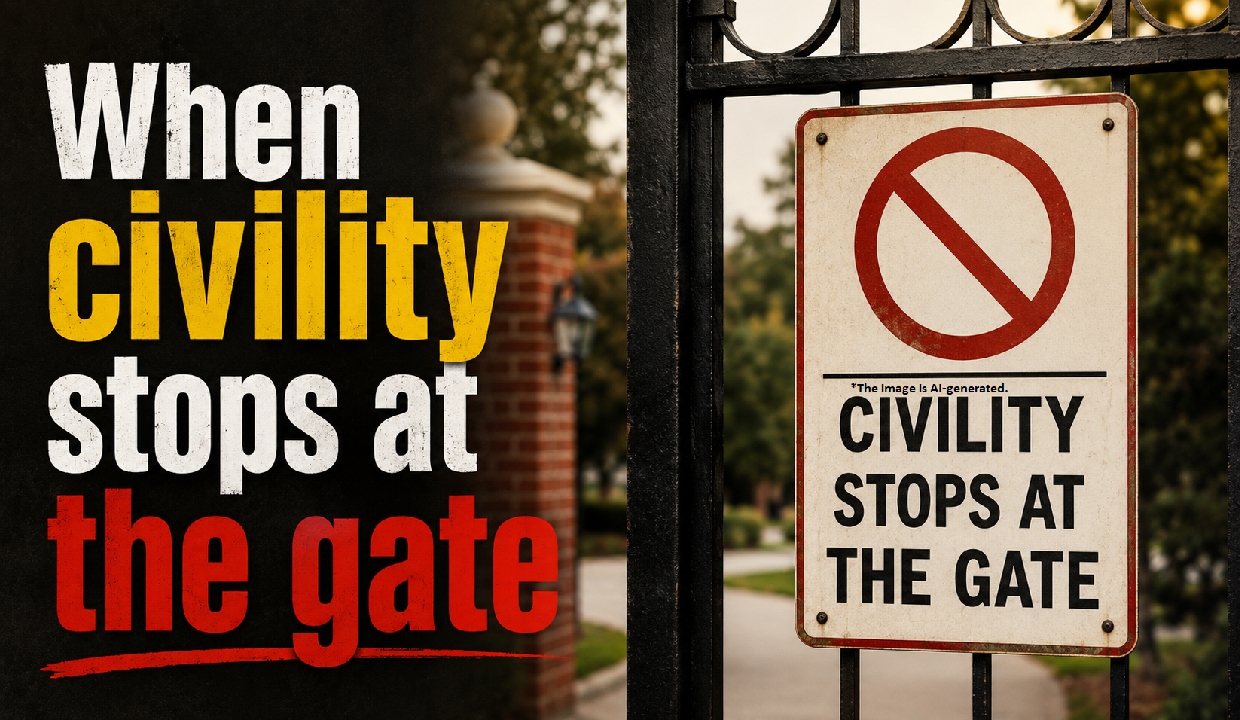
When civility stops at the gate
A pleasant May drizzle had just passed, and I was out for my morning walk with my wife within the society premises. The roads were still wet, but that did not concern me much, until a car drove through a puddle and splashed water all over us, leaving our trousers soaked. What stayed with me even more than the sudden discomfort, however, was the manner in which the car simply drove on without slowing down, without so much as a glance in the rear-view mirror, and without any hint of an apologetic smile or a raised hand that might have acknowledged what had just happened.
Was my expectation unreasonable? I did not think so, especially considering that we live in a well-to-do condominium inhabited by people who are, by all conventional measures, educated professionals in corporates and government offices, neighbours who are almost an extended family, and yet, in that brief moment, there was a complete absence of acknowledgement. I know, at least for myself, that had I been on the other side, I would have stopped and apologised, and it is perhaps this contrast that made it evident that the incident was not an isolated one.
A few months ago, we were nearly run over by another individual driving a large car, possibly the same person. When confronted, he chose not to apologise, but to argue, asserting that we were at fault, and that we had no right to even photograph his vehicle.
On another occasion, during a society meeting, a gentleman spoke harshly to anyone who dared to disagree with him, and his tone with the estate manager bordered on intimidation, with remarks that carried implicit threats about changing authority. He was equally dismissive, even disrespectful, towards some of the women present, and what struck me most was not merely what was said, but the manner in which it was said. The same group has become more vocal with the announcement of society elections. Their exchanges, if stripped of their tone, might almost appear comic. But the aggression that accompanies them is difficult to ignore, particularly when one considers that these are the very individuals who may soon be responsible for managing our shared spaces.
What troubles me is that this is no longer confined to isolated incidents or individuals, for the same tenor, sharp, dismissive, and often derogatory, seems to have seeped into our larger discourse, visible in society meetings, in everyday interactions, and increasingly in public life, not restricted to one place or level, but echoing across contexts, even globally.
I am not alone in sensing this discomfort, as many others feel it too, even if they do not always articulate it, and it leaves me with a quiet, unsettling question about whether we have become the right people at the wrong time, or whether the standards we grew up with, of courtesy, restraint, and mutual respect, are no longer as valued as they once were. The answer lies not in lamenting the times but in choosing not to be shaped entirely by them, because if civility is indeed fading, it will not return through argument or assertion, but only, if at all, through quiet practice, one interaction at a time, and through a conscious effort to pause, reflect, and respond with a sense of consideration that acknowledges the presence and dignity of others in the spaces we share. Perhaps change begins when we choose courtesy, even when none is offered.
The writer is founder of Kala - Krazy About Literature And Arts, is an author, speaker, coach, arbitrator, and strategy consultant; Views presented are personal.
Leave a Comment
Comments (1)
Unreasonable, yes. The money, more money has changed attitudes. Values, morals and gratitude are in decline. This is no exception. Moving to a slow town might help but no-one is untouched by it anymore.