Weathering climate chaos
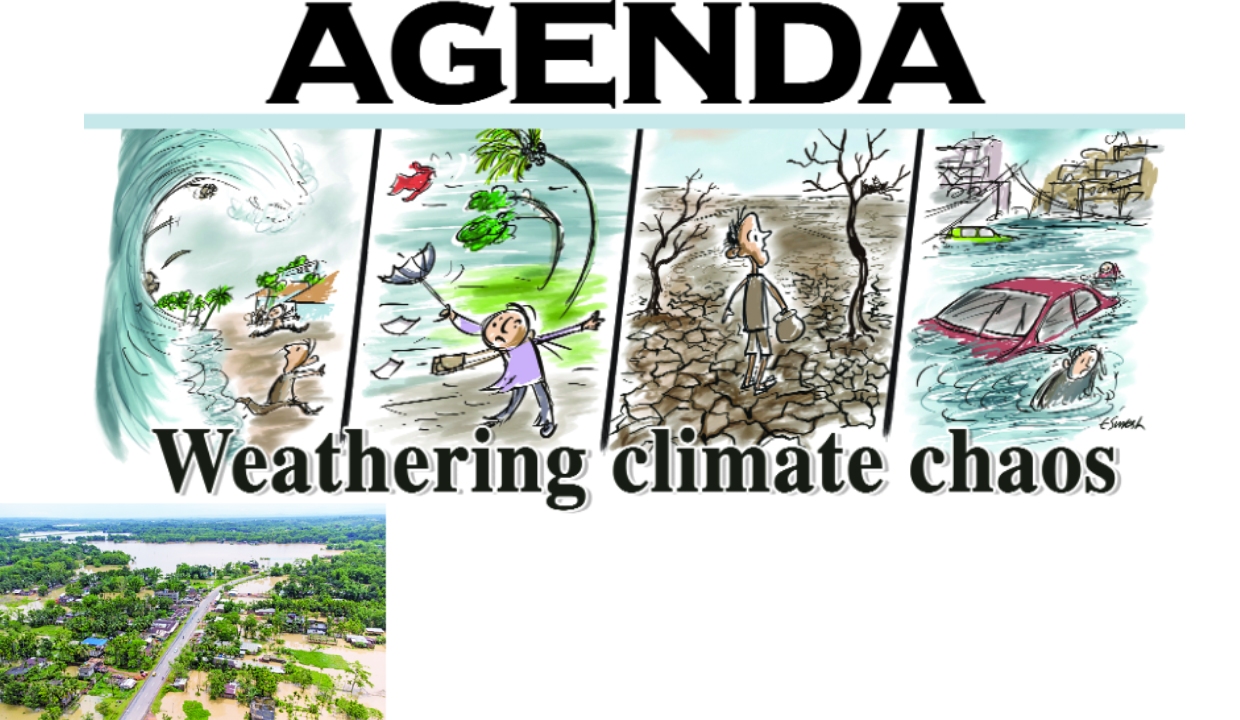
At a time when climate change dominates global discussions, one fundamental truth remains overlooked: It can only be addressed by restoring humanity’s relationship with nature. Aligning with nature not only mitigates climate change but also transforms human behavior, creating societies rooted in wisdom, harmony, and sustainability. For centuries, India’s civilizational philosophy has understood this principle. True sustainability can be achieved by reviving age-old sustainable practices
Adapting with nature: The missing solution to climate change
Today, discussions on addressing climate change are taking place across the world, yet it has not been effectively resolved through discussion alone. However, by conserving water on the Earth, we increased greenery, and that greenery absorbed carbon from the atmosphere and stored it in the soil. As a result, vegetation grew even more rapidly. Therefore, climate change can be addressed and ultimately eliminated through adaptation. When we devoted our lives to working with nature and supporting its processes, water returned to the land, greenery flourished, and people experienced greater happiness, contentment, and peace. They then began solving problems through a way of life rooted in wisdom and harmony with nature. Thus, climate change adaptation and mitigation occur through changes in human behaviour. Encouraging people to work with water, soil, and greenery transforms behaviour. This is true sustainable development (sustainability).
The concept of sustainability originates from India’s ancient idea of “Shubh” (auspicious and beneficial), which has existed for thousands of years. The term “sustainability” became globally prominent in 1992 at the Second Earth Summit in Rio de Janeiro, Brazil. In India, it has been associated with concepts such as Sanatan (eternal) and Satat Vikas (continuous, auspicious development). The word Shubh has traditionally been linked with Labh (profit), so that individuals do not become so greedy that they harm nature.
Preparations for the Second Earth Summit took place in Paris in December 1991. I attended along with Om Thanvi, Shubhu Patwa, and others. I also participated in the Rio de Janeiro Summit in 1992 as a representative of voluntary organizations. What follows is based on what I personally saw, heard, and experienced.
In India, sustainability is guided by the belief that:
“Nature has not been inherited from our ancestors; it has been borrowed from our children. Protecting and conserving it is our responsibility.”
Whatever we take from nature is a debt owed to future generations. While we are alive, we must return it through our efforts. The Vedas contain a prayer asking the Earth to punish anyone who harms it for selfish gain:
“O Earth, destroy those who hate you, attack you, or seek to harm you for their own benefit.”
(Atharva Veda, Book 12, Hymn 1, Verse 14)
Similarly, before placing their feet on the ground each morning, Indians traditionally seek forgiveness from Mother Earth:
“O Goddess Earth, clothed by the oceans and adorned by mountains, consort of Lord Vishnu, I bow to you. Please forgive me for touching you with my feet.”
In the Indian knowledge tradition, sustainable development is synonymous with Sanatan-that which has no end and continually renews itself. True development is that which involves continuous creation without destruction, degradation, or displacement. Economists, industrialists, and environmentalists can all unite around this path.
When society lives in harmony with nature, no environmental degradation occurs. But when human greed disrupts nature’s regenerative processes, nothing remains sustainable or enduring. Human development should therefore preserve and strengthen nature’s ability to regenerate. Such development leads to stability and permanence, which is what sustainability truly means.
To understand and define sustainability, scientists and engineers must incorporate nature’s regenerative processes into technology and design. Whether renewal is brought about by human innovation or by nature itself, both contribute to stability. Human-created systems should never damage nature’s ability to regenerate. This principle has been embraced by Tarun Bharat Sangh and forms the basis of regenerative and sustainable development. Non-violent development is the only truly sustainable development.
Industrial development becomes sustainable when it supports nature’s regenerative capacity. Production should not degrade nature. If some degradation occurs, efforts must simultaneously restore ecological balance through regeneration. This principle aligns with internationally accepted sustainability concepts recognised by UNCED.
Sustainable development requires attention to permanence and long-term balance in all human and natural activities. Development that ignores sustainability does not endure. Economic growth and industrial production should be managed in ways that do not damage nature. Excessive pursuit of profit causes society to forget Shubh (the principle of sustainability). Greed destroys sustainability, while ethical thinking preserves it.
Today, not only India’s industrial sector but also agriculture, weather patterns, and ecological systems face instability. Sustainable development requires ensuring that nature’s regenerative processes are never interrupted and that principles supporting regeneration are consistently followed.
At the beginning of the 21st century, the world’s population reached six billion and is expected to stabilize between ten and eleven billion over the next fifty years. Major challenges include access to drinking water, availability of arable land for food production, and poverty. Nearly one-quarter of the world’s population lives on less than one U.S. dollar per day.
Key priorities include reducing mortality among children under five by two-thirds and reducing maternal mortality among young mothers by 75 percent. Energy consumption is another major challenge. Demand for all forms of energy continues to rise. Expanding access to reliable, sustainable, and environmentally friendly energy sources, while improving energy efficiency, will remain crucial in the coming decades.
Deforestation is also a serious challenge. Forests are shrinking primarily because of agricultural expansion. Forest restoration and improved management will therefore be critically important in the years ahead.
Appropriate technology should be locally adaptable, environmentally friendly, resource-efficient, and culturally suitable. It should rely on local resources and labor wherever possible. Indigenous technologies are often more useful, cost-effective, and sustainable. Nature itself should be treated as a model for design, an approach often described as “designing with nature.”
Technology should use fewer resources and generate minimal waste. The principles of Reduce, Reuse, and Recycle help reduce resource consumption, minimise waste, and lower pollution. These practices reduce pressure on natural systems and allow regeneration to continue.
Environmental education should be at the center of all learning processes. Beginning environmental education at the school level can foster a deep connection between children and the Earth. Over time, “thinking like the Earth” can become part of our values, decisions, and lifestyles, making society more sustainable.
Every system has a carrying capacity-the number of organisms it can support over the long term. For humans, carrying capacity is more complex because quality of life depends on many factors beyond food alone. Sustainability depends heavily on respecting ecological carrying capacity. If it is exceeded through overexploitation of resources, environmental degradation begins and may eventually become irreversible.
Achieving sustainability requires ensuring that consumption never exceeds regeneration and that environmental change remains within the limits a system can tolerate. Development should improve quality of life across social, cultural, and economic dimensions rather than benefiting only the already privileged.
Population growth must also be stabilized. In India, the government released the National Action Plan on Climate Change (NAPCC) on 30 June 2008 to address climate challenges. The plan emphasizes adaptation to climate change and the ecological sustainability of India’s development pathway. In India today, water and climate change are inseparable-water scarcity is effectively a climate crisis.
The NAPCC stresses that maintaining high economic growth is essential for improving living standards and reducing vulnerability to climate impacts. It identifies measures that advance sustainable development while simultaneously addressing climate change. The plan is built around eight national missions that form a long-term, multidimensional strategy. By 2024, India had begun implementing serious climate adaptation and mitigation programs in agriculture and industry.
Long-term energy and ecological security are also essential. Fossil fuel resources are declining globally, and access to oil, gas, and coal is becoming increasingly constrained. As a result, renewable energy has gained importance. India has placed significant emphasis on solar and wind energy. Given the country’s high levels of solar radiation, solar power offers a particularly promising long-term solution.
The national missions also encourage private-sector innovation in technologies for adaptation and mitigation. Alongside these missions, the government supports regional development initiatives, clean technology programs, grants for voluntary organizations, green architecture initiatives, sustainable mining frameworks, and other sustainability-oriented efforts.
Sustainable development is ultimately a vision and a way of thinking and acting that protects resources and the environment for future generations. It cannot be achieved through policies alone. Society must embrace sustainability as a guiding principle for both everyday choices and major political and economic decisions.
Environmental degradation affects future generations most severely. They may inherit a poorer quality of life despite having no voice in today’s decisions. Therefore, planning and policymaking must consider their interests. Sustainable development can only improve when citizens and stakeholders are actively involved.
Ultimately, sustainability will become reality only when everyone contributes to a world where economic freedom, social justice, and environmental protection advance together. Sustainable development is not easy, but it is an unavoidable responsibility. Through better planning, stronger policies, and effective implementation, it can be achieved. Governments can no longer approach environmental issues through narrow, short-term perspectives. Integrating sustainability into both public and private decision-making is not merely desirable-it is essential.
My ancestors left me the fertile, life-giving agricultural traditions of the Ganga and Yamuna regions. During my lifetime, agriculture and industry increasingly abandoned the path of Shubh and pursued profit-driven growth. I left government service and dedicated myself to restoring nature through respect and love for the Earth.
For the past 51 years, Tarun Bharat Sangh has mobilized communities and helped construct more than 15,000 water conservation structures. These efforts have made over 1,500 villages water-secure. As a result, 23 rivers-including the Arvari, Ruparel, Sarsa, Maheshwara, Sabi, Tevar, Sairni, Parbati, Noura, Bhawani, Kotwari, and others in Rajasthan; the Agrani and Mahakali in Maharashtra; and the Ichanhalla River in Karnataka-have been revived.
The impact of this work extends across approximately 10,600 square kilometers, where significant success has been achieved in climate adaptation and mitigation. This remains one of the world’s most remarkable examples of community-led ecological restoration. In the 21st century, we continue working to bring water back to dry landscapes and rivers.
As long as nature allows me to serve, I will continue working for nature and future generations with sustainability as my guiding principle. The entire world must do the same. Only then can our planet become a true center of sustainable development.
Major climate disaster in the recent times that played havoc in the country
Cyclone Fengal (2024)
Striking the southern coasts of India, Cyclone Fengal brought severe coastal flooding, strong winds, and infrastructure damage. It highlighted a growing regional pattern of late-season tropical storm intensification.
Sikkim Glacial Lake Outburst Flood (2023)
Triggered by extreme rain over the Himalayas, a glacial lake outburst flood (GLOF) breached the South Lhonak Lake. The resulting torrent washed away the Chungthang Dam and devastated downstream communities
Cyclone Biparjoy (June 2023)
Forming in the Arabian Sea, Cyclone Biparjoy became one of the longest-lived tropical storms in recent memory. It sustained maximum wind speeds up to 195 km/h before making a destructive landfall in Gujarat.
Cyclone Tauktae (2021)
Classified as an extremely severe cyclonic storm, Cyclone Tauktae battered India’s western coast. It intensified rapidly due to warming in the Arabian Sea, directly impacting Mumbai and making landfall in Gujarat.
Cyclone Amphan (2020)
A catastrophic Category 5-equivalent Super Cyclone that struck West Bengal and neighboring Bangladesh. It was the costliest cyclone recorded in the North Indian Ocean, causing widespread destruction to the Sundarbans mangrove ecosystem and urban infrastructure in Kolkata
Cyclone Fani (2019)
As the strongest tropical storm to hit Odisha in two decades, Cyclone Fani packed winds of up to 250 km/h. Timely mass evacuations saved thousands of lives, but the storm caused massive economic damage to coastal energy networks.
Kerala Floods (2018)
Abnormally high rainfall during the monsoon season led to the worst flooding in Kerala in nearly a century. The disaster caused over 400 fatalities, displaced over a million people, and served as a major warning regarding Western Ghats environmental degradation. Heavy rains in Wayanad and Idukki caused severe landslides and left the hilly districts isolated.
Dr. Rajendra Singh is an acclaimed water conservationist and environmentalist. He is dubbed as "Waterman of India" or "Jal Purush," for reviving dried rivers. In 2001, he was awarded the Ramon Magsaysay Award for community leadership for his pioneering work in community-based efforts in water harvesting; Views presented are personal.