A feast of affection, abundance and tradition
There are festivals in which a single sacred preparation defines the table, and there are others in which abundance itself becomes ritual. Jamai Sashti belongs unmistakably to the latter. In a Bengali household preparing for the day, celebration begins long before the son-in-law sits down to eat. The best fish is chosen at the market, vegetables are prepared, milk is reduced for sweets, seasonal fruit is arranged, and the kitchen becomes the centre of family anticipation. The meal is not merely meant to satisfy hunger. It is an act of welcome, affection and honour. For the married daughter, the day is also a return to her parental home, making the feast a reunion as much as a ritual. Jamai Sashti was observed earlier this year on Saturday, 20 June, with the Shashti tithi beginning on the afternoon of 19 June and ending on 20 June.
Jamai Sashti is observed by Bengali Hindu families on the Shukla Paksha Shashti associated with the Bengali month of Jyeshtha and is linked to the worship of Goddess Shashti, traditionally revered as a guardian of children, fertility and family welfare. The observance is also known in older contexts as Aranya Shashti, reflecting an association between the goddess, fertility and nature. Over time, the day acquired its distinctive social character as married daughters returned to their parental homes with their husbands, allowing families separated by marriage to gather again. The son-in-law, or jamai, became an honoured guest, but the deeper emotional centre remained the relationship between the daughter, her parents and the household she had left after marriage.
A popular Bengali vrata-katha gives the festival another layer of meaning. According to the traditional story, a young wife secretly ate food and blamed the theft on a cat, the animal associated with Goddess Shashti. Angered by the false accusation, the goddess caused the woman to lose her children. After remorse, prayer and reconciliation with the goddess, her children were restored. In later retellings, social restrictions kept the woman from visiting her parental home, so her parents invited her and her husband on the day of Shashti worship. The story connects the observance with honesty, motherhood, protection and the enduring desire of parents to remain connected with a married daughter.
The rituals of the day retain this language of protection and blessing. Mothers-in-law traditionally worship Goddess Shashti before welcoming the jamai, and some customs include blessing him with durba grass and grain, offering seasonal fruits, tying a sacred thread, applying a ceremonial mark and fanning him with a palm-leaf fan. The gestures vary between families but share a wish for the well-being of the daughter and her husband. Only after these formalities does the most visible expression of jamai-adar begin: the feast. Jamai Sashti has no single compulsory menu, and family, region, season and means all shape what is served. Yet the recurring pattern is unmistakable. The table is generous, fish is given pride of place, meat often follows, sweets arrive in abundance, and Jyeshtha’s summer produce gives the meal its seasonal character.
That seasonality begins even before the cooked food. Mango, litchi, jackfruit, jamun and other summer fruits often appear in the welcome or at the end of the meal, reflecting what Bengal’s orchards and markets offer at this time of year. The cooked feast often follows the logic of a traditional Bengali meal, moving through contrasting tastes rather than placing everything on the plate at once. A fitting opening is Shukto, the gently bitter vegetable medley in which bitter gourd may be combined with raw banana, drumstick, potato and other vegetables in a lightly spiced gravy. Its restrained bitterness provides a deliberate counterpoint to the richer courses that follow. Mochar Ghonto, made from finely prepared banana blossom cooked with spices, coconut and often potatoes, brings another deeply Bengali vegetable tradition to the table, turning an ingredient that demands patience into something fragrant, textured and celebratory.
The progression may continue with Potoler Dolma, pointed gourds carefully hollowed and stuffed, often with chhena, coconut or a spiced filling before being cooked in gravy. Its time-consuming preparation itself signals a special meal. Lentils, too, can become festive through fish. Macher Matha Diye Moong Dal combines roasted moong dal with pieces of fried fish head, commonly from a large rohu or katla, creating a dish in which the nuttiness of the lentil absorbs the richness of the fish. It shows how Bengali cooking can turn the head of a large fish into a prized course. Contemporary Jamai Sashti menus continue to feature fish-head dal alongside elaborate fish preparations.
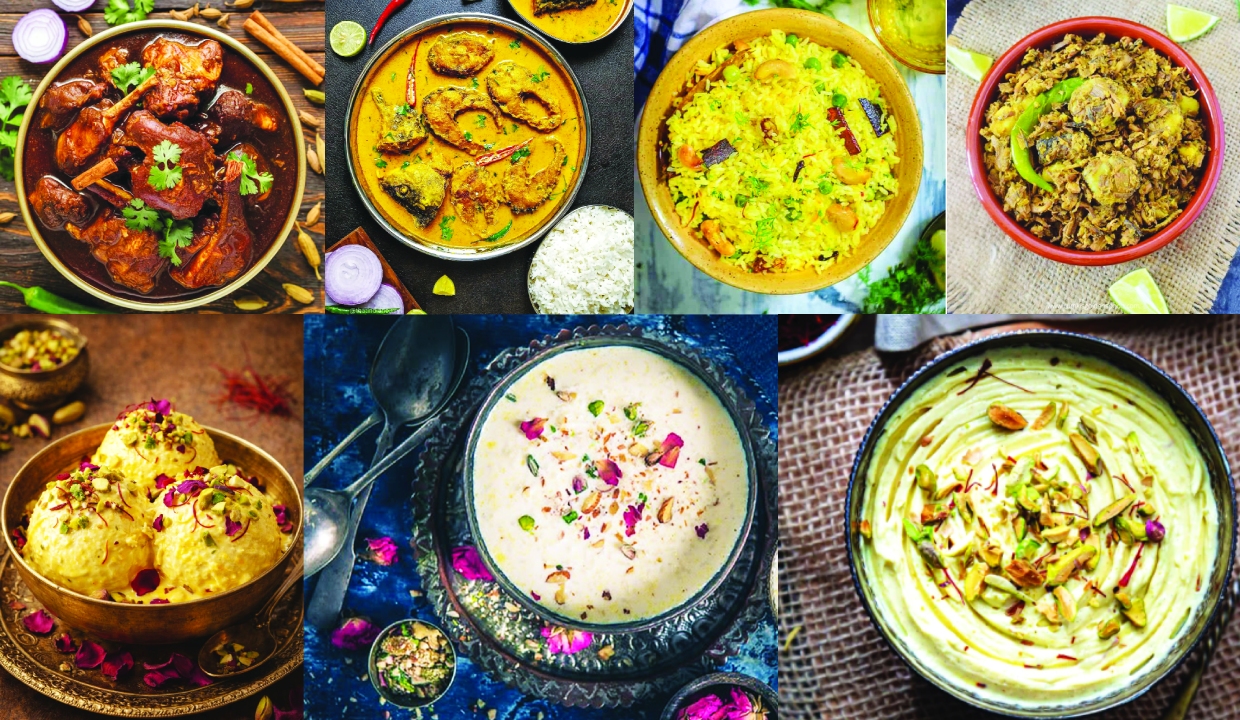
Rice then becomes the stage upon which the richer dishes arrive. Plain steamed rice remains essential with mustard-based fish, but a celebratory spread may also include Basanti Pulao, fragrant yellow rice enriched with ghee, whole spices, cashews and raisins, with a faint sweetness that distinguishes it from an everyday pot of rice. It prepares the palate for what is often the most anticipated part of Jamai Sashti: fish. In Bengal, the quality, size and variety of fish offered to the jamai can itself communicate generosity, and recent Jamai Sashti coverage continues to place hilsa, prawns and katla at the heart of the feast.
Among these, Shorshe Ilish carries particular prestige. Pieces of hilsa are cooked in a sharp mustard paste with turmeric, green chillies and mustard oil, allowing the fish’s natural richness to meet one of Bengal’s most characteristic flavours. The technique remains restrained so the hilsa stays central. Ilish Paturi uses the same affinity between hilsa and mustard in another form. The fish is coated with mustard and green chilli, wrapped traditionally in banana leaf or another suitable leaf, and cooked gently so that the parcel traps moisture and aroma. Opening the leaf at the table releases its fragrance at once. Indian Express Bengali highlighted ilish paturi specifically as a Jamai Sashti preparation in 2026, illustrating how closely hilsa remains tied to contemporary jamai-adar.
Prawns add a different kind of luxury. Chingri Malai Curry pairs large prawns with a silky coconut-milk gravy scented with ginger, green chilli and warm spices. The sweetness of coconut softens the marine flavour of the prawns, producing a richer and more rounded dish than the mustard heat of hilsa. Katla Kalia, meanwhile, represents another classic mode of festive Bengali fish cookery. Thick steaks of katla are fried lightly and finished in an aromatic, fuller-bodied gravy, often built from ginger, spices and a carefully cooked masala. The contrast between mustard-sharp hilsa, coconut-rich prawns and gravied katla gives the table abundance without repetition. Current festival menus regularly feature hilsa, chingri and katla in multiple forms.
For many families, fish is still not the final savoury statement. Kosha Mangsho brings slow-cooked mutton to the meal, its colour deepened by patient bhuna-style cooking as onions, ginger, garlic and spices are worked down until they cling to the meat. The dish is rich, concentrated and celebratory. Jamai Sashti food coverage repeatedly includes mutton as part of the lavish meal, showing how the festival embraces both the aquatic identity of Bengali cuisine and the indulgence of a meat course.
After so much richness, the meal traditionally needs a change of direction. Aamer Chutney, made from green or semi-ripe mango cooked with sugar or jaggery and tempered with spices, brings together sweetness, acidity and the unmistakable flavour of the season. It acts almost as a bridge between the savoury courses and dessert. Papad may accompany it, but the mango is more culturally revealing because Jamai Sashti falls when Bengal is immersed in summer fruit. The feast therefore does not merely display wealth through quantity. At its best, it displays attentiveness to season and household knowledge.
Then come the sweets, and on Jamai Sashti they are not an afterthought. Payesh, made by slowly simmering rice in milk until the grains soften and the liquid thickens, is one of the most intimate forms of Bengali celebration food. Sugar, cardamom, nuts or raisins may be added, while other occasions and seasons allow jaggery to change its character. Beside it may appear Sandesh, created from fresh chhena kneaded smooth with sugar and shaped into delicate portions. Its simplicity depends on keeping the chhena tender without making it loose. Jamai Sashti recipe collections continue to treat sandesh as a natural part of the festive sweet table.
Roshogolla offers the opposite texture. Soft chhena balls are cooked in sugar syrup until they expand into light, spongy sweets that release syrup with every bite. Rajbhog follows a related tradition but is larger and more opulent, often flavoured or filled, making it particularly suited to a feast built around honouring a guest. Pantua changes the technique again. Instead of being poached directly in syrup, the milk-based balls are fried until deeply coloured before soaking, producing a denser texture and caramelised exterior. Chomchom, another celebrated Bengali chhena sweet, adds still another form, typically elongated and syrup-soaked, sometimes finished with grated coconut or khoa.
No Bengali festive sweet course would feel complete without Mishti Doi, in which sweetened milk is cultured into yoghurt and traditionally set in earthen pots. The caramelised sweetness of the milk offers a cool finish after mustard, chilli, fish and mutton. Together, payesh, sandesh, roshogolla, rajbhog, pantua, chomchom and mishti doi demonstrate that Jamai Sashti abundance is not simply about serving many sweets. It is also a display of Bengal’s extraordinary command over milk, chhena, syrup, fermentation and texture. Festival menus and recipe coverage repeatedly identify sandesh, roshogolla and mishti doi among the familiar closing pleasures of the day.
The beverages surrounding the feast also respond naturally to the heat of Jyeshtha. Aam Pora Shorbot, prepared from roasted raw mango blended with water, salt, sugar or jaggery and spices such as roasted cumin, offers tartness and a deep roasted character suited to summer. Gondhoraj Ghol turns diluted yoghurt into a refreshing drink scented with the intensely aromatic Gondhoraj lime, while Daaber Jol, the water of tender coconut, provides a simple seasonal welcome. Other cooling sherbets may appear, while tea can return as conversation continues. They show that Jamai Sashti hospitality extends beyond the main thali.
Jamai Sashti has inevitably changed with Bengali life. Smaller households, working families and restaurant celebrations have altered where and how the feast is prepared. Yet the essential idea remains recognisable: food turns kinship into something visible. The future of Jamai Sashti therefore depends on preserving more than the custom of feeding a son-in-law generously. It depends on carrying forward the culinary knowledge that gives the day meaning: how banana blossom is cleaned for mochar ghonto, how bitterness is balanced in shukto, how mustard is ground for hilsa, how a leaf parcel protects the fragrance of paturi, how milk becomes chhena, sandesh or mishti doi, and how summer mango can move from a fruit platter to chutney and shorbot. If younger generations inherit these techniques along with the stories behind them, Jamai Sashti will remain more than a festive lunch. It will continue to be a living expression of Bengali family memory, seasonal wisdom and hospitality, served from one generation to the next.
The writer is Secretary, Cuisine India Society; Views presented are personal.