Vivek Vihar fire tragedy: Safety grilles turned into deadly walls
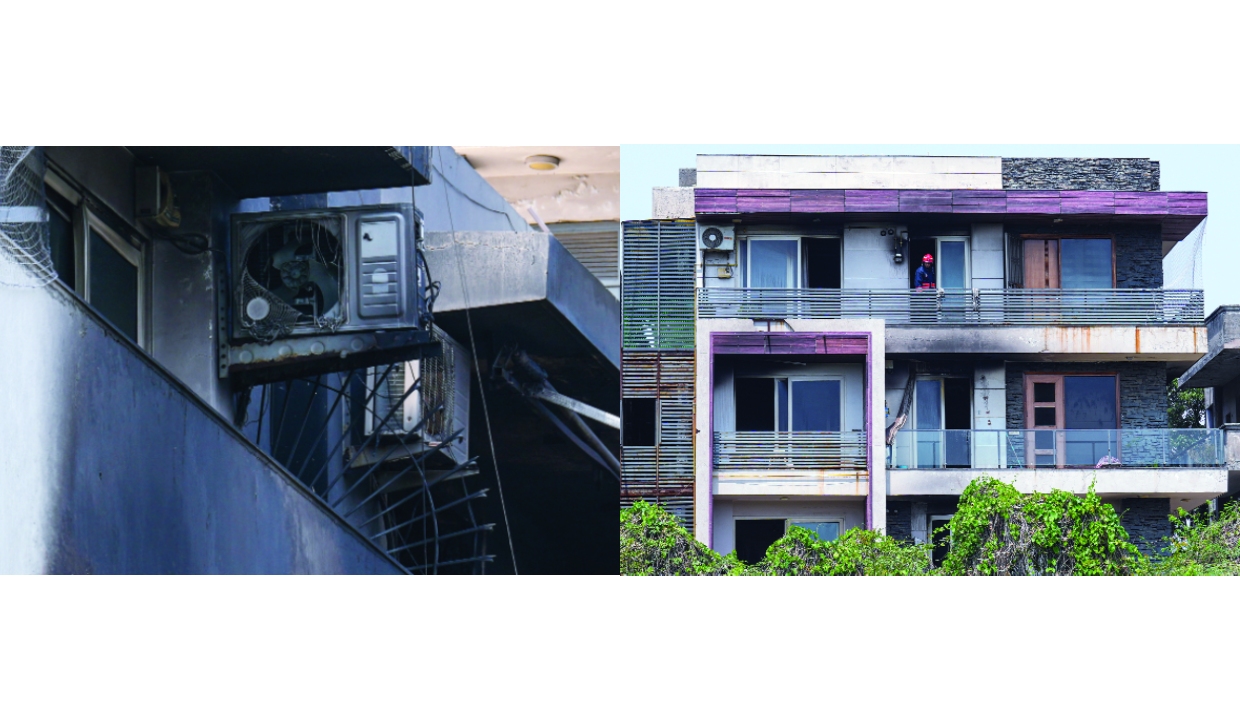
The building at B-13, Vivek Vihar Phase-I, does not look like a site of catastrophe from the front lane on Sunday morning. The facade is largely intact. It is only when you walk around to the rear, past the narrow passage that fire trucks could not enter, that the full picture presents itself: blackened window frames, hollowed-out rooms, balconies stripped of the grilles that once sealed them shut, and the smell of smoke that has soaked into the brick and will not leave.
Nine died here before dawn Sunday: three families, three floors, one building, including a toddler. A resident, here for four decades, watched from his first-floor balcony around 3:30 am. At first, he saw a flicker on the second floor of the next building. In minutes, the fire became intense. “I’ve never seen flames spread so fast,” he said at the entrance hours after the fire. “By the time I understood, the whole back was gone.”
The building is approximately seven years old. Most of the eight flats are owned. Over the years, residents had added what people add in dense urban neighbourhoods: metal grilles on balconies to prevent break-ins, plastic netting to keep pigeons away, and extensions to hold flower pots or dry clothes. Each addition made practical sense at the time it was made. Together, they created a sealed structure with a single staircase and a terrace door that was locked from the inside.
When the fire started at the rear second floor and rose, the grilles became barriers. Netting blocked firefighters’ hoses. The locked terrace door trapped three victims. With the electricity supply disrupted amid the fire, residents said centrally locked doors may have become difficult to open, while the lift became unusable. At the rear, thick iron grills and enclosed balconies further complicated the evacuation and rescue process. “There is one central staircase which serves as both the entry and the exit. The rear side gate was covered with a grill, which we had to cut using tools,” a firefighter involved in the operation said. He added that to rescue around 15 people, the team deployed ladders from different sides and used a turntable ladder vehicle.
The resident said he ran for a pipe and aimed water at the flames from his balcony. The heat pushed him back. Others gathered quickly in the lane below, dragging mattresses and positioning them under the windows in case anyone jumped. Rescuers worked with whatever was available. Someone eventually brought a metal-cutting tool from a nearby house. A generator was started after the building’s electricity had been cut. Firefighters used the tool to slice through the grille.
“We kept calling out to the people inside. Some responded. Some did not,” said a man from the neighbourhood who had joined the rescue effort. He looked at the rear of the building as he spoke. “The ones on the upper floors, we could hear them, but we could not reach them.”
A woman who lives two buildings away said she woke up to the sound of screaming. “I thought it was a quarrel at first. Then I smelt the smoke. When I came out, the entire back of the building was orange,” she said. She paused. “Those families had lived there for years. Everyone knew everyone.”
Another neighbour from the area, who reached the spot around 4 am, said the fire had already reached the third floor and was reaching the fourth by the time he arrived. The rear lane, he said, was too narrow for fire trucks to enter. Ladders had to be carried in on foot. Hoses had to be repositioned repeatedly. The gap left by the grilles and netting was barely a few inches. “Getting even a water pipe through was almost impossible,” he said. “And from the outside, you could see people in there. That is the worst feeling.”
He said firefighters eventually managed to cut through one section of the grille and pulled three people out through the opening. But the higher floors had denser layers of netting. The access was simply not there.
A firefighter who was part of the operation confirmed that the rear of the building posed the greatest challenges. The protective structures residents had installed over the years, the very features meant to make the flats safer, had made it nearly impossible to reach those trapped inside. “If the terrace had not been locked, they might have survived,” he said.
By Sunday morning, the building’s rear portion stood exposed and blackened. The grilles were cut open, and the rooms were emptied by smoke and fire. Neighbours stood in the lane outside in small clusters, speaking in low voices about what they had seen and what, perhaps, could have been different.
The building had parking space on the ground floor, eight flats above it with four each on the front and back sides, a lift adjacent to the staircase, servant quarters, and a narrow rear gate opening into a cramped back lane lined with adjoining structures and overhead wires.
Describing the rescue efforts, Sanjeev Rana, member of a non-profit disaster management team, said, “We received a call around 6 am. When we went upstairs with the fire department personnel, we first saw one charred body on the second floor, then five bodies on the next floor. After that, we moved to the top floor.”
On the top floor, three people had tried to save themselves but could not escape because the door leading to the rooftop had a central locking system, he said.
Neighbours said Nitin was involved in the paper trade in Chawri Bazar and also owned a restaurant in Karkardooma. His younger son, Prasuk, aged around 22, survived as he had travelled to Ujjain with friends.
On the third-floor flat, five members of another family — Arvind Jain (60), his wife Anita Jain (58), their son Nishant Jain (35), daughter-in-law Anchal Jain (33), and their grandchild, Akash Jain — were found dead.
“Arvind and Anita were widely known in the locality because they maintained close ties with everyone,” a resident said, adding that their son Nishant worked as a chartered accountant in Connaught Place, while their daughter-in-law was employed in a private bank. The couple had a child after eight years of marriage, neighbours said.
“Naveen came down using the stairs and got burnt. We rushed to the side of the building to rescue their two daughters, aged around 21 and 23, who were standing on the edge of the balcony. We spread mattresses below and used ladders to bring them down,” a resident said.
Grief, disbelief grip family and friends
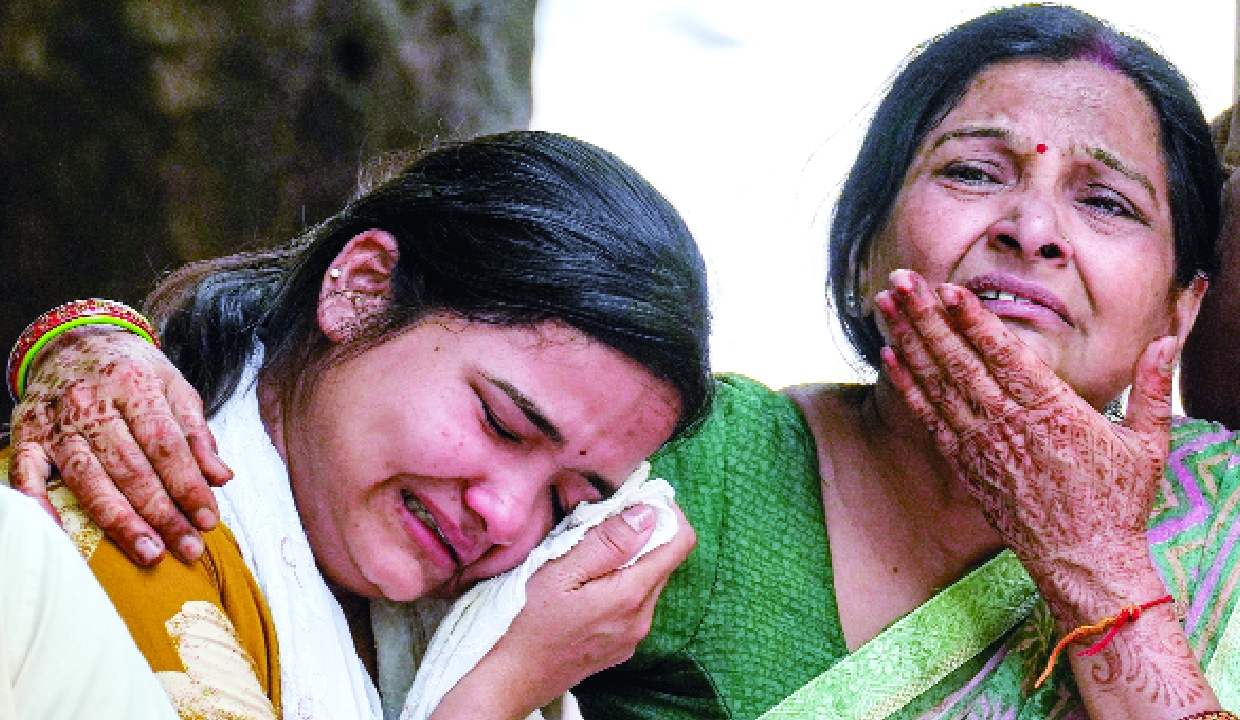
New Delhi: Grief and disbelief gripped family and friends of those killed in the devastating fire in east Delhi’s Vivek Vihar on Sunday, with several recalling frantic early morning phone calls from the victims, desperate for help.
According to family friends, Nishank Jain, one of the deceased, had tried to reach out to several people as fire spread rapidly through the residential building.
“He tried calling so many people — kept saying, ‘Save me, save me’,” a close friend said. Manoj, a family friend and architect who was working on the family’s new home, said Nishank made calls to him around 3:50 am and again at 4 am, as the situation inside the building worsened.
“I couldn’t pick up the calls. I saw missed calls on my phone in the morning. When I got to know what had happened, I rushed to the hospital,” he said.
Relatives said Nishank was supposed to travel to Manesar with his elder brother Deepak Jain (38), a company secretary, to celebrate the latter’s son’s birthday but did not go at the last moment.
“Nishank did not go, had he gone, he would be alive,” a relative lamented.
Friends recalled Nishank as a generous person who would often donate money for social causes.
Family friend Amit Jain said he came to know about the incident around 8:30 am, hours after the blaze had engulfed the four-storey (G+4) residential building.
There was also resentment among relatives over what they described as gaps in rescue. “Had fire services responded quickly, they would have been alive,” an acquaintance said.
They also claimed that at least three people attempted to escape through the roof but could not, as the door was locked.