TVK mirrors AAP’s surge to end decades of two-party rule
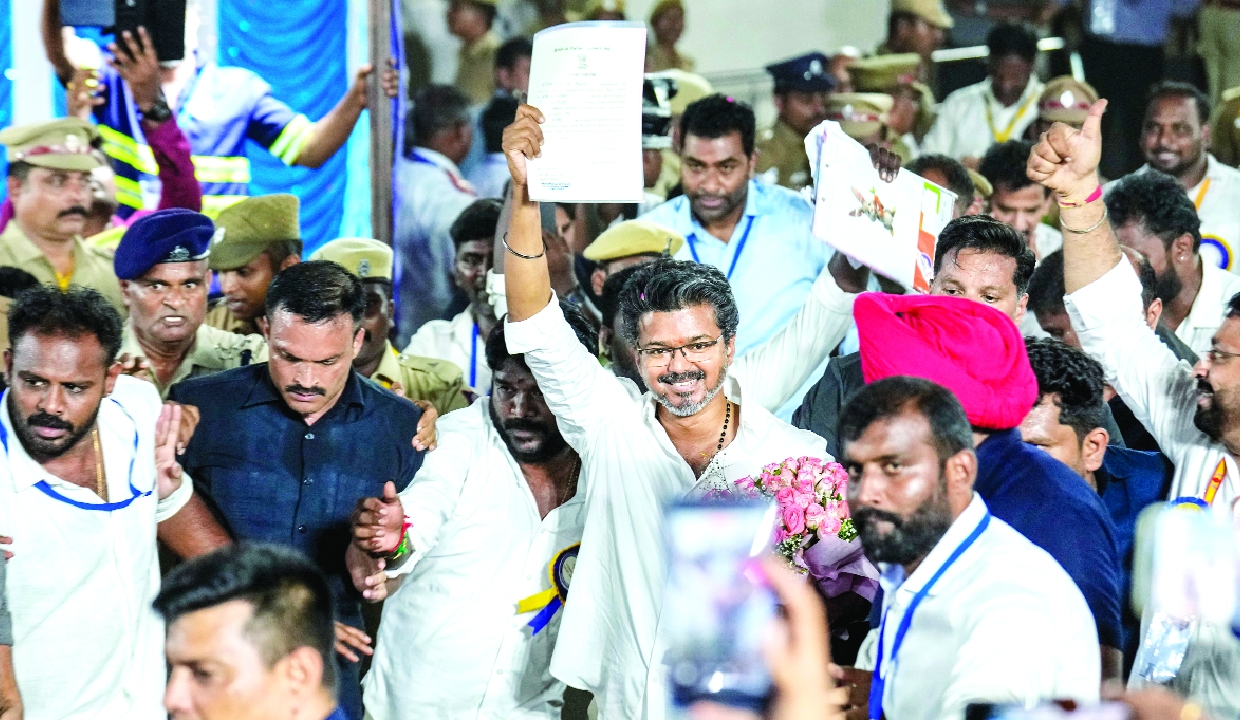
In a political deja vu, the Tamilaga Vettri Kazhagam (TVK) led by South superstar Vijay was on Monday poised to win its debut Assembly polls and form a Government in Tamil Nadu under circumstances resonating closely with the rise of Arvind Kejriwal-led Aam Aadmi Party in Delhi over a decade ago.
In a trail-blazing performance, Vijay and his Tamilaga Vettri Kazhagam (TVK) ended decades-long DMK-AIADMK sway over the state politics, as Kejriwal and his Aam Aadmi Party (AAP) did to the BJP and Congress in Delhi.
AAP had formed a minority Government in Delhi after its maiden election in December 2013, a year after the party was founded, and then went on to win the 2015 Assembly polls with a brute majority.
In the triangular fight, AAP had won 67 of the 70 Assembly constituencies in Delhi, reducing the BJP to a meagre tally of three seats and the Congress to zero. Kejriwal became the chief minister of Delhi, a post he held till September 2024.
As the counting of votes progressed in Tamil Nadu, the TVK, pitted against the ruling DMK and AIADMK, was leading in more than 100 assembly constituencies out of 234 and was heading to form a Government two years after it came into being.
Kejriwal’s rise was rooted in an intense anti-corruption movement that swept India around 2010, giving birth to AAP as a party founded on the promises of alternative politics and giving primacy to the cause of aam aadmi (common man). Like Kejriwal, Vijay too vowed to fight against corruption and dynastic politics, more specifically traditional politics, and took the deep plunge by announcing to go solo in the Assembly polls.
While claiming a clean break from traditional politics, the two leaders and parties have also comfortably used freebies as their poll strategy.
Vijay has promised Rs 2,500 monthly assistance to women, six free LPG cylinders for every household, 8 grams of gold and silk saree for brides from low-income families, Rs 4,000 monthly support for unemployed graduates and various other facilities.
Free electricity, water, bus travel for women, pilgrimage for the elderly, health facilities and education were the cornerstones of Kejriwal’s model of governance in Delhi between 2015 and 2025. The TVK’s success instantly drew comparisons between Vijay and Kejriwal and the two parties that started from scratch and instantly rose to power. The emerging tectonic shift in Dravidian politics bore a close resemblance to the circumstances of the rise of AAP, a decade apart.
Vijay launched the Tamilaga Vettri Kazhagam (TVK) in 2024 and jumped into Tamil Nadu politics, retiring from his acting career, while Kejriwal had resigned as an Indian Revenue Service (IRS) officer and turned social activist before joining the India Against Corruption (IAC) movement and forming AAP.
Even though separated by time, geography and context, both TVK and AAP have an unmistakable similarity of cashing in on the public disenchantment with old political parties and leaders.
Kejriwal was able to rally the support of the people with his “common man” persona, while Vijay drew on his huge stardom as well as the promise of change.
Further, both AAP and TVK, drawing strength from the popularity of their leaders, have been quick to grasp political success, without following the gradual, incremental growth spread over years and decades.
In both cases, social media and grassroots mobilisation played a crucial role in amplifying the messages of their leaders and expanding their reach beyond traditional political structures based on leader-worker culture.
The poll dynamics, particularly vote division among the contesting parties, also played a crucial role in the rise of the two outfits.
While AAP managed to completely drain Congress votes to its side in 2015, the TVK also appears to be benefiting from the dual setup of DMK-AIADMK in Tamil Nadu.
The TVK now stands at a threshold, its surprise victory expected to open the floodgates of change in Dravidian politics, not just weakening the political dominance of the Dravida Munnetra Kazhagam (DMK) and the All India Anna Dravida Munnetra Kazhagam (AIADMK) but also making the way for parties like the BJP, which has been struggling to make a dent for decades.