Tushar Mehta crafts brilliantly bizarre legal wit
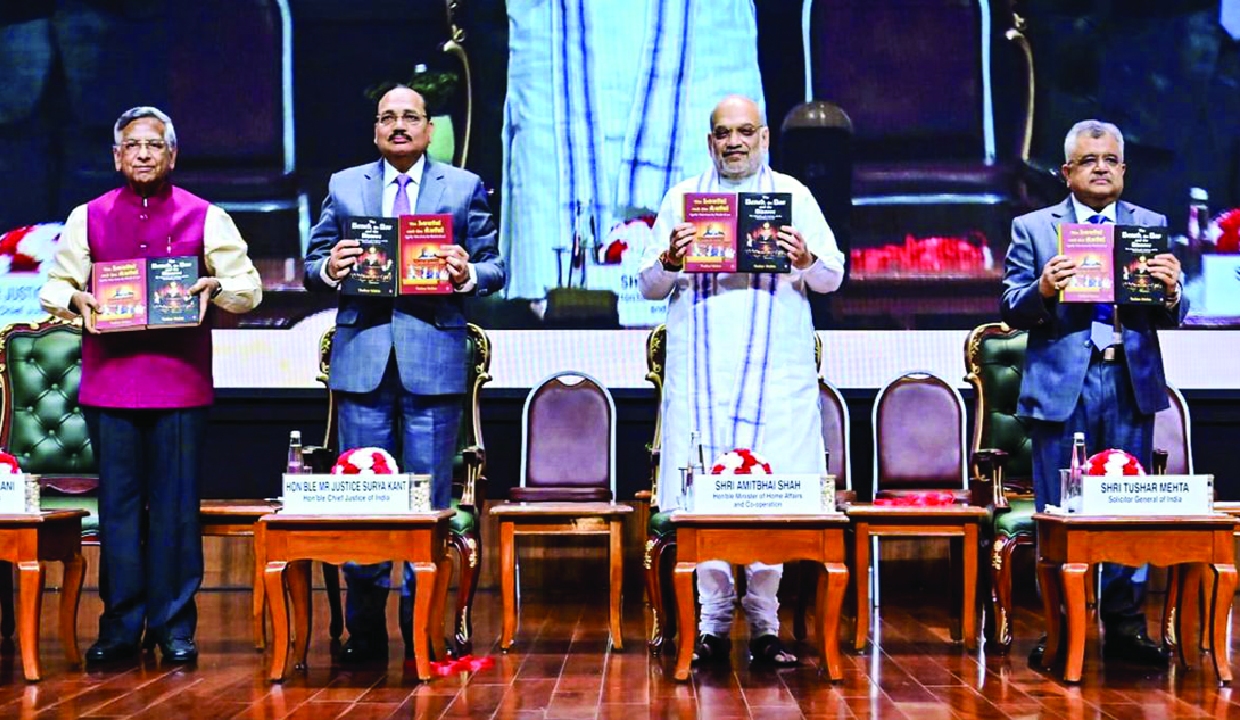
The Bench, the Bar, and the Bizarre: The Unfamiliar, the Curious, and the Extraordinary in Law penned by Tushar (a magnificent name symbolising fine drops of dew and evocative of a sense of purity, calmness and serene winter beauty!) Mehta, the Solicitor General of India, was formally unfurled on May 8, 2026 before a most impressive gathering graced by the venerable Chief Justice of India Justice Surya Kant and our brave, resolute and visionary Home Minister Amit Anilchandra Shah (who proudly dons the mantle of his lifelong hero and role model Sardar Patel!) and the choicest who’s who of political, judicial, and media leaders, whose names read like a veritable roll of honour, within the majestic confines of Bharat Mandapam ensconced deep inside the heart of the Pragati Maidan Complex. The book saw the light of day as a well bound bouquet of amazingly curious, deucedly absurd and helplessly uproarious events from the legal world, aimed at legal professionals and general readers! The chapter on “Judicial Rebels” and “Law beyond the Living” are replete with extraordinary wit and humour. In the chapter on Artificial intelligence, the author has dexterously summed up the varied challenges posed by AI in an easy, free flowing narration and frankly confessed, “I am neither a techno-romantic nor a techno sceptic, But the thought of artificial intelligence entering judicial adjudication — whether through the bench or the Bar is a chilling one, The real danger is not the that machines will start thinking like humans, but that humans will stop thinking like humans and begin to imitate machines”.
The Lawful and the Awful: Quirky Tales from the World of Law features humorous tales and unexpected moments in law. The most interesting chapters are “Weird Tales of Weirder Judges” and “The Anatomy of a Rotten Judge”. The author in a jocular vein says that there are very good judges and very bad, and even horrible judges. The description on the quality and eminence of several British and American judges is brilliantly explained by him, though he has not touched the Indian judges in the same manner to avoid any untoward controversy or otherwise.
The author dedicated the books to his beloved mother Lataben Mehta on the auspicious occasion of Mother’s Day. In his words, he said in a voice choked with emotion that everything he was today was built on his mother’s sacrifice and on her continued blessings from heaven. In doing so, he virtually reverberated the timeless words of the monumental lawyer and 16th towering American President Abraham Lincoln, unquestionably the Father of Modern Democracy — “I remember my mother’s prayers and they have always followed me. They have clung to me all my life” and “The greatest lessons I have every learned were at my mother’s knees... All that I am, or hope to be, I owe to my angel mother”.
Tushar’s books demonstrate an unusual combination of scholarship, courtroom precision, and literary ease. Unlike many legal writers who rely excessively on technical vocabulary, Tushar explains constitutional questions with clarity, patience, and intellectual confidence. His prose reflects rigorous academic training, yet it never feels burdened by any distracting complexity. Every single chapter reveals a writer who has mastered astute legal reasoning while still respecting the reader’s curiosity and attention.
One of the most impressive aspects of his writing is the depth of research. Tushar approaches legal controversies with balance, careful documentation, and analytical sharpness. He connects constitutional theory with contemporary governance in a truly remarkable manner that feels both scholarly and practical. His arguments are persuasive because they are built patiently, layer by layer, rather than through rhetorical exaggeration. Readers can sense the discipline of a serious academic mind working behind every observation.
Equally noteworthy is Tushar’s refined sense of humour. It is a universally recognized age old proverb that “Laughter is the best medicine” to which I am highly emboldened to add the timeless words of Sir Charles Spencer Chaplin Jr. (popularly known as “Charlie Chaplin”!), the legendary British comic actor, filmmaker, singer, film editor and composer, “A day without laughter is a day wasted.” Legal literature often becomes starched and stiff, self-important, and emotionally distant, but Tushar's writing avoids that trap marvellously. He introduces and revels in wit subtly, sometimes through irony, sometimes through understated commentary, and occasionally through incisively observed anecdotes. These invariably lighten dense discussions without weakening the seriousness of the subject. The humour feels intelligent rather than performative, making difficult themes more engaging and memorable.
Ultimately, Tushar succeeds not only as a legal thinker but also as a communicator of rare effectiveness. His books enrich public discourse because they combine academic brilliance with readability, authority with accessibility, and seriousness with warmth. They deserve appreciation from lawyers, students, policymakers, and general readers alike. In an era lamentably marked by intellectual writing frequently becoming either excessively simplified or unbearably dense, Tushar’s work achieves an admirable balance between scholarship, persuasion, and humane expression.
Tushar has by his well honed literary skills, nay prowess, proved beyond a shadow of doubt for all the world to see that the pen can be infinitely mightier than the black gown (signifying submission to the law!) and the twin white bands (signifying the Tablets of Law!) that can be traced back to the 17th Century British tradition that refuses to set eternally at a global level! I need hardly add that no word of praise from a lesser mortal like me can embellish the praise and acclaim he has well justifiably earned from near and far for his twin literary offering. His powerful voice remains thoughtful, disciplined, and surprisingly conversational, qualities that ensure his arguments continue resonating beyond the trappings of academia and courtrooms. The author has deliberated upon and narrated the critical aspects of the judicial system by drawing upon the American and British systems and has scrupulously avoided critical aspects of the Indian judicial system. This may disappoint the Indian reader, but the intelligent reader with insightful information on the Indian judiciary can draw clear references where the author wants to strike. The contents of the books have an international appeal, and surely, Tushar must be having plans to launch his books on American and British soil in the very near future.
In conclusion, I am irresistibly drawn to the words of George Bernard Shaw — “You don’t stop laughing when you grow old, you grow old when you stop laughing.”
May ever smiling, always hospitable Tushar Mehta continue to tirelessly strive to write, guide and inspire generations of lawyers, judges and erring ones to come! And may God Almighty bless his scholarship, wisdom, erudition, literary skills and legal acumen always!
The writer is an avid debater, public speaker, writer, broadcaster, telecaster, artist, painter, sculptor, music critic and filmmaker; Views presented are personal.