The weaponisation of the UN
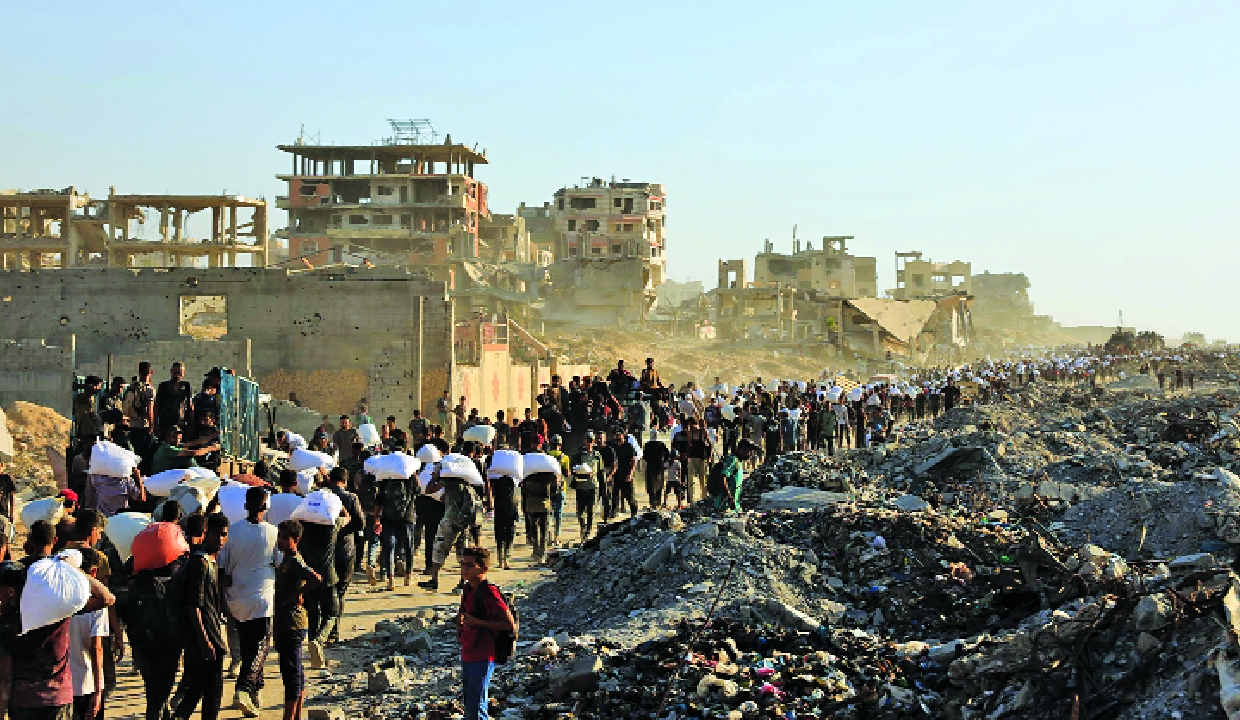
As the war in Gaza continues to divide global opinion, a new United Nations report accusing Israel of grave violations against Palestinian children has reignited questions not only about accountability, but also about the credibility and consistency of international institutions
Two developments this week show how readily the great powers and multilateral institutions will settle the fate of another conflict in the Middle East. At Lake Lucerne, the United States and Iran agreed a roadmap to wind down the war in Lebanon and built a mechanism to govern the fighting between Israel and Hezbollah, while Israel itself was given no seat at the table.
In Geneva, the UN Human Rights Council received a report accusing Israel of the gravest crimes in international law over its conduct towards the children of Gaza. India holds no stake in either battlefield, yet has reason to watch how this second judgment was reached.
The death of a child is the heaviest sorrow a society can carry, and that it is no lighter for the nationality the child happened to hold. A child killed in Gaza is an irreplaceable world ended; so is a child in Tel Aviv, or on a road in the Kashmir Valley. To ask how a child died, and at whose hand, is the seriousness that might protect the next one.
There is another moral question that deserves reflection in India. The massacres of October 7, in which Israeli civilians, including children, were murdered, kidnapped and brutalised, marked the beginning of this war. Yet many voices that now speak with certainty about Israel’s conduct had little or nothing to say when those atrocities occurred. Moral concern cannot be selective. A standard that condemns civilian suffering only after one side responds, while remaining silent when the violence that triggered the conflict is unleashed, diminishes its own credibility. One may criticise Israel’s actions and still recognise that any serious moral accounting of this war must begin with October 7. To omit that starting point is not impartiality; it is incompleteness.
In 2018 and again in 2019, the Office of the UN High Commissioner for Human Rights issued reports on Jammu and Kashmir that New Delhi rejected as fallacious, tendentious and motivated. The objection was never that Kashmiri suffering was unreal; no honest Indian would say so. The objection was to the UN system. A UN office had assembled unverified figures, relied on interested testimony, set aside the long history of cross-border terrorism, and pronounced a confident verdict on a place it had no standing to judge. Governments in Delhi of every stripe have held that line since.
That is the lens through which the Gaza report deserves to be read. This Commission is the only standing body in the UN system aimed permanently at a single country, created by a resolution that half the Council declined to support. It rests its conclusions on testimony it cannot independently verify and, in places, on its own previous reports; it reaches determinations on ballistics and military operations for which it has no evident expertise, then dresses them as legal findings, though it is no court and can convict no one. It allowed the accused state ten days to answer a hundred-page document covering three years of war. None of this certifies Israel’s account of any single incident. But the report’s central claims are precisely the kind an impartial process would treat as contested rather than settled.
Much turns on disputed ground. The Commission’s own reports have not kept their ratios of children to combatants consistent. Its treatment of schools and hospitals sets aside a documented pattern of armed groups operating from within civilian sites, the fact that decides whether a strike was a crime or a tragedy of war: weapons recovered from a kindergarten, a tunnel shaft beneath an infant’s cot, an attack on the Al-Taba’een site that the report lists without recording that the building had become a base for militants. The account of the Al-Ahli hospital explosion, attributed to Israel within hours, was later contradicted by American, British and Canadian assessments pointing to a misfired Palestinian rocket.
On starvation, the report passes over the more than a million children vaccinated against polio in coordination with the WHO, and the diversion of humanitarian aid by the armed groups themselves. One need not settle any of these to see the difficulty: Each judgment falls the same way, against the accused, and a tribunal whose every doubt resolves in one direction is not weighing evidence. It is ratifying a verdict it brought with it.
There is also a distinction that should matter to a democracy. A democracy carries the means of its own correction: courts that rule against the government, a free press, an electorate that removes it. Israel, whatever one concludes about its conduct, has these institutions; the armed movements arrayed against it offer their people none.
Candour is owed about the forum doing the judging. The human-rights machinery of the United Nations carries a long and uneven record, having seated serial abusers on its councils and trained a permanent focus on one democracy while openly repressive states drew little notice. Such a body has not earned the authority to pronounce final verdicts on a sovereign nation, and the principle does not bend according to which nation stands in the dock. Accountability imposed from outside, on evidence a state was never allowed to test, only imitates the rule of law.
This is the pattern India must recognise, because it was once turned against India itself. A standing body, insulated from accountability, selects a single sovereign state, assembles a record it does not let that state test, and converts a political campaign into the language of law and its gravest charges. The instrument is the human-rights report; the purpose is the weaponisation of the United Nations against an unfavourable state.
Verdicts handed down from Geneva harden the warring and embolden those who profit from grievance; they have never stopped a war or returned a child to a parent. Peace is made by states willing to talk, and made faster when the world resists anointing permanent villains and victims. India’s instinct, shaped by its own experience, has favoured dialogue over denunciation. The children of Gaza and of Tel Aviv need a peace two peoples can be helped to build. That is the cause India should keep in view.
A UN office had assembled unverified figures, relied on interested testimony, set aside the long history of cross-border terrorism, and pronounced a confident verdict on a place it had no standing to judge. Governments in Delhi of every stripe have held that line since.
Dr Manjari Singh is a strategic affairs expert specialising in the Middle East and Greater West Asia; Views presented are personal.