The strategic calculus behind America’s Venezuela operation
The US spends roughly $1 trillion annually on its military. A country that has shown superiority in the economic and technological fields also has to exhibit its dominance in the military field. Military power was displayed over a weaker enemy, Venezuela, in a half-hour operation at 2.00 a.m. local time on 3 January, capturing President Nicolas Maduro and his wife, Cilia Flores. About 150 US military aircraft, including fighter jets, drones, and helicopters, took off from land and sea. Fighter jets provided air cover, while US satellite and cyber capabilities blocked Venezuelan radars. Technology was used to switch off the power supply of Caracas, the capital city. The efficiency and confidence of the US military are noteworthy. The use of technology was the most important part of the operation, leading to the inability of the Venezuelan military to offer any resistance. If, however, Venezuelan armed forces were ready to resist, questions are raised over the Chinese air defence network and weapons deployed in Caracas. The assessment of the Chinese air defence system is already under a shadow, as it could not provide protection to Pakistan when India launched Operation Sindoor on 7 May last year.
Maduro and his wife were taken to the USS Wasp, one of the American warships prowling Caribbean waters, and were later transferred to New York via the Guantanamo Bay base. Maduro was produced before a New York federal court on charges of narco-terrorism, cocaine importation conspiracy, and possession of machine guns and destructive devices. He pleaded not guilty before the federal judge. No deaths or fatal injuries were caused to any Americans in the operation; however, around 80 deaths were reported among Venezuelan civilians and army personnel.
This has been one of the most successful operations in US history. George HW Bush’s 1989 invasion of Panama took 42 days to capture Manuel Noriega, during which 23 American troops were killed and 325 were injured. While George W. Bush’s approval rating rose to 90 per cent after 9/11, Trump’s stands between 40 and 45 per cent. Prior to this operation, only 40 per cent of Americans supported bombing boats allegedly carrying drugs in the Caribbean. Trump also seeks actions that increase his approval rating, which is needed to win the election scheduled later this year in November. All 435 seats in the US House of Representatives and 35 out of 100 seats in the US Senate will be contested to determine the 120th United States Congress. His power will be curtailed if he loses a majority in either House. Accelerated oil production is expected to bring oil prices below $50 a barrel globally. This may also provide an edge to Trump’s Republican Party in the mid-term national elections.
The US has been preparing for the operation for over four months, and during this period President Trump frequently stated that Maduro was part of drug cartels in Venezuela that were illegally sending drugs to the US. He also expressed his intention to change the regime in Venezuela. However, experts were of the opinion that invoking drugs was a way to gain legitimacy for his actions, while Trump was actually eyeing Venezuela’s oil deposits, the largest in the world. After the successful “Operation Absolute Resolve”, he wasted no time in announcing at a press conference, “We are going to have very large US oil companies, the biggest anywhere in the world, go in, spend billions of dollars, fix the badly broken infrastructure, and start making money for the country.” He further added that the Venezuelan oil industry had been a “total bust” for a long time and said, “They were pumping almost nothing by comparison to what they could have been pumping.”
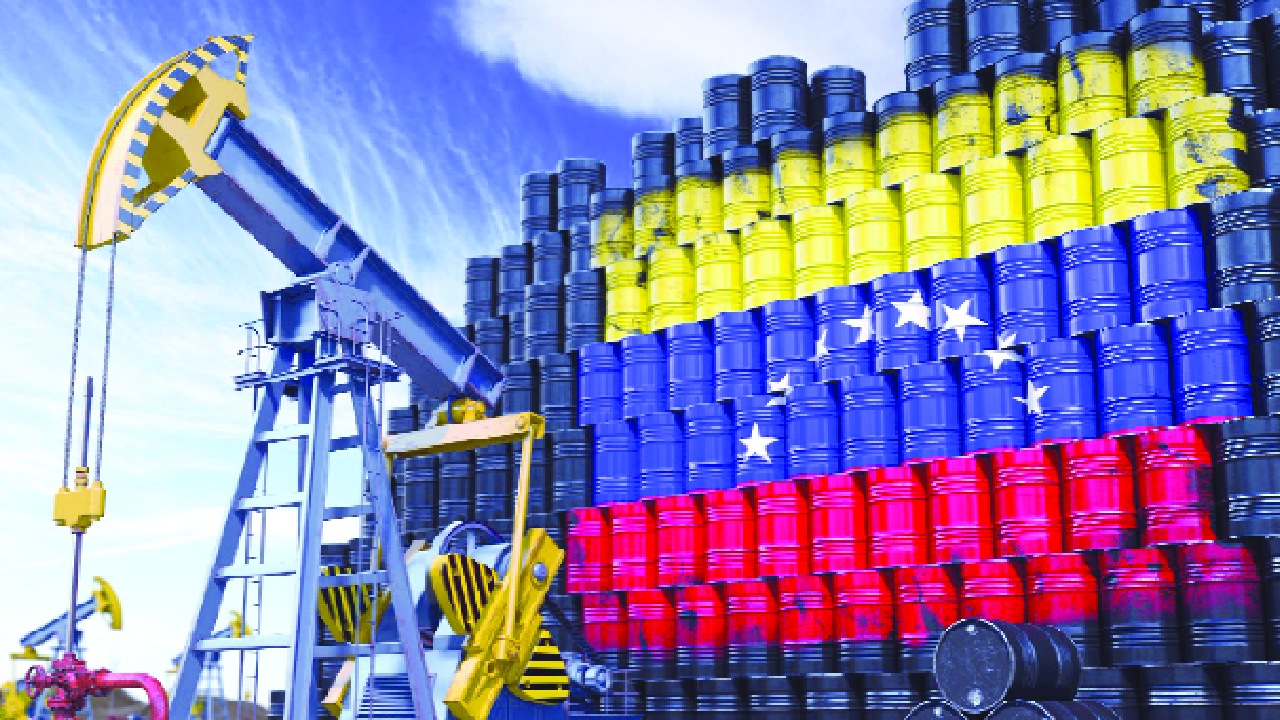
Venezuela holds oil reserves of 303 billion barrels, followed by Saudi Arabia with 267 billion barrels, Canada with 159 billion barrels, and the US and Russia with 80 billion barrels each. Venezuela struggles to produce one million barrels a day, around one per cent of global production. Venezuelan oil is extra heavy and can be extracted only at exorbitant production costs. It is also more polluting.
The extraction process emits more greenhouse gases into the atmosphere. In a warming world, when we are unable to transition away from fossil fuel consumption, should we pursue such heavy oil? Doing so will only accelerate global warming. Moreover, if prices fall due to accelerated production, oil consumption will rise, and the pace and scale of transition to green energy across countries will suffer a setback.A research firm, Energy Aspects, conducted a study and found that Venezuela’s oilfields suffer from years of insufficient drilling, dilapidated infrastructure, frequent power cuts, and equipment theft. PDVSA, the national oil company, lacks the capital and expertise to increase production.
Experts from Energy Aspects have cautioned that increasing oil production will not be cheap. Adding another half a million barrels per day would cost $10 billion and take two years. To reach Venezuela’s maximum production level of 3.5 million barrels per day, infrastructure would need substantial upgrading, and American oil companies would have to invest $10 billion annually for ten years, amounting to a total investment of $100 billion. America would then control nearly 30 per cent of the world’s oil reserves.
India, once a major processor of Venezuelan heavy crude and importing up to 400,000 barrels a day at peak levels, had to stop imports when sweeping US sanctions were imposed in 2020. At the time of the sanctions, ONGC Videsh Limited (OVL) operated the San Cristobal oilfield in eastern Venezuela. With the sanctions, critical technology, equipment, and services were blocked, and output at San Cristobal declined sharply. Venezuela has failed to pay nearly $1 billion to OVL for its stake in the field and dividends due from partnerships in the San Cristobal and Carabobo-1 oilfields.
Experts believe that once sanctions are eased, OVL could move rigs and equipment to San Cristobal and resume operations. However, with Trump in control of Venezuelan oil, OVL may not be able to restart operations without his approval. He has already announced that major US oil companies will move in, repair infrastructure, and maximise oil production. The investments required would be enormous, and companies from other parts of the world would likely be excluded from benefiting. Trump is also expected to levy a significant share of revenue earned by American oil companies for the US Treasury. It may be recalled that he imposed a 15 per cent levy on Nvidia for selling chips to China.
While explicitly endorsing the “Monroe Doctrine”, Trump said during a media briefing, “American dominance in the Western Hemisphere will never be questioned again.” In a provocative remark that shocked the world, he stated that Vice President Delcy Rodríguez, appointed Acting President of Venezuela, had little choice but to submit to Washington’s diktat. He added that failure to cooperate would result in the same fate that befell Maduro.
Trump’s actions have also unsettled governments in Colombia, Cuba, and Denmark. Colombia’s President Gustavo Petro has promised to defend the homeland amid the threats. Cuban President Miguel Díaz-Canel, addressing a rally in Havana, expressed support for Venezuela, but the Trump administration has treated Cuba as a pariah, reducing economic and security cooperation to a bare minimum. Denmark’s Prime Minister has warned that any attempt by Trump to take over Greenland would result in the collapse of NATO. In the absence of a rules-based world order, confusion now prevails from Latin America to Iran.
The writer is Retired Head of Karnataka Forest Force and presently teaches Economics in Karnataka Forest Academy; views are personal