The Narrative Asymmetry: Why International Indices Misread India's Global Weight
By rewriting the biased narratives of the past and challenging the metrics of the present, India is not just telling its own story; it is contributing to a more accurate history of human achievement
The evolution of soft power-the ability of a nation to shape global preferences through attraction rather than coercion-has transitioned from a secondary diplomatic asset into a core structural component of national strength. In an age defined by hyper-connectivity, a country's international standing is no longer determined solely by its material resources or military throw weight. Instead, the global narrative surrounding a nation-the story the world tells about its history, intellectual contributions, and future potential-serves as the invisible architecture of its foreign policy. For India, a nation possessing immense civilisational weight, the primary challenge of the twenty-first century lies in reconciling its profound historical depth with a global perception system that often fails to capture its modern scientific reality.
Historically, the global understanding of scientific and cultural progress has been viewed through a geographically and temporally narrow lens. For centuries, a dominant historiography characterised the Indian civilisation primarily through the prisms of mysticism, philosophy, and spirituality, while frequently omitting its foundational contributions to empirical inquiry, mathematics, and logic. This perceptual distortion suggests that while India provided the world with "soul", the "mind" of modernity-the rigorous, analytical framework of science-was an exclusively Western invention. This is not merely an academic oversight; it is a profound diplomatic and economic disadvantage. When a nation is categorised exclusively as a land of "heritage" rather than "innovation", its influence in high-stakes technological and economic forums is subtly but systematically sidelined. This "narrow lens" effectively anchors a modern, rising power to a static, ancient past, denying it the agency to be seen as a contemporary leader.
The intellectual lineage of the modern digital age provides a stark example of the need for a narrative correction. The fundamental architecture of contemporary life-the decimal place-value system, the concept of zero, binary logic, and early formulations of calculus-has deep roots in Indian thought that preceded the Industrial Revolution by centuries. The binary code powering today's global servers and the probabilistic inference driving modern artificial intelligence carry a DNA that is thousands of years old. Reclaiming this narrative is not an exercise in looking backward with nostalgia; it is an assertion of civilisational continuity. It demonstrates that the same mathematical rigour that birthed the decimal system now forms the bedrock of India's contemporary technological prowess. By establishing this link, India can challenge the idea that its current scientific successes are "borrowed" or "derivative", proving instead that they are the modern manifestations of a long-standing tradition of rigorous inquiry.
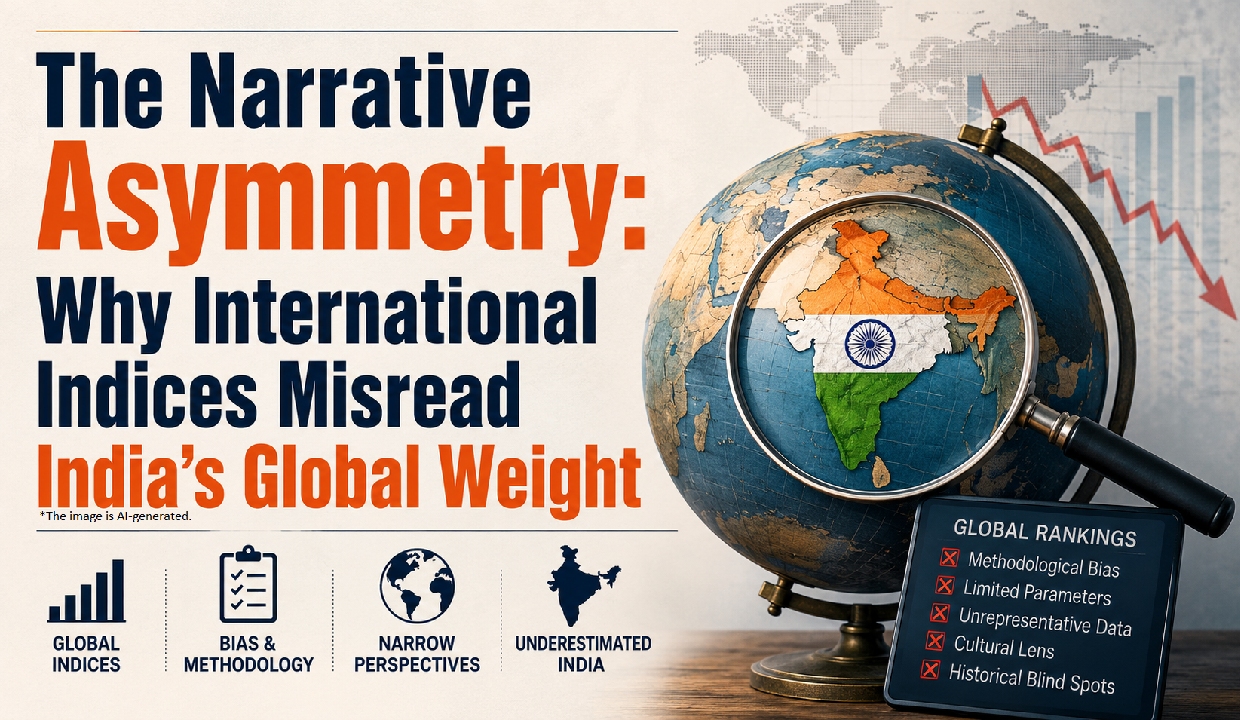
The importance of this shift becomes evident when examining how soft power is measured by the international community today. Global indices often rank nations based on metrics like familiarity, influence, and reputation. However, a persistent and damaging asymmetry exists in India's rankings: the country consistently scores highly on "Culture and Heritage" but underperforms on "Science and Technology" and "Influence". This gap is rarely a reflection of actual output or capability. Rather, it is a narrative problem rooted in a colonial-era knowledge apparatus that continues to view the Global South through a restrictive framework. For India to exercise true comprehensive statecraft, it must bridge the gap between its recognised cultural resonance and its unrecognised scientific achievements.
This discrepancy points toward a deeper systemic issue: the inherent bias within global indices themselves. Many such rankings-whether they measure soft power, press freedom, or economic innovation-are constructed on frameworks that embed the cultural and political assumptions of their creators. Often relying on ambiguous parameters, subjective expert surveys, and small, unrepresentative sample sizes, these indices are not neutral instruments. They shape sovereign credit ratings, investor perceptions, and diplomatic leverage. When these frameworks fail to account for India's unique scale, its specific models of digital public infrastructure, or its indigenous scientific successes, they produce results that are fundamentally skewed. India cannot afford to treat these rankings as background noise; the methodology behind them must be challenged and rewritten to reflect a truly global, representative perspective. This methodological skew appears even more glaring when contrasted with hard macroeconomic realities, as evidenced by the IMF routinely praising India's economic success and explicitly calling it "a bright spot on this otherwise dark horizon".
In the contemporary landscape, this rebalancing is essential as India demonstrates world-class capabilities in domains ranging from aerospace engineering to large-scale digital systems: Chandrayaan-3, Aditya-L1, the Prototype Fast Breeder Reactor (PFBR) and the awaited Gaganyaan Mission. These are not isolated successes; they are a testament to a robust scientific ecosystem. When these achievements are not reflected proportionally in global rankings, it highlights the urgent need for a more inclusive definition of "innovation" that looks beyond the traditional clusters of the North Atlantic.
The transition toward a multipolar world is as much about cultural and intellectual rebalancing as it is about economic and military shifts. As geopolitical churn continues, the space for diverse narratives is expanding. By highlighting its foundational contributions to global science and simultaneously challenging the narrow metrics of current international assessments, India is moving toward a position of civilisational confidence. This process is essential for fostering a truly global understanding of human progress, moving beyond the outdated binary of "traditional" versus "modern". Security and economic strength provide the framework for peace, but it is the perception of intellectual leadership that builds the bridges of understanding necessary for long-term global influence.
Ultimately, soft power is the currency of modern diplomacy. The ability to project a confident, comprehensive identity allows a nation to engage with the world on its own terms. Whether through the lens of ancient mathematical treatises or cutting-edge aerospace research, the goal is to prove that intellectual excellence is not the province of any single region or era. As the global community strives to solve complex challenges in climate, technology, and health, a more equitable and representative understanding of scientific history and national capability will be vital. By rewriting the biased narratives of the past and challenging the metrics of the present, India is not just telling its own story; it is contributing to a more accurate history of human achievement.
R K Pachnanda, Former Chairman, Haryana Public Service Commission; Former Chairman, Haryana Electricity Regulatory Commission; Former DG-ITBP; Former DG-NDRF; Commissioner of Police. Kolkata; Director, Bharat ki Soch; Views presented are personal.
Tejusvi Shukla; Assistant Director (Research), Bharat Ki Soch; Views presented are personal.