The India-EU moment: Forging partnerships amid a fractured global order
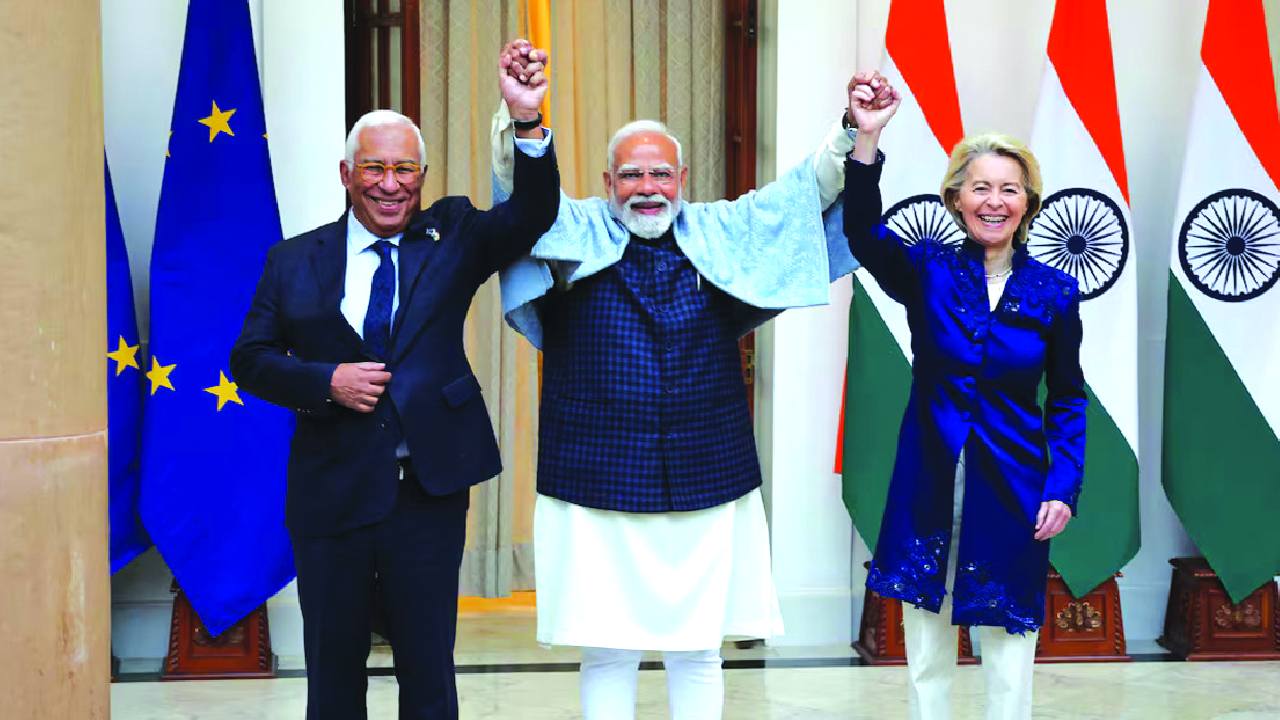
India and the European Union have announced the conclusion of a Free Trade Agreement (FTA), described as ‘a mother of all deals’, and signed a New Security and Defence Partnership. These were announced during the landmark visit of the European Union (EU) Commission and Council presidents on the eve of India’s Republic Day, coinciding with the 16th India-EU Summit held the following day. Both sides signed 13 outcomes in total, covering trade, economic, and defence relations, as well as a broad range of issues spanning skilling and mobility, disaster management, clean energy, science and technology, and connectivity. They also adopted a Comprehensive Strategic Agenda, which will define ties until 2030.
This recent upturn in the relationship between New Delhi and Brussels is not only a product of mutual interests, but equally of shared unease. The global order that shaped transatlantic and Indo-European relations for decades is fraying, as assumptions about security guarantees, economic interdependence, and alliance reliability are increasingly challenged. Efforts for an FTA date back to 2007, but recent geopolitical developments have brought the two closer.
The EU has been disappointed by the United States, feels increasingly threatened by Russia, and, coupled with growing scepticism towards China, has reconsidered its relationships. For New Delhi, the quest for multi-alignment, reinforced and sharpened by recent events, continues to dominate
engagements.
The US is undergoing a transformation and redefining its global role. Its trajectory remains unclear and unpredictable, but it is likely to be less tethered to the institutions, patterns, ideas, and ideologies established in the wake of the Second World War. Though dominated by the US, this order benefited Europe and India, which had adjusted to its contours over time. However, no power has been as impacted by Trump’s adventurism as the EU. His unpredictability, along with U.S. Vice President JD Vance’s stark dislike of Europe, has brought transatlantic relations to a low point. The realisation that Europe can no longer rely on NATO’s security umbrella or economic and cultural ties with the US has rattled Brussels. This has accelerated its pursuit of strategic autonomy and new partners. For India, Trump 2.0 posed challenges to a bilateral relationship considered strategically important and central to its global outlook. Thus, Trump’s America was a key factor pushing this India-EU FTA, as acknowledged by an EU ambassador in Delhi. India offers an ideal alternative for Europe — a large market, a growing defence ecosystem, a rising technology hub, and a moderate voice in global affairs.
These developments are also crucial in the post-Ukraine war period, as Moscow’s attempts to weaken and divide Europe have pushed Brussels to enhance economic and defence capabilities. Russia is perceived as an existential threat. While a target of European criticism, India’s rising economic and defence prowess is seen as a valuable partner as the EU charts a new trajectory.
India’s decision to maintain ties with Russia despite immense pressure has been vindicated by recent events, exemplifying strategic autonomy-a model Europe increasingly admires. Brussels also welcomed that, during Putin’s recent visit to Delhi, no major defence agreement was signed, and India continued to reduce dependence on Russian oil and defence supplies. Nonetheless, Russia will remain a point of disagreement.
India could also play a critical role in the EU’s ReArm Europe Plan 2030, announced in response to the Russian threat, with various European capitals pledging massive defence packages. European publics face economic anxieties, pension concerns, and debates over burden-sharing, alongside renewed discussions, such as Germany’s, on mandatory military service. A stronger partnership with India could help alleviate fiscal pressures. Defence ties with countries such as France and Germany are already strengthening, contributing to cautious optimism.
Meanwhile, China is a special case where both sides broadly align in principle but differ in approach; the intensity, nature, and timing of the perceived threat vary. For Europe, China ranks below Russia and the US in foreign policy priorities. Notably, the EU is far from cohesive on China. For India, however, the Chinese threat is paramount, and New Delhi seeks stability and predictability in its relations. China’s emerging power shift, accelerated by Trump-era policies, underscores the urgency of preserving the remnants of a rules-based order — a shared concern for both
India and Europe.
Thus, global unpredictability and geopolitical complexities have nudged India and the EU closer, setting aside differences. The FTA sends a message to old friends and new challengers: both sides capitalised on a crisis and seized the opportunity. The timing was highlighted by European Commission President Ursula von der Leyen during the joint press conference, who stated: “The time is right for renewed, fresh momentum, and for opening a new chapter in EU-India friendship.”
While the growing partnership benefits both sides, it also reflects the transactionalism that defines today’s world. The agreements’ intricacies are natural and solvable, but the relationship’s foundation must be robust. It must aim to improve the lives of two billion people, not merely to address global anxieties. It must be a relationship of choice, not convenience. With the right intent and effective execution, the sky is the limit for India-EU friendship.
The writer is a Research Assistant and Programme Coordinator for the Security Studies Programme at Carnegie India; views are personal