Tech gives instant answers but can’t replace ethics: PK Mishra
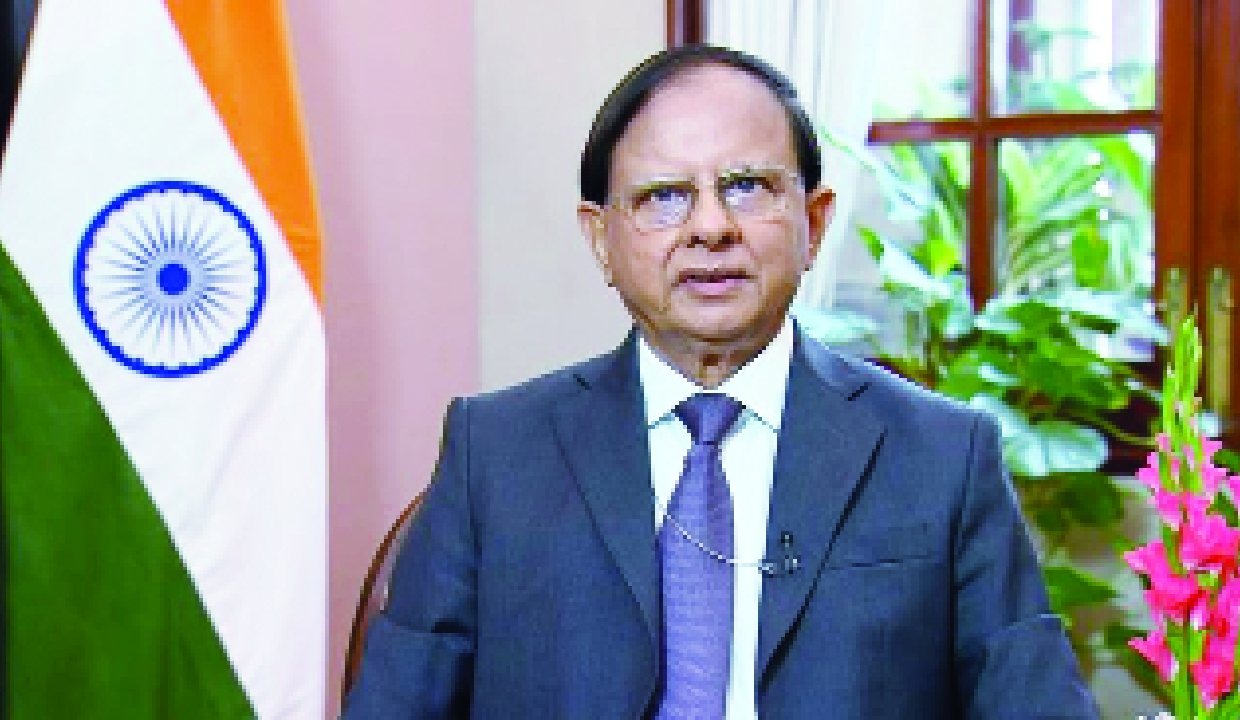
Dr PK Mishra, Principal Secretary to the Prime Minister, on Tuesday addressed the Third Convocation of Nalanda University at Rajgir, Bihar. He congratulated the 221 graduates representing 14 nations, marking their academic accomplishment as a milestone built on hard work and perseverance.
While recognising the ancient Nalanda Mahavihara as one of the greatest learning centres in history, Dr Mishra said that “There are universities that are institutions. And then there are universities that are civilisational symbols. Nalanda belongs to the latter category”.
Highlighting the historical and geographical significance of the region, Dr Mishra underscored Nalanda’s core philosophy that knowledge must remain open to dialogue, connected across disciplines, and directed towards humanity’s greater well-being.
He praised the university’s new Net Zero campus, inaugurated by Prime Minister Narendra Modi, recalling Bodh Gaya, where Lord Buddha attained enlightenment. Dr Mishra observed that “Indeed, the entire Asian continent has greatly benefited from the teachings of Lord Buddha. I am sure, the learning from this great University will spread far and wide across the continents”.
Reflecting on Nalanda’s foundational intellectual traditions, Dr Mishra highlighted its interdisciplinary approach. He stressed the importance of cultivating vada, rigorous dialogue and inquiry, as an antidote to modern intellectual passivity, cautioning that while technology provides instant answers, it cannot replace ethical reasoning and moral responsibility, or fully comprehend human meaning, suffering, dignity, or aspiration. “Civilisations decline not when they lose information, but when they lose the capacity for reflection and independent thought,” Dr Mishra asserted.
Detailing India’s commitment to democratising learning, Dr Mishra outlined the National Education Policy’s focus on multidisciplinary education, multilingual instruction, and the formal integration of Indian Knowledge Systems.
Examining the profound and widespread impact of Artificial Intelligence, Dr Mishra raised crucial questions regarding ethics, bias, privacy, and human agency. He warned that AI models trained predominantly on English-language and Western datasets may not adequately capture the agricultural, medical, or climatic realities of Asia and the Global South, risking a dangerous gap between technological models and local realities.
Positioning Asia at a critical global inflection point, Dr Mishra recognised the rapid economic growth of the region’s nations, highlighting India’s transition into a bright spot in the global economy.
Reflecting on ancient graduation traditions, Dr Mishra invoked the Taittiriya Upanishad, highlighting the enduring relevance of the 11th anuvaka of the Shiksha Valli, which provides the Guru’s golden rules for an ethical life, including speaking the truth, abiding by dharma, and never being idle in studies. Dr Mishra also said that “Education is not simply the acquisition of knowledge or professional competence. It is the cultivation of judgment, character, and ethical responsibility,” he concluded.
Lt General Syed Ata Hasnain, Governor of Bihar; Professor Sachin Chaturvedi, Vice-Chancellor, Nalanda University; Rudrendra Tandon, Secretary (East), Ministry of External Affairs; members of the Governing Board, members of the Academic Council; faculty members, distinguished representatives of the Embassies and High Commissions of our partner nations were present on the occasion.