Tariffs and triumph: India outpaces the global economy
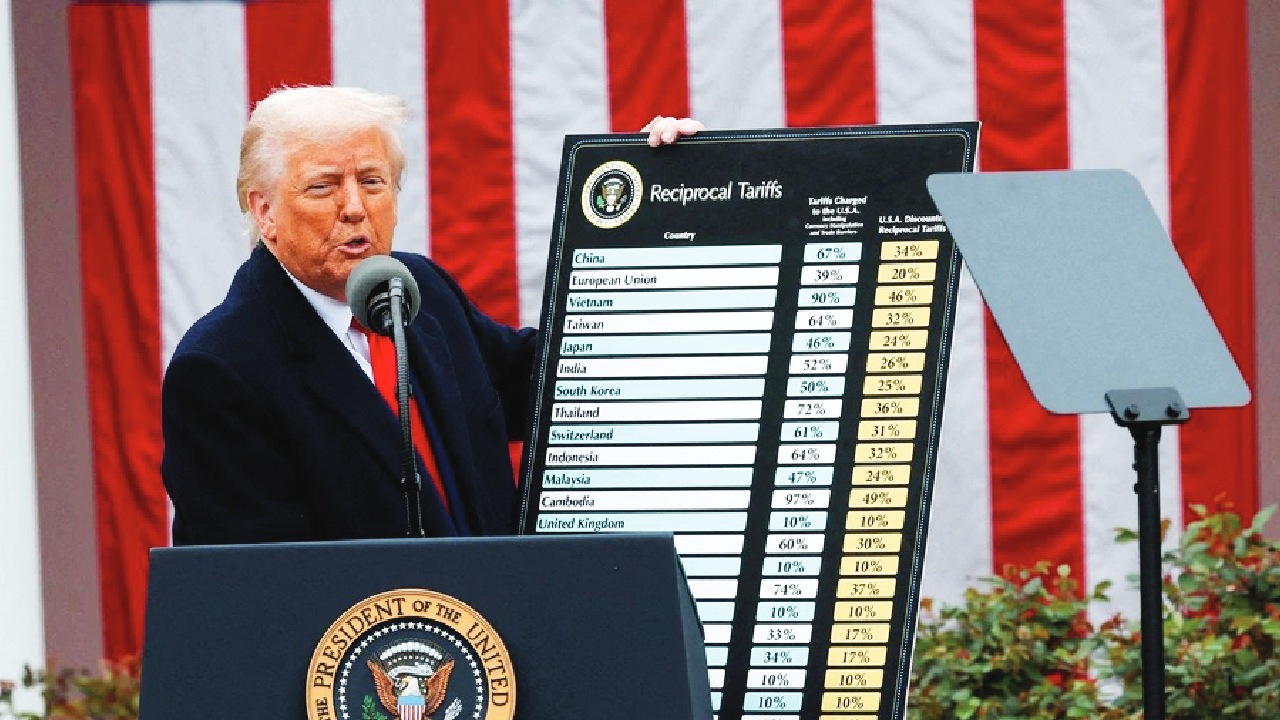
On ‘Liberation Day’ in April, US President Trump announced a sharp increase in tariffs on imports from several friendly countries. Experts had forecast that major trading partners would retaliate, and that the world was likely to plunge into a deep recession. This even led to markets crashing across the globe. It was also predicted that growth would slow down everywhere. The US, too, was expected to face high inflation and poor growth. Nine months down the line, however, the US has registered record growth of 4.3 per cent, and India’s growth figure in the second quarter of the current financial year has also proved robust at 8.2 per cent. In this piece, let me examine how India remains on a fast-growing trajectory despite trade disruptions caused by soaring tariffs.
Initially, the US announced a 150 per cent tariff on China. In turn, China reciprocated with a similar tariff and additionally banned the export of several rare-earth elements such as dysprosium, neodymium, samarium, gadolinium, terbium, lutetium, scandium, and yttrium (medium/heavy REEs). Though China, Vietnam, Brazil, Russia, and India — in this order — hold the largest deposits of rare-earth minerals, China controls 90 per cent of refining capacity. Rare-earth elements mined in different parts of the world are shipped to China for separation and processing. Neodymium/dysprosium, iron, and boron are combined in an alloy to form magnets that withstand high
temperatures and are used in emerging technologies like drones, robots, missiles, fighter jets, and automobiles. These magnets are essential for increasing torque and speed, and they enhance precision and efficiency.
China used its rare-earth leverage to bring Trump to the negotiating table, and he was compelled to compromise with President Xi at Gyeongju, South Korea, in October on the sidelines of the APEC meet. The ban was thereafter lifted universally for one year. The US also had to bend and allow exports of advanced H200-series chips from Nvidia to China. This brought both countries closer in mutually advantageous economic interdependence. Eventually, Trump’s
tariff on China was brought down to 47 per cent.
China, being a manufacturing hub, has consistently enjoyed a trade surplus with countries like the US, the EU, and India. One-third of the country’s trade surplus of $380 billion is with the US. While Chinese exports to the US in November 2025 plunged 29 per cent compared with November 2024, its exports to the EU surged 15 per cent over the same period. Overall, Beijing posted a 5.9 per cent increase in exports to the rest of the world, with Africa, Southeast Asia, and Latin America accounting for increases of 26, 14, and 7 per cent respectively. Despite US tariffs, China’s growing trade surplus comes from trans-shipments - rerouting shipments to other destinations.
Initially, experts feared that Trump’s 50 per cent tariff (including 25 per cent on purchases of energy from Russia, which funds the war in Ukraine) would impact nearly 26 per cent of India’s exports to the US. In practice, however, the impact has been closer to 10 per cent. Like China and several other countries, India has managed to reroute goods through third countries and thereby evade high tariffs. From his election campaign onwards, Trump threatened to impose reciprocal tariffs to reduce trade deficits with partner nations. Taking advantage of this, US importers stocked high inventories, enabling them to keep import prices lower than expected for several months. Of the new tariffs, roughly one-third of the incremental burden was absorbed by US importers, one-third by Indian exporters, and the remaining one-third was passed on to US consumers, keeping inflation in check. In fact, October inflation of 3 per cent slid to 2.7 per cent in November.
Further, US growth in 2025 is also attributed to the AI boom. The biggest US companies have invested trillions of dollars in expanding data centres. These investments largely count as capital expenditure and generate limited employment.
Consequently, despite good GDP growth, unemployment has risen from 4 per cent to 4.6 per cent in Trump’s second term so far. It is unlikely that the remaining years of his tenure will see a similar boom, given AI saturation and trade disruptions caused by high tariff rates. These are bound to adversely affect growth and fuel inflation. Stockpiled imports will not help in the years ahead. A higher proportion of tariffs will be passed on to consumers, and even interest-rate cuts may stall. This could lead to the Republican Party’s defeat in the forthcoming Congressional elections in November 2026 and enable Democrats to secure a majority in both Houses. The party has already suffered electoral setbacks in Georgia and Mississippi state elections, the mayoral election in New York, and national elections in Virginia and New Jersey.
While US growth is likely to slow, India’s economy has proved resilient with its large domestic market and services exports. Amid trade wars and volatile capital flows, India continues to be the fastest-growing economy in the world. Trade moves have been strategic: the supply chain of critical inputs like rare-earth magnets and key minerals has been diversified, and free trade agreements with countries such as the UK, New Zealand, the UAE, Singapore, and Malaysia have been signed. These agreements reduce tariffs and boost trade with partner countries.
India faced turbulence due to higher US tariffs, record foreign portfolio outflows, and the rupee sliding past 91 to a dollar. Domestic demand, driven by interest-rate cuts of 125 basis points to revive credit growth, implementation of long-pending labour codes, tax cuts for the middle class, and rationalisation of GST slabs, has boosted consumer confidence. Public expenditure on infrastructure has also remained robust. A good monsoon has supported agricultural growth. Government capital expenditure has soared, with 52 per cent of allocations utilised in the first half of the fiscal year. Average GDP growth in the first two quarters has remained at 8 per cent, with manufacturing and services growing by 9 per cent. These now account for nearly 60 per cent of gross value added and almost half of exports.
There are, therefore, positive indications for India’s growth ahead. Still, we need to focus on improving credit transmission - as despite rate cuts, MSMEs and households remain concerned about credit. Slowing tax revenue due to recent reforms and the risk of
resurgent inflation as consumption accelerates also require attention. We must safeguard tariff-hit sectors such as textiles, jewellery, automobiles, and shrimp through tax breaks and credit guarantees.
Health tourism — currently a $40-billion industry — is likely to grow to $100 billion by 2030. Foreign patients visiting India for advanced, affordable, and reliable treatment have the potential to boost the economy further. Just as IT services made India indispensable, our expertise in cardiac surgery, oncology, organ transplants, neurosurgery, advanced orthopaedics, and robotic interventions has made India a trusted global medical hub. India’s medical-tourism story is not about cheap care, but about care on par with global standards at affordable prices.
Alongside China, India is one of the few countries sending large numbers of STEM graduates to the global market to support AI, technological advancement, digital infrastructure, and high-tech manufacturing. We are already the world’s fourth-largest economy and are set to become the third-largest in the coming years. Despite headwinds, India will continue to grow impressively in 2026 and beyond.
The writer is Retired Head of Karnataka Forest Force and presently teaches Economics in Karnataka Forest Academy; views are personal