Shouting over Democracy: The death of debates in Indian Parliament
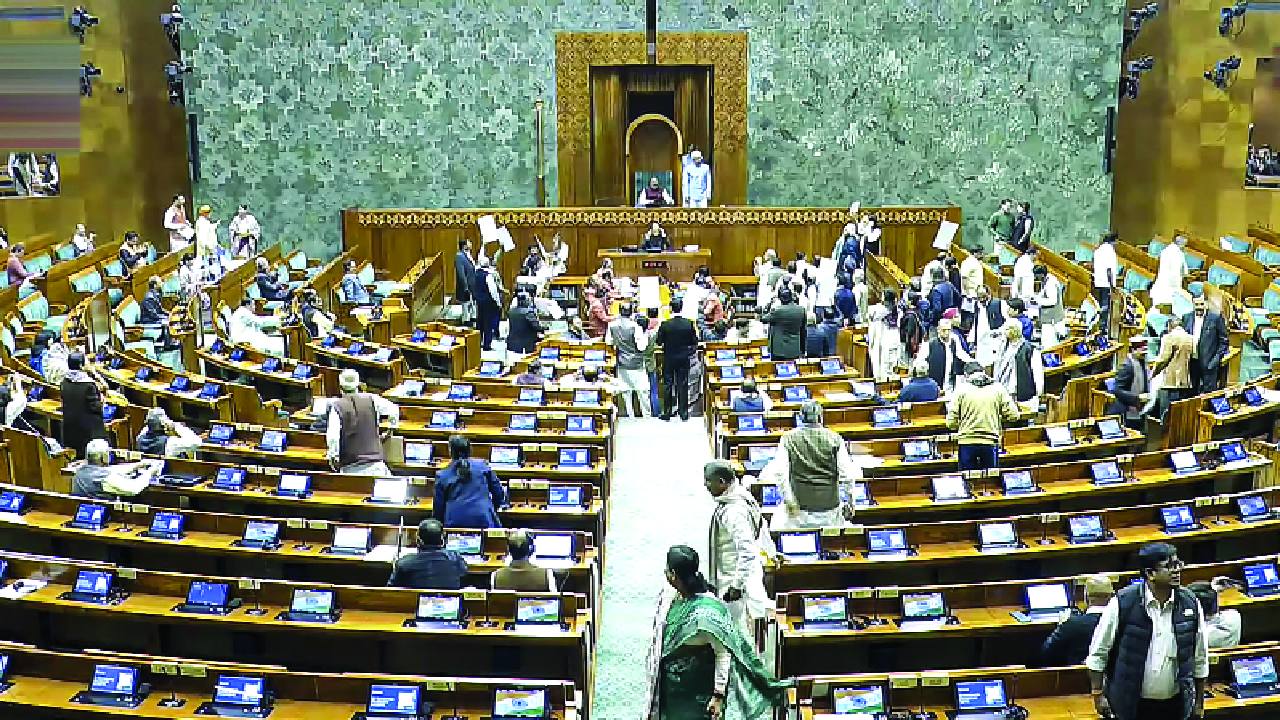
The Indian Parliament, once heralded as the “temple of democracy,” has increasingly begun to resemble a gladiatorial arena (the term is used metaphorically now for any competitive public space, like a political arena or court battle) where reason goes to die and shouting matches are the only way to combat. The Indian Constitution provides a framework for the smooth functioning of Parliament, specifically empowering presiding officers to deal with unruly disruptions.
While the Constitution lays the foundation for this, the very idea of democracy and freedom of speech is being violated by uproar in Parliament. The recent spectacle of “frivolous disputes” in Parliament has reached the lowest ebb of parliamentary conduct. When the “temple of democracy” becomes a place of “competitive noise,” ordinary citizens lose more than just tax money; they lose faith in the institution itself.
The current disruptions are not a sign of a strong opposition or a strong government; they are a sign of a broken system. The opposition blocks the House because they believe the floor is a platform for protest, not debate. The government passes important legislation in the “din,” ignoring the scrutiny of standing committees. This is not governance; it is shirking one’s duty. Our lawmakers need to ponder over this, especially the Speaker of the Lok Sabha and the Chairman of the Rajya Sabha, and need to take steps to maintain the confidence of the people in Parliament.
There are key constitutional and procedural rules to deal with unruly disruptions in Parliament. Article 118 empowers each House of Parliament to make rules to regulate its business and conduct, thereby maintaining internal discipline. Article 105 deals with the powers, privileges, and immunities of Parliament and its members. It allows the House to punish members for breach or contempt of privileges, including misconduct such as vandalism or violent behaviour, for which they cannot claim immunity.
Article 122 states that the validity of any proceedings in Parliament cannot be questioned in any court on the basis of any alleged defect in procedure, thereby ensuring internal autonomy. If this is the condition, why are our presiding officers allowing such mobocracy in the hallowed building meant for debate and law-making?
Parliament was always meant to engage with and undertake legislative and deliberative business, representing the people of India. In Sita Soren v. Union of India (2024), a seven-judge Supreme Court bench ruled that lawmakers (MPs/MLAs) do not enjoy immunity from prosecution for bribery to vote or speak in Parliament or Assemblies, overturning the 1998 PV Narasimha Rao verdict. The court clarified that acts of vandalism and violence (disruptions) are not protected by parliamentary privilege, asserting that they violate constitutional, not legislative, norms.
The Supreme Court thus held that legislators who indulge in vandalism and general mayhem cannot claim parliamentary privilege and immunity from criminal prosecution, and that parliamentary privileges and immunities are not ‘gateways’ for legislators to claim exceptions from the law of the land, especially criminal law. Vandalism on the Assembly floor could not be equated with the right to protest by opposition legislators.
Legislators in both the ruling dispensation and the opposition should act within the parameters of the public trust imposed on them to do their duty. They had taken office swearing true allegiance to the Constitution.
They had to uphold the sovereignty and integrity of India and perform the duty imposed on them by the people who elected them. It was definitely not for them to “betray the trust of the people” who elected them to make laws by engaging in wanton destruction of public trust in the Assembly and then claim privilege and immunity from the very process of law. When elected representatives enter the Well, tear papers, and physically obstruct their peers, they are not acting as legislators; they are acting as a mob.
Now, therefore, the time has come, as strong public opinion is building up, for strict disciplinary action by presiding officers-namely the Speaker of the Lok Sabha and the Chairman of the Rajya Sabha — as well as presiding officers of state assemblies, to exercise the powers vested in them to deal with misconduct under the Rules of Procedure and Conduct of Business under Rules 373 and 374 in the Lok Sabha and Rules 255 and 256 in the Rajya Sabha. Further, under Rule 374A in the Lok Sabha, the Speaker can automatically suspend a member for a specified period, without any motion, for actions such as entering the Well or shouting slogans. However, this provision is rarely invoked, but people want it as a regular option as they are fed up with such tactics in the name of democracy. For excessive disruptions and unruly behaviour, Parliament can expel members, but this option is seldom exercised.
There is an urgent need to impose financial disincentives and implement a “no work, no pay” rule. If the House is adjourned due to deliberate disruption, the per diem allowance of every member present in the Well should be forfeited. Further, no bill should be passed in an “uproar.” If a bill cannot be debated on the Floor for at least four hours, it must be referred to a Standing Committee for at least 30 days. If a member quotes from an unverified or “disputed” external text, the Speaker’s office should have the authority to remove it from the permanent record unless the member officially produces the document within one hour.Mahatma Gandhi once warned that if public opinion is not mature, democracy can easily convert into a mobocracy.
In a mobocracy, the crowd has no “mind or premeditation”; it acts in frenzy. This frenzy needs to be firmly curtailed with an iron hand as people are losing faith fast. Let us hope good sense prevails and Indian democracy thrives well.
The writer is former Director-General ICFRE in the Ministry of Environment, Forest and Climate Change; views are personal