Saudi, Pak, Turkey forge Mecca Pact
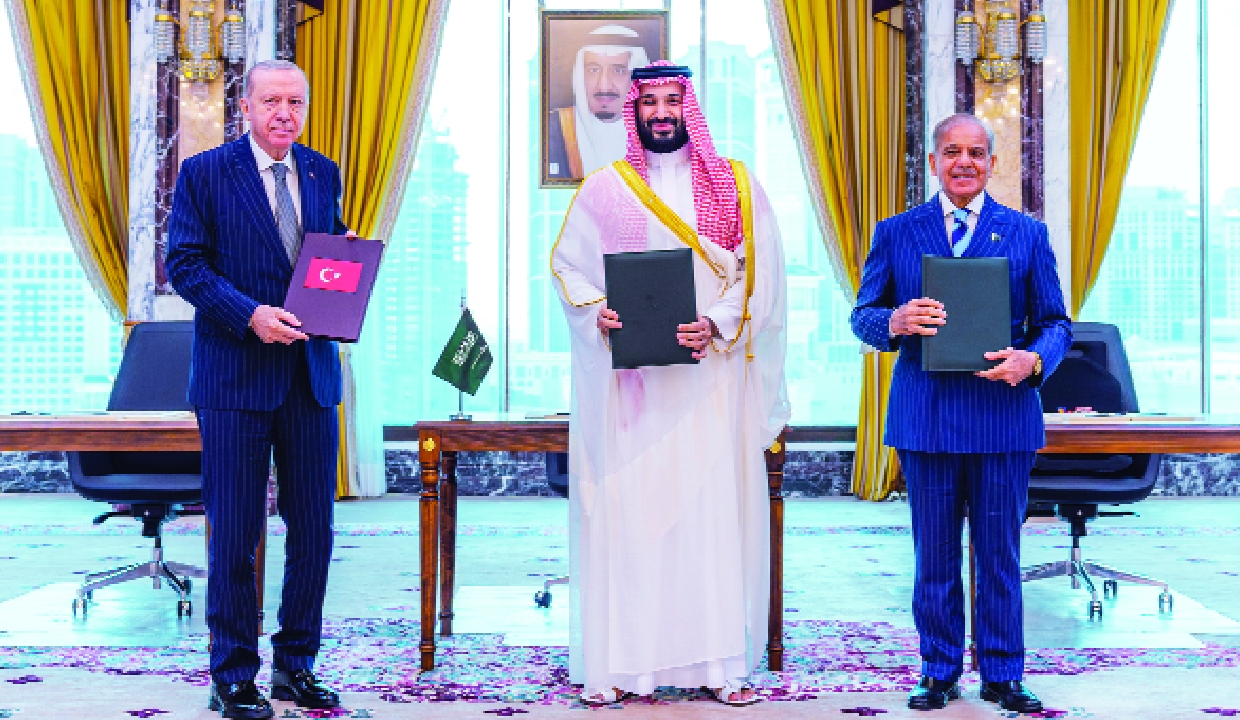
Amid growing uncertainty in West Asia, Saudi Arabia, Pakistan and Turkey on Friday signed a trilateral defence agreement, informally echoed the ‘Mecca Pact’, committing themselves to closer military cooperation and a collective security framework.
The agreement was finalised after a high-level summit in the holy city of Mecca attended by Saudi Crown Prince Mohammed bin Salman, Turkish President Recep Tayyip Erdogan and Pakistani Prime Minister Shehbaz Sharif, who was visiting the Kingdom after performing the Umrah pilgrimage.
According to a joint declaration issued after the summit, the three countries agreed to institutionalise defence cooperation through enhanced military coordination, strategic consultations and joint security mechanisms. A key feature of the pact is a mutual defence clause that treats an armed attack against any one of the three signatories as an attack against all, signalling a significant step towards formalised collective security among the partners.
Pakistan’s Foreign Ministry described the agreement as a natural progression of the countries’ longstanding political, strategic and defence ties. It said the framework reflects their shared commitment to promoting regional peace and stability while strengthening cooperation based on common security interests. “The agreement is intended to enhance collective deterrence and deepen defence collaboration in response to emerging regional security challenges,” the ministry said.
India on Friday said it was closely monitoring the newly announced trilateral defence agreement between Saudi Arabia, Pakistan and Turkey, signalling that New Delhi is assessing the strategic implications of the emerging security framework amid an increasingly volatile geopolitical environment in West Asia. Responding to media queries, Ministry of External Affairs spokesperson Randhir Jaiswal said the government was carefully following developments related to the agreement and would assess its implications as further details emerge. The measured response underscores India’s watchful approach towards changing strategic equations in its extended neighbourhood, particularly at a time when regional security dynamics remain fluid.
The announcement comes against the backdrop of continuing instability across West Asia, where the conflict involving Iran has intensified geopolitical uncertainty. Repeated missile attacks, disruptions to maritime trade routes and concerns over global energy supplies have prompted several regional powers to reassess their defence and security partnerships.
The security environment has become increasingly volatile following military exchanges involving Iran, Israel and the United States earlier this year, raising fears of a wider regional confrontation with broader geopolitical consequences.
Turkish officials sought to allay concerns by describing the new arrangement as a purely defensive initiative. They maintained that the pact is not directed against any particular country, does not replace existing bilateral or multilateral security arrangements and remains open to broader regional cooperation should other countries choose to participate.
Strategic observers see the initiative as a notable attempt by three influential Muslim-majority nations to deepen policy coordination at a time when traditional security architectures are being tested by multiple regional crises.
Analysts argue that beyond its military dimension, the agreement carries considerable diplomatic significance by signalling a greater willingness among regional powers to develop indigenous security frameworks rather than relying exclusively on external alliances. If backed by sustained political commitment and institutional mechanisms, they believe the partnership could enhance the three countries’ collective influence on regional security issues.
Each member contributes distinct strategic strengths to the new framework. Turkey possesses one of NATO’s largest and most capable armed forces alongside a rapidly expanding domestic defence industry. Saudi Arabia combines significant financial resources, global energy influence and its status as the custodian of Islam’s two holiest mosques. Pakistan brings extensive operational military experience and remains the only Muslim-majority nation with declared nuclear capabilities.
The pact also builds on decades of defence cooperation among the three countries. Pakistan has long maintained military training and advisory programmes in Saudi Arabia, while Ankara and Islamabad have expanded collaboration in defence production, military technology and joint training. Saudi Arabia has also emerged as a major buyer of Turkish defence equipment, including advanced unmanned aerial systems.
Security experts believe the agreement could pave the way for closer cooperation in defence manufacturing, intelligence sharing, joint military exercises and technology transfer. At the same time, analysts point out that Pakistan’s nuclear doctrine remains focused on its security calculus vis-à-vis India, making any nuclear component to the new partnership unlikely.
Pakistan has also expanded military engagement with Gulf countries in recent months through additional deployments and broader security cooperation, while simultaneously exploring defence partnerships linked to investment and energy security across the region.
Although the three governments have presented the Mecca Pact as a defensive arrangement aimed at strengthening regional stability, its long-term strategic implications are expected to be closely watched by major regional stakeholders, including India, as West Asia undergoes one of its most consequential geopolitical transitions in recent years.