Sanskrit: The language that shaped a civilisation
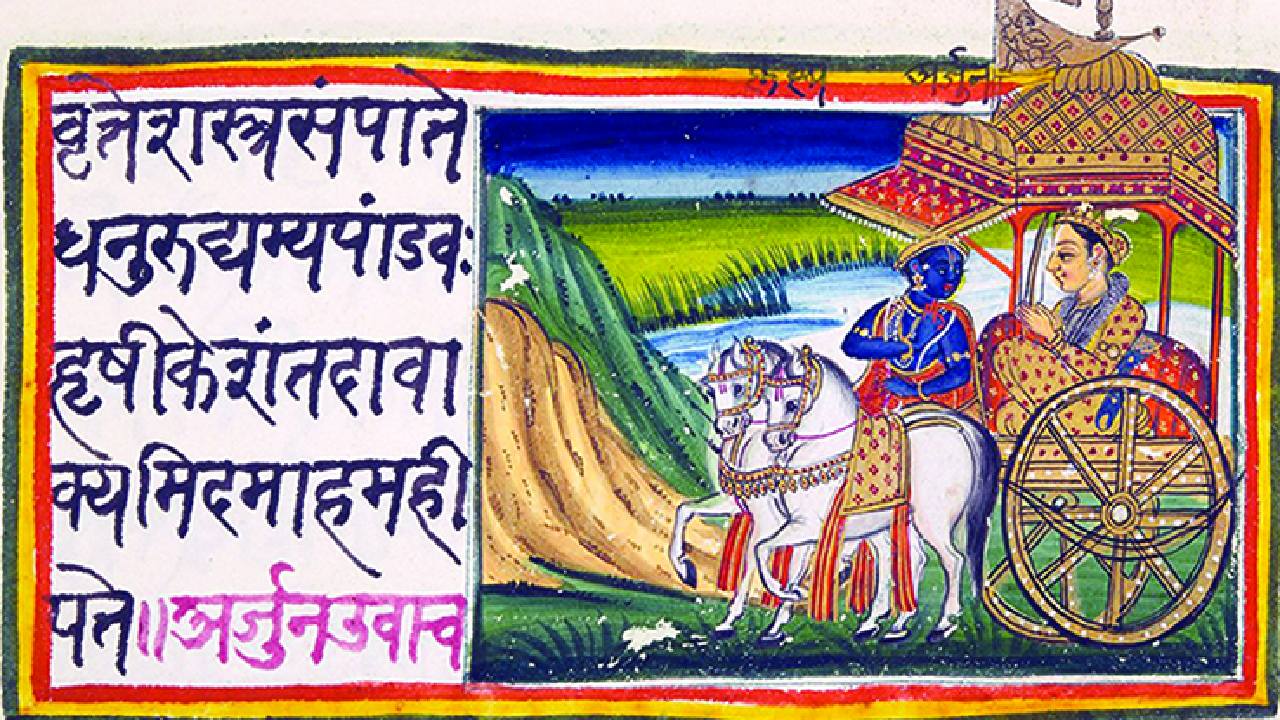
Sanskrit means ‘perfectly made’. It is a language of extraordinary precision. Sanskrit is one of the oldest recorded languages. It developed a most comprehensive linguistic system very early in history so that it could easily be committed to memory. The earliest writings in Sanskrit, the Rig Vedic hymns, are in the form of poetry.
Before the development of script, India relied on oral transmission to preserve and disseminate knowledge, including scriptures and philosophical teachings. The Vedas, Brahmanas, Aranyakas, Upanishads and early Puranas were passed on orally from teacher to disciple, the ‘Guru-Shishya parampara’, over generations. This knowledge was considered Shruti, that which is heard, emphasising its oral origins. The oral transmission of knowledge in Sanskrit was a highly disciplined and precise process. The emphasis was not only on memorisation, but also on accurate pronunciation and intonation. Even after the introduction of scripts, the oral tradition of learning and reciting Sanskrit texts continued to be an integral part of the Indian educational system.
The Sanskrit texts were set into two categories: Shruti and Smriti. Shruti literally meant “heard” or “revealed”. The authority of these texts was of the highest order. They were considered eternal and unchangeable. The most important and foundational Shruti texts are the Vedas. Smriti, on the other hand, meant “remembered”. These texts were human compositions. Unlike Shruti, Smriti texts were regarded as secondary to the Vedas in terms of authority. The Smriti texts include the Epics, the Puranas, Dharmashastras and other scriptures dealing with customs, moral codes et al. Smriti literature also provides practical guidelines and interpretations of the principles found in the Shruti texts. As has been said, one of the oldest and most important Shruti scriptures, the Rig Veda, is a collection of hymns dedicated to deities and natural forces. It was composed not less than four thousand years ago. It is in Sanskrit. The hymns are highly poetic and profound. The importance of both the Shruti and the Smriti texts is historical and cultural. They have played a crucial role in shaping the Indian ethos.
The Vedas have survived over millennia. The reason for it is the language of it. Vedic Sanskrit was far simpler than Classical Sanskrit. The use of phonetic patterns, metre and rhythm made memorisation and recitation easier. The use of metrical verses made them more rhythmic and melodious, aiding memorisation. The Vedic tradition included a detailed study of phonetics, which helped in preserving the correct pronunciation and accentuation of the Vedic texts. The fact that these texts were highly revered also helped them remain relevant.
Panini, the famous grammarian, created, in about 40 pages, the most complete linguistic system in history. His masterwork, ‘Ashtadhyayi’ (eight chapters), made Sanskrit the lingua franca of the Asian continent for more than a thousand years. His work was one of the most astonishing intellectual achievements of the human mind. Panini lived around the 5th-4th century BCE in a town near Taxila. Ashtadhyayi is quite clearly the work of a single individual, fascinated with reconstructing things to understand how they worked. What Panini took apart and reconstructed, as per the rules he created, was Sanskrit, the language of the Vedas. The sacred hymns and the language itself were analysed by him. It was nothing less than grasping the nature of the cosmos. Just as in yoga, wherein we are mindful of our breath, so was the case with Panini, who became mindful of what we spoke.
What made Sanskrit perfect? Why was it a language of extraordinary precision? In English, the noun can usually be understood from the context. But in Sanskrit, eight different suffixes are used to embed meanings into the forms of words. From a single Sanskrit noun in isolation, one can tell its syntactical function. The features of Sanskrit are an expression of subtlety. Panini set out to capture in exacting detail how Sanskrit worked. To do this, he needed a meta-language. His meta-language had to be concise, to be committed to memory, and to be passed on orally. The Sutras that Panini created describe Sanskrit’s chronology, morphology and syntax. The word used to describe Panini’s work is “Vyakaran”. Vyakaran is seen as the paradigm for other major themes of enquiry in ancient India, such as astronomy and philosophy. The derivational qualities of Panini’s grammar can be compared to the deductive principles of Euclid’s geometry.
Sanskrit gradually took wing. It became a language in which great works were composed. As it spread in the centuries after Panini, Sanskrit helped give India a cultural and social position that no political entity would be able to establish. It made India an exporter of cultural capital. From the start of the Common Era, and for well over a millennium thereafter, Sanskrit bound together a huge civilisational territory, continental in scale. At its peak, a quarter of the world’s population lived within it. Sanskrit became the sign across this vast space of a particular style of polity, civility and beauty, from Afghanistan to Java. It lasted for a thousand years because it was beautiful. It afforded participation in a big world where an Indian was not local. Living in India, one could be quoted in Cambodia. Cambodian princes wrote a Sanskrit no different from the poets in Tamil Nadu and Gujarat. Panini’s ‘Vyakaran’ played a role in securing that coherent intelligibility, setting standards to which the later users of Classical Sanskrit strove to adhere. It was not that Panini and his system froze Sanskrit. Despite the normative influence that Ashtadhyayi exerted, Sanskrit continued to evolve, just as it had in Panini’s days.
From its origins as a language of power, it became the language in which people sought to disrupt power, and to explore the literary imagination. Unlike other global languages like Latin, Arabic or English, Sanskrit spread not through conquest or colonisation, but because it served a purpose. Sanskrit was the language of science. Most Sanskrit texts in science and other subjects were in poetic form, aiding easy memorisation. It is a pity, though, that few scholars of Kharoshthi, Brahmi and Grantham script exist who can translate our rich Sanskritik heritage for a lay reader. It is also a tragedy that India remains largely unaware of the treasure trove of civilisational knowledge these ancient Sanskrit manuscripts contain. There is a dire need to identify institutions reputed for their large and priceless collections of Sanskrit manuscripts. Priority needs to be accorded to preserving, conserving and restoring them on a large scale with set timelines.
Creating human resources familiar with old Sanskrit scripts is equally the need of the hour. Interpreting this heritage is as important as energising our efforts at archaeological exploration, for who knows what more we may discover while delving into the Sanskritik treasure trove.
The writer is an Advisor, Bharat Ki Soch Foundation; views are personal
Corrigendum
This is to inform one and all that the article “Sanskrit: The language that shaped a civilization” (https://dailypioneer.com/news/sanskrit-the-language-that-shaped-a-civilisation) has been reprinted by mistake. The article first appeared on November 29, 2025 with the title “Bharitya Sanskriti and Sanskrit”. We regret the mistake.
Editorial team, The Pioneer