Safeguard citizens amidst rising global tensions: PM
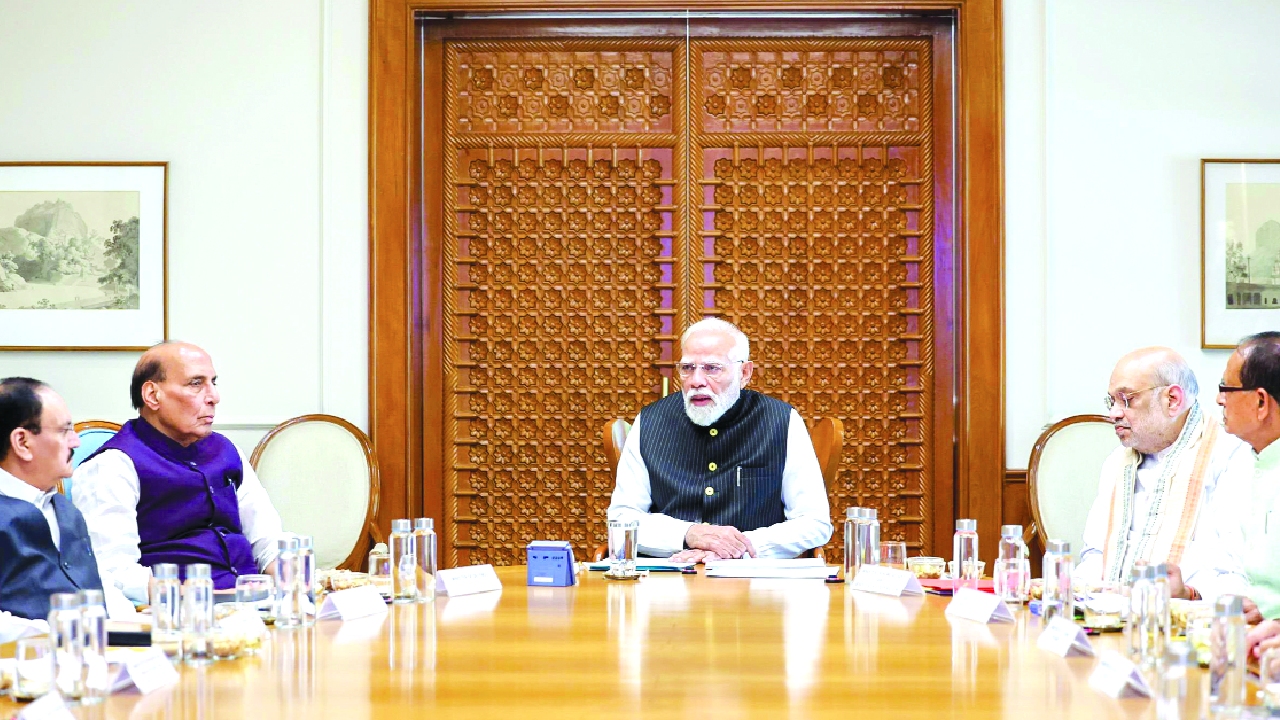
Prime Minister Narendra Modi on Sunday chaired a meeting of the Cabinet Committee on Security to review the situation and ongoing and proposed mitigating measures in the context of the ongoing West Asia Conflict.
Sources said PM Modi directed that a group of ministers and secretaries be created to work dedicatedly in a whole-of-Government approach. PM also instructed the sectoral groups to work in consultation with all stakeholders.
Defence Minister Rajnath Singh, Home Minister Amit Shah, Agriculture Minister Shivraj Singh Chouhan, External Affairs Minister S Jaishankar, Finance Minister Nirmala Sitharaman,
Health Minister JP Nadda, Commerce Minister Piyush Goyal and Railways and Information Broadcasting Minister Ashwini Vaishnaw were among those who attended the high-level meeting, sources said.
According to the sources, Prime Minister said that the conflict is an evolving situation and the entire world is affected in some form. In such a situation, all efforts must be made to safeguard the citizens from the impact of this conflict.
Prime Minister instructed that all arms of Government should work together to ensure the least inconvenience to the citizens. PM also asked for proper coordination with State Governments to ensure no black-marketing and hoarding of important commodities.
Sources said the Cabinet Secretary gave a detailed presentation on the global situation and the mitigating measures taken so far and being planned by all concerned Ministries/Departments of the Government of India.
A detailed assessment of availability for critical needs of the common man, including food, energy and fuel security, was made. Short-term, medium-term and long-term measures to ensure the continued availability of essential needs were discussed in detail. It was also discussed that the ongoing conflict in West Asia will have significant short, medium and long-term impact on the global economy and its effect on India was assessed, and counter-measures, both immediate and long-term, were discussed.
The expected impact and measures taken to address it across sectors like agriculture, fertilisers, food security, petroleum, and power, MSMEs, exporters, shipping, trade, finance, supply chains and all affected sectors were discussed. The overall macro-economic scenario in the country and further measures to be taken were also discussed.
The impact on farmers and their requirement for fertiliser for the Kharif season was assessed. The measures taken in the last few years to maintain adequate stocks of fertilisers will ensure timely availability and food security. Alternate sources of fertilisers were also discussed to ensure continued availability in the future.
It was also determined that an adequate supply of coal stocks at all power plants will ensure no shortage of electricity in India. Several measures were discussed to diversify sources of imports required by chemicals, pharmaceuticals, petrochemicals and other industrial sectors. Similarly, new export destinations to promote Indian goods will be developed in the near future.
Several measures proposed by different ministries will be prepared and implemented in the coming days after consultation with all stakeholders.
Union Ministers Sarbananda Sonowal (Ports and Shipping), Manohar Lal Khattar (Power), Pralhad Joshi (Food and Consumer Affairs), Kinjarapu Rammohan Naidu (Civil Aviation) and Hardeep Singh Puri (Petroleum), NSA Ajit Doval and the prime minister’s two principal secretaries, PK Mishra and Shaktikanta Das, were also present.
On March 12, PM Modi had said that the war in West Asia has triggered a worldwide energy crisis, posing a critical test of national character that requires dealing with circumstances through peace, patience and increased public awareness.
The prime minister has spoken to several global leaders since the West Asia conflict started on February 28, when the US and Israel attacked Iran. Iran has retaliated by targeting Israel and several of its Gulf neighbours.
Iran controls the Strait of Hormuz, a key shipping route through which 20 per cent of the world’s energy is transported. Since the conflict, very few ships have been allowed by Iran to cross it.
The blockade has resulted in severe disruptions in energy supply to many countries, including India. Since the conflict, Modi has had telephonic conversations with leaders from Saudi Arabia, UAE, Qatar, Bahrain, Kuwait, Jordan, France, Malaysia, Israel and Iran.
PM Modi’s 25-year Political journey
New Delhi: Prime Minister Narendra Modi achieved a historic milestone on Sunday in Indian politics by becoming the longest-serving head of an elected Government in the country. With this, Prime Minister Modi has surpassed Pawan Kumar Chamling, who held office as Chief Minister of Sikkim for 8,930 days. He has now completed 8,931 days as head of Government, combining his tenure as Chief Minister of Gujarat and as Prime Minister, thereby entering his 25th year in a leadership role.
He is also the first Prime Minister of India to have been born after Independence and has secured victory in three consecutive Lok Sabha elections in 2014, 2019 and 2024, a feat that underscores political longevity and sustained public mandate. He was sworn in as the 14th PM of India on May 26, 2014.