Ramlila Maidan once again: Does the Congress rally signal a political turn?
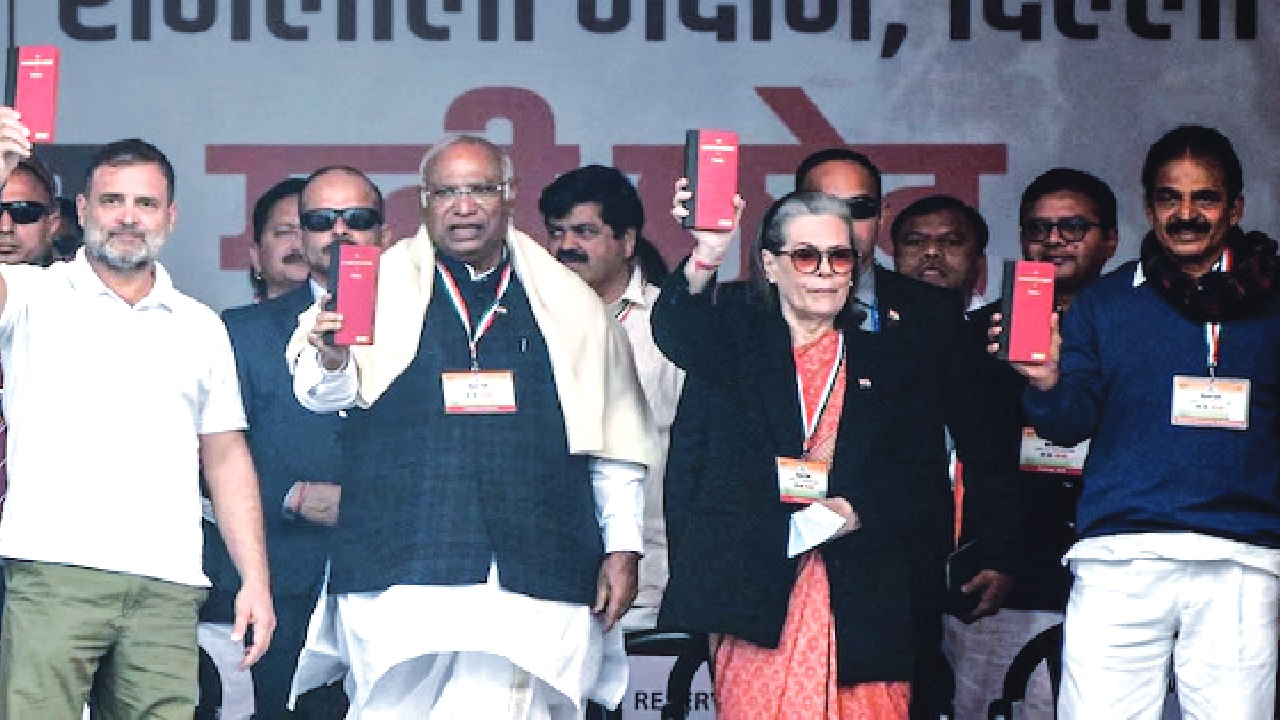
Delhi’s Ramlila Maidan might not be the biggest ground in India today, but it is a beacon of historic significance. It has been the venue of many historic political and social rallies over the last seven decades which, from time to time, have set the tone and tenor for future politics, at times leading to changes in political dispensations.
Should the Rahul Gandhi-spearheaded Congress’s ‘Vote Chor Gaddi Chhod Rally’, held on December 14, 2025, in the heart of Delhi and in the vicinity of the historic Lal Qila-the symbol of power-be viewed in this backdrop? Did it carry the trappings of redirecting political discourse in the country, currently dominated by a Narendra Modi-centric strategy focused on the ideological decimation of the Congress and a galaxy of its leaders?
Can this tumultuous event prove to be a turning point in shifting the nation’s focus to vote theft as the sole cause for the Congress-led Opposition camp’s successive electoral defeats? Where does the Congress go from here and after this?
No doubt, the rally, to the surprise of both Congress supporters and rivals, was a resounding success. It was well organised, with the venue brimming to capacity. The responsive crowd connected well and gave strong signals of emotive participation. Above all, a strong chord was visibly established between the leaders on the dais and the participants-something that has become a rarity in the Congress. This was reflected in the fact that despite jostling and overcrowding, hardly anyone was seen leaving the venue.
Why was there a surge of Congress workers from all corners of the country packing Ramlila Maidan, something not seen in the recent past? And that too after a crushing defeat in the Bihar Assembly elections.
There is little doubt that the Congress leadership sitting in the AICC strategised more effectively this time. Mobilising leaders and cadres from faction-ridden states and Union Territories was carried out in a matter-of-fact manner rather than being casual and ritualistic, as has been the case for quite some time. One strong factor behind this could be Mr Gandhi being the prime mover of the ‘Vote Chor Gaddi Chhod’ movement both inside and outside Parliament. Nonetheless, doubts continue to linger over the electoral efficacy of this drive, but it can certainly act as a revival device for the Congress by preparing its dormant and demoralised cadres for the fight ahead.
The atmosphere was undoubtedly electrifying, despite dejection on the faces of participants owing to the delayed arrival of Mr Gandhi. One reason they had come was to establish, even from a distance, a direct rapport with him and return home energised, despite most state and UT units of the party being faction-ridden, with the arbitrariness of handpicked PCC chiefs-egged on by AICC lobbies-hitting the organisation hard.
The fact that Mr Gandhi reportedly spent more time with Argentine football icon Lionel Messi while travelling to Hyderabad, and that he hurriedly wound up his presence at Ramlila Maidan to catch a flight to Germany, did rankle many participants. It is difficult to understand what prevented him and his strategists from planning his schedule better. Had he so desired, or been properly advised, nothing would have prevented Mr Gandhi from spending an hour or two with the capacity crowd at the rally. This would have doubled their joy and enthused them immensely.
All said and done, the rally-predominantly attended by party leaders and the rank and file, with hardly any public presence-did make an impact. It paved the way, by energising them, for leaders and workers to return to their respective states and UTs and re-establish the long-lost rapport with the public. It could act as a much-needed catalyst, provided there is proper follow-up. Whether such a follow-up plan is in place remains unknown.
The way forward from here is still extremely difficult, particularly on two counts:
n A weakened organisational set-up from the AICC to the PCCs, with little attempt at galvanisation.
n A formidable opponent in the BJP, which remains electorally battle-ready at all times and relentless in its endeavour to reinvent itself.
There is a total mismatch between these two realities, which has led to the continuous rise of the BJP and the corresponding decline of the Congress.
How does one carry forward the message of unity from Ramlila Maidan to the states and UTs? Will merely holding protests at PCC headquarters and conducting customary press conferences help achieve this goal?
Under the prevailing circumstances, and given the bleak future confronting it, the Congress has no option but to accept the challenge without further delay and prepare to capitalise on people’s growing disenchantment with the Narendra Modi government. The top leadership must shed lethargy, as was evident even in organising the Delhi rally, set its priorities in order, and act swiftly.
This is not to suggest that party programmes, protests, or demonstrations should not be held, but party managers must not lose sight of the urgent need to overhaul the organisational network. The goodwill generated by the Ramlila Maidan show can yield dividends only if a cohesive organisation exists to carry the message to the grassroots. Unfortunately, this has not been the case in many states. Even more unfortunate is the fact that the AICC leadership has consciously allowed this situation to fester due to a complete absence of accountability at any level.
A striking feature of the December 14 rally was the existence of a clear channel of communication from top to bottom. PCC chiefs were asked to close ranks and ensure the presence of all factions at the rally, which had a salutary effect. More often than not, as seen in the past, AICC in-charges of states and UTs either show little interest, act casually, or operate entirely under the influence of PCC presidents and their coteries, ignoring wider sections of the rank and file. This further inflames factionalism, with no attempts made to douse the flames. Frequently, as Mr Gandhi himself stated during one of his recent tours of Gujarat, this leads to allegations of BJP sleeper cells being active within PCCs.
Action must begin at the top, and none other than Mr Gandhi must not only be seen acting decisively, but also hitting hard wherever necessary. Despite his public pronouncement to this effect in Gujarat six months ago regarding BJP sleeper cells and the need to show certain individuals the door, no concrete action has yet been taken. This malaise continues to afflict many states and UTs.
The bottom line is that words must be followed by firm and matching action. The bane of the Congress’s problems lies in its failure to do so, thereby emboldening vested interests. Otherwise, even a successful ‘Vote Chor Gaddi Chhod’ rally risks becoming a one-off event. This danger looms large.
The writer is a political and national affairs analyst; views are personal