PM pitches new global parametres

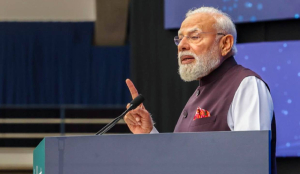
Prime Minister Narendra Modi on Saturday proposed a G20 initiative aimed at enhancing clean energy transitions by boosting recycling, easing supply chain pressures and advancing joint research on critical minerals, and suggested forging a partnership to make satellite data more accessible and interoperable.
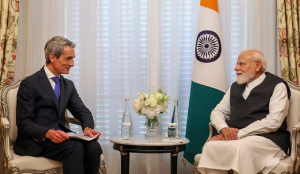
On the sidelines of the Summit, Modi met several world leaders, including his British counterpart Keir Starmer, French President Emmanuel Macron, South Korean President Lee Jae-myung, Brazilian President Lula da Silva and several other world leaders on the sidelines of the G20 Summit and discussed issues of bilateral and mutual interests.
PM Modi also met his Japanese counterpart Sanae Takaichi on the sidelines of the G20 Summit and discussed bilateral cooperation in areas like innovation, defence and talent mobility. It was the first meeting between PM Modi and Takaichi after she assumed the leadership of her country in October. Modi also held discussions with South African President Cyril Ramaphosa on cooperation in various areas, including trade, investment, mining, critical minerals, AI and food security.
The G20 Open Satellite Data Partnership proposed by PM Modi during the second session at the G20 Summit in Johannesburg suggests that satellite data of G20 space agencies would be made available to developing countries for agriculture, fisheries, and disaster management, among other activities.
In his address, Prime Minister Modi emphasised that natural disasters continue to pose a significant challenge to humanity, and this year, too, they have affected a substantial portion of the world’s population.
Modi told a gathering of world leaders that “resilience cannot be built in silos” and pitched for greater collaboration among the members of the influential grouping. “The G20 should promote such comprehensive strategies which, by linking nutrition, public health, sustainable agriculture, and disaster preparedness, can build a stronger global security system,” he said.
G20 members comprise the world’s major economies, representing 85 per cent of global GDP, 75 per cent of international trade, and two-thirds of the world’s population, according to the G20’s official website. It comprises Argentina, Australia, Brazil, Canada, China, France, Germany, India, Indonesia, Italy, Japan, the Republic of Korea, Mexico, Russia, Saudi Arabia, South Africa, Turkiye, the UK, the US, the European Union, and the African Union.
South Africa is hosting the Summit this year, the first time a G20 Summit is held on the African continent. This is the fourth consecutive summit of the grouping to be held in the Global South. Before South Africa, the G20 presidencies were held by Brazil (2024), India (2023) and Indonesia (2022).
In his address, Modi underlined that the approach to disaster resilience should be beyond “response-centric”, rather it should be “development-centric”, and said this was India’s vision behind setting up the Coalition for Disaster Resilient Infrastructure (CDRI). A declaration adopted at the G20 Leaders’ Summit here underlined that solidarity, equality and sustainability are key pillars of inclusive growth.
Modi said during the New Delhi G20 Summit, “We had resolved that by 2030 we will triple the renewable energy and double the energy efficiency rate”.
PM Modi said that this vision has been integrated into India’s technology ecosystem, and the same has resulted in significant benefits, be it in space applications, AI or digital payments, where it is a world leader. He was addressing the third session of the G20 Summit on the topic - “A Fair and Just Future for All - Critical Minerals; Decent Work; Artificial Intelligence.”
“We must all ensure that AI is used for global good and its misuse is prevented. To do this, we must create a global compact on AI based on certain core principles, including effective human oversight, safety-by-design, transparency, and strict restrictions on the use of AI in deep fakes, crime, and terror activities,” Modi said.
The prime minister also had a “wonderful meeting” with Korean leader Lee Jae-myung, which was their second meeting this year. Modi said the meeting was “indicative of the strong momentum in our Special Strategic Partnership.