Navika Sagar Parikrama: A voyage of women empowerment and maritime diplomacy
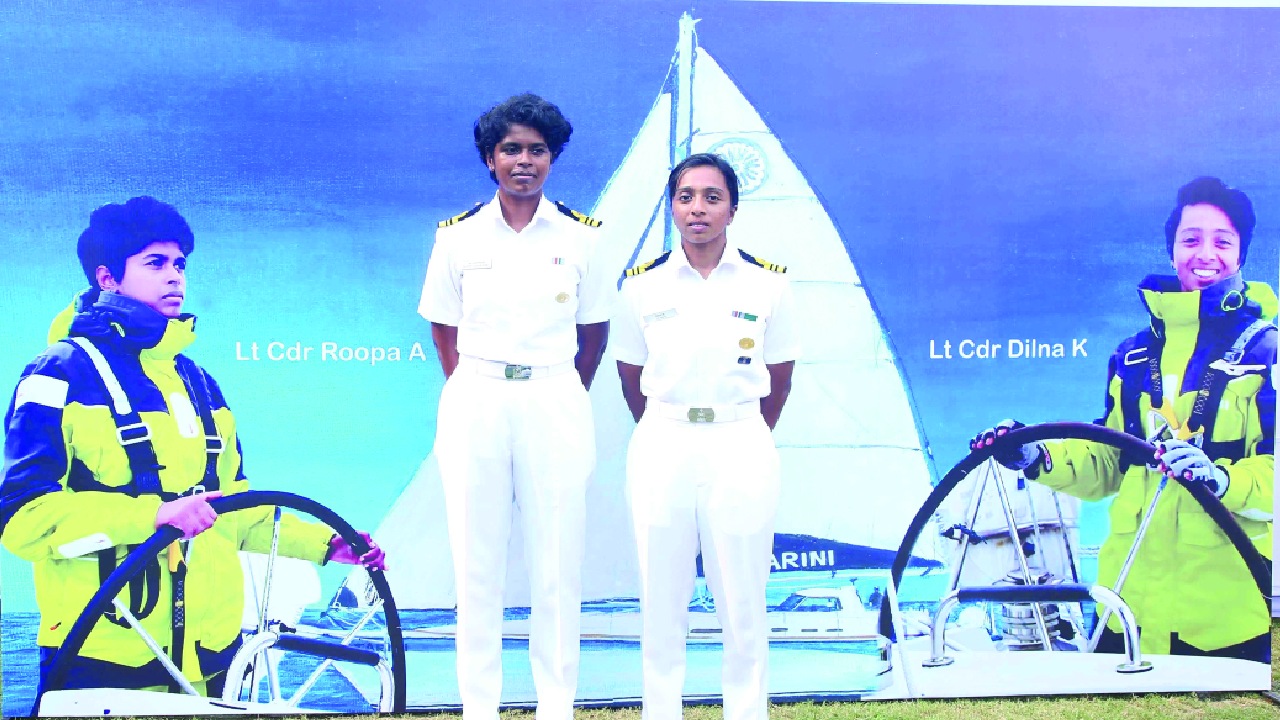
On October 2, 2024, the Indian Navy launched a mission that quietly yet powerfully redefined the intersection of adventure, national resolve, and diplomacy. Under the banner of Navika Sagar Parikrama II (NSP II), Lieutenant Commander Dilna K and Lieutenant Commander Roopa A set sail on a historic circumnavigation of the globe — an expedition that would span eight demanding months, cover more than 25,500 nautical miles, and conclude with their return to India on 29 May 2025.
Along the way, they made strategic port calls at Fremantle in Australia, Lyttelton in New Zealand, Port Stanley in the Falkland Islands, and Cape Town in South Africa. This remarkable voyage was far more than a test of seamanship and endurance. It was a visible assertion of India’s evolving naval ethos — one that places women firmly at the centre of operational excellence — and a sophisticated exercise in maritime diplomacy. Through a single sailing vessel and a two-officer crew, the Indian Navy projected confidence, capability, and commitment to global engagement.
Navika Sagar Parikrama is a mission steeped in symbolism. “Navika” signifies a woman sailor, while “Sagar Parikrama” means a complete oceanic circumnavigation. The first such all-women mission in 2017–18 aboard INSV Tarini marked a watershed moment for the Indian Navy. NSP II built upon that legacy but raised the bar further. With only two officers at the helm, the 2024–25 edition demanded heightened levels of physical stamina, mental resilience, and professional mastery. Departing from Goa aboard INSV Tarini, Lt Cdr Dilna and Lt Cdr Roopa embarked on a journey that tested human limits as much as nautical skill. They encountered volatile weather systems, towering waves, mechanical challenges, and the psychological strain of prolonged isolation.
The route included crossing the equator twice, sailing through Point Nemo — the most remote location on Earth — and rounding three legendary capes: Cape Leeuwin, Cape Horn, and the Cape of Good Hope. These waters, notorious in maritime history for their ferocity, demanded precision, patience, and constant vigilance. At its heart, Navika Sagar Parikrama II stands as a powerful marker of women’s rising role within India’s armed forces. The success of this mission dispels any lingering doubts about women’s ability to operate independently in high-risk, high-responsibility environments. It reinforces a simple but transformative truth: competence, leadership, and decision-making are not defined by gender.
Both officers are seasoned naval professionals trained extensively in navigation, meteorology, marine engineering, damage control, and survival at sea. Their selection reflected not symbolism, but institutional confidence in their operational capability. In doing so, the Navy aligned itself with broader national aspirations of gender equity — translating policy intent into visible action on the world’s oceans.
The impact of their achievement extends well beyond the naval community. For young women across India, especially those contemplating careers in uniformed services or maritime professions, this mission offers a compelling example of what is possible. By succeeding in one of the most demanding nautical challenges, Dilna and Roopa dismantled stereotypes in a domain where endurance, intellect, and adaptability matter far more than physical distinctions.
Equally significant were the mission’s carefully chosen port calls, each serving as a node of diplomatic engagement. In Fremantle, a major maritime hub in Australia, the officers interacted with members of the Indian diaspora, local leaders, and naval counterparts. Invitations from the Western Australia Parliament, HMAS Stirling, Fremantle Sailing Club, and Ocean Reef Senior High School reflected the warmth and strategic depth of India–Australia maritime ties.
In Lyttelton, New Zealand, the engagement took on an academic and people-centric dimension. The officers interacted with diplomats, university communities, students, and scholars, underlining India’s commitment to outreach in the South Pacific and its emphasis on education, research, and shared maritime interests.
The stop at Port Stanley in the Falkland Islands was perhaps the most distinctive leg of the journey. Hosted by the local administration, the officers visited the Falkland Islands Legislative Assembly and met the Deputy Governor, government representatives, and Royal Navy officials. These interactions reinforced India’s support for peaceful maritime cooperation and scientific exchange, even in geographically remote and strategically sensitive regions.
Cape Town marked the final international halt — a city whose maritime heritage resonates strongly with India’s historical and contemporary links to Africa.
For a nation with an extensive coastline and expanding blue-water ambitions, maritime diplomacy is an indispensable tool of foreign policy. NSP II exemplified how naval presence can be exercised without coercion — through dialogue, cultural exchange, and goodwill. At every port, India demonstrated respect for international maritime norms, freedom of navigation, and collaborative ocean governance.
The mission also strengthened bonds with Indian diaspora communities, whose engagement added an emotional dimension to the voyage. These interactions reinforced national identity abroad and amplified India’s soft-power narrative through lived experience rather than formal diplomacy.
Environmental stewardship formed another quiet but crucial pillar of the mission. Throughout the circumnavigation, the officers documented marine biodiversity, monitored plastic pollution, and collected water samples from diverse oceanic regions. These samples are now part of research initiatives at the National Institute of Oceanography, contributing to a deeper understanding of ocean health and climate dynamics. By traversing ecologically fragile zones such as the Southern Ocean and South Atlantic, the mission underscored the inseparable link between maritime security and environmental security. In their public interactions, the officers consistently highlighted the urgency of protecting marine ecosystems — a message increasingly central to global maritime discourse.
INSV Tarini’s return to India on 29 May 2025 was marked by a ceremonial welcome attended by the Hon’ble Defence Minister, the Chief of the Naval Staff, and senior officials. The occasion formally acknowledged not only the completion of an extraordinary voyage, but also the professionalism, discipline, and leadership displayed throughout the mission. Navika Sagar Parikrama II stands today as more than an endurance sail. It reflects a confident, forward-looking India — one that is inclusive in its institutions, assured in its maritime reach, and responsible in its global conduct.
Through courage, competence, and quiet determination, Lt Cdr Dilna K and Lt Cdr Roopa A did more than circle the globe. They expanded horizons, redefined possibilities, and charted a course for future generations of Indian women — and for India’s maritime vision itself.
Commander (Dr) Kalesh Mohanan is Officer-in-Charge of Naval History Division of the Indian Navy. He has done PhD and Postdoctoral research in naval history; views are personal