Marvels of India - Cotton: Bharat’s Gift to the World
World’s Oldest Cotton
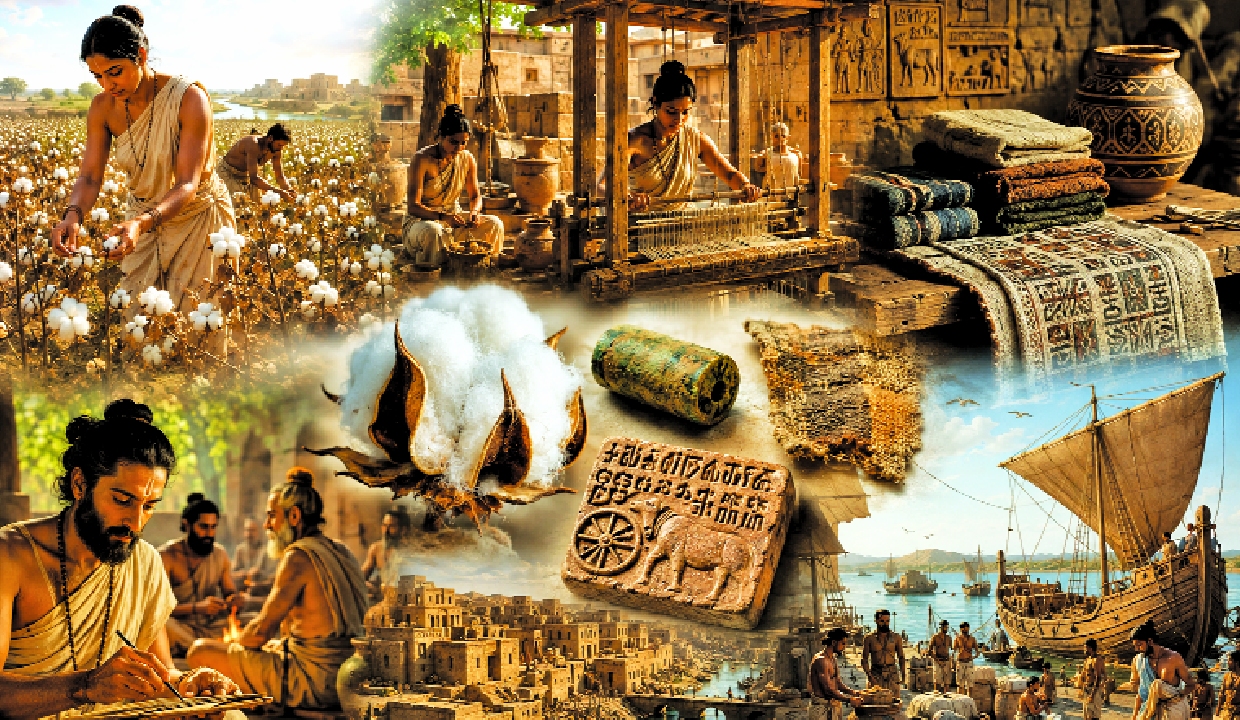
Cotton features significantly in Bharat’s agricultural legacy. Metallurgical analysis of a copper bead recovered from a Neolithic burial in the Indian subcontinent revealed mineralised threads identified as cotton, making these fibres the earliest known example of cotton. This was confirmed by a research paper in the Journal of Archaeological Science (2002).
A Native Species, A Civilisational Crop
The species cultivated in the Sindhu-Saraswati Valley - Gossypium arboretum - is indigenous to the Indian subcontinent and distinct from the cotton introduced by Europeans in the 16th century. Sites such as Mohenjo-daro, Harappa, Lothal and Dholavira have all yielded indirect evidence of textile impressions, dye residues etc., testifying to a sophisticated, organised textile economy.
Cotton, Trade and Food Security
Cotton’s role extended beyond clothing. As Sven Beckert notes in his book titled “Empire of Cotton: A Global History” (2015), Harappan farmers were the first to spin and weave cotton and the Vedas also mentioned cotton spinning and weaving. The Harappans sailed the Arabian Sea and the Persian Gulf, trading animal hides, gems and fabrics. Cotton was central to this commerce, generating surpluses that ensured food security.
Bharat’s Civilisational Signature
Herodotus, the ancient Greek historian, described Indian cotton as “exceeding in beauty and goodness”. Across millennia, cotton is not merely a crop; it is Bharat’s civilisational signature.