India’s Ancient Wisdom of Mixed-Crops and Inter-Crops Farming
May the farmers be happy, healthy, and wealthy. — Parashara
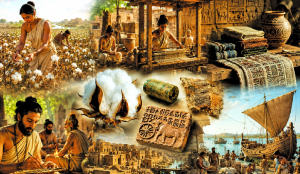
For over 5000 years, before the advent of synthetic fertilisers or corporate seed patents, Indian agricultural knowledge systems had already cracked the code of sustainable farming. The ancient art of mixed cropping and intercropping practiced across the subcontinent for millennia is not merely a farming technique. They represent a practical philosophy of resilience expressed through plants. Emerging evidences from archaeology and agronomy shows clearly that our ancestors understood diversity as the path to survival.
Today, climate change is intensifying. Groundwater is depleting. Monocultures are failing. The answers to our 21st-century agricultural challenges may lie at the meeting point of ancient wisdom and modern science.
The Archaeological Record
The Indus Valley Civilization (c. 2600-1900 BC) did not rely on a monocropping. Ground-breaking archaeobotanical research published in the Journal of World Prehistory (2017) has revealed that Indus farmers practiced “multi-cropping” systems, often pairing deep-rooted pulses with shallow-rooted cereals in the same field. At the site of Rojdi in Gujarat, communities relied on millet-based systems that could fluidly shift between monocropping, intercropping and maslin (mixed seed) cultivation depending on seasonal conditions.
The most striking evidence comes from Khirsara, also in Gujarat. A detailed study of macro-botanical remains and soil organic matter isotopes showed a dramatic agricultural transformation around 4200 years ago, when an abrupt arid event gripped the region. Facing severe climatic stress, the inhabitants deliberately shifted from a 90% barley-based monoculture to a diverse system dominated by drought-resistant millets alongside sorghum and rice. This was not passive adaptation. It was intentional and strategic crop-switching, an ancient form of risk management. The site survived the climatic crisis and continued for generations.
At the site of Binjor in northwestern India, direct dating of food grains published in Radiocarbon (2020) documents the advent of summer monsoon crops around 2600-2500 BC, reflecting a calculated response to changing rainfall patterns. As a synthesis published by Cambridge University Press in Antiquity (2023) concludes, Indus agricultural strategies were regionally diverse, context-sensitive and driven by conscious farmer choice.
Pan-Indian Traditions and Practices
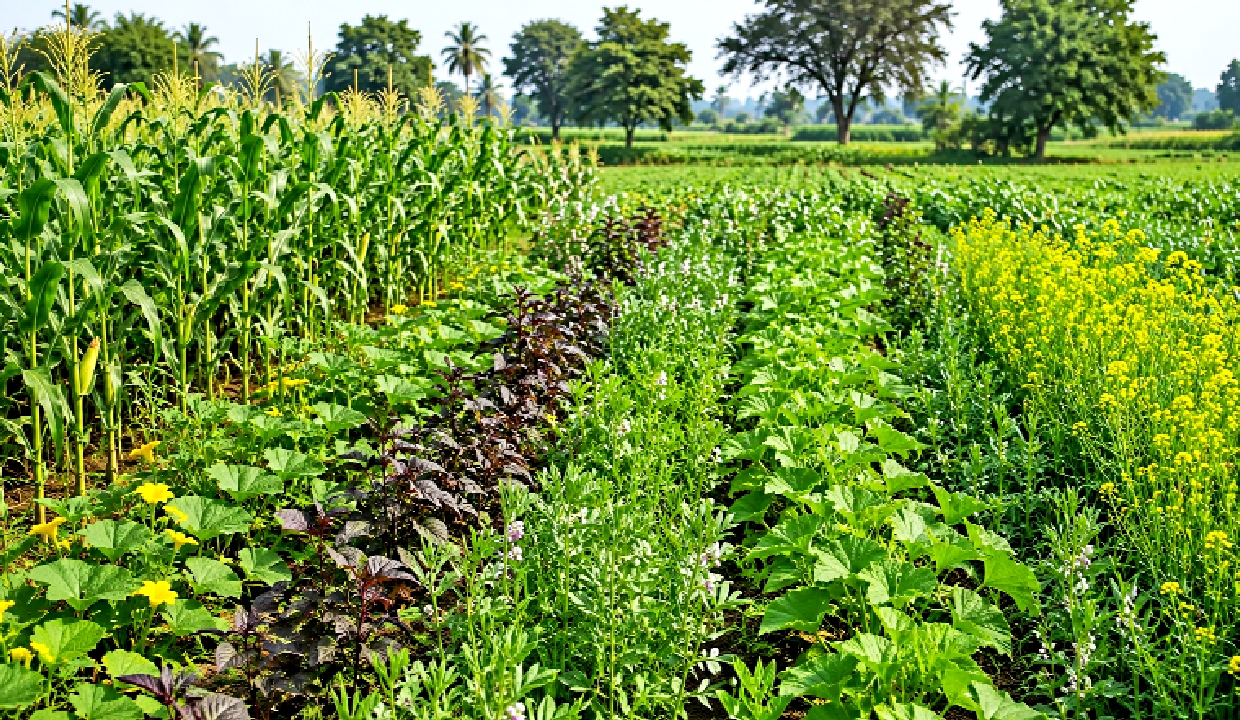
The wisdom of intercropping lived in the soil of every ecological zone. In the misty hills of Nagaland, the Chakhesang tribe perfected the Ruza farming system (often documented as Zabo). A 2024 study in the Indian Journal of Traditional Knowledge describes this as an integrated system where water-harvesting ponds, terraced rice fields, fish, livestock and mixed crops function as a single living organism. On the semi-arid Deccan plateau, farmers paired deep-rooted pigeon pea with shallow-rooted millets, so plants drew nutrients from different soil layers without competing. In Odisha and Madhya Pradesh, local communities sowed a dozen different tubers, cereals and legumes together in a single clearing. In Kerala and Bengal, coconut groves hosted black pepper vines, yams and vegetables. This was sophisticated risk management not primitive agriculture.
There are two distinct cropping methods documented across India. First, mixed cropping or broadcasting, in rainfed areas like Rajasthan and the Deccan Plateau, farmers mixed seeds of before sowing, the goal was survival. If rainfall was scarce at least one crop would endure. This was the farmers insurance policy. Second, spatial intercropping, farmers arranged plants in specific row or strip patterns to manage sunlight, water and root depth. In Kashmir farmers intercropped fruit trees with saffron and vegetables. Traditional farmers across India also recognised symbiotic relationships without understanding the chemistry. Pairing legumes with cereals kept the soil fertile. Marigold or certain herbs planted alongside vegetables repelled pests. These were empirical discoveries tested over centuries.
The Moringa tree grew naturally on farm edges for generations as one remarkable example of this wisdom. Dravidians cultivated it in every home yard. The Ain-i-Akbari, written 400 years ago, listed it as a commercial oilseed crop. India once exported Moringa oil to the West for perfumes and cosmetics. Research published in Acta Horticulturae (2021) confirms the oil remains stable for up to twelve months. Every part of the tree found use: tender pods turned into achar and chutni, leaves cooked as sabji and seeds prepared as medicine. Ayurveda values Moringa (Shigru) for diabetes, asthma and cardiac disorders. We cut these trees in the name of modernisation. Their loss is not just a plant but a practical logic.
Lessons for a Climate-Uncertain Century
Contemporary agronomy is rediscovering what traditional farmers always knew. study in the Indian Journal of Agronomy (2024) found that barnyard millet intercropped with green gram produced 25% more food per unit of land than either crop alone. Cotton intercropping in Gujarat has reported gains as high as 44%. These are not marginal gains. They are transformative.
The mechanism is simple. Diverse plant communities use light, water and soil nutrients more completely than single species. Legumes fix nitrogen for neighbouring cereals. Deep roots access minerals shallow roots cannot. Pest cycles are disrupted because the host plant is never alone. A mixed field never fails entirely. If one crop wilts, another stands.
India must feed over 1.4 billion people under unpredictable monsoons and rising temperatures. The industrial model of monocultures has proven brittle. When a pest or dry spell strikes a monoculture, the entire harvest vanishes. When it strikes a mixed field, something survives. The lesson from Khirsara 4,200 years ago is the lesson for tomorrow: diversify or perish.
This is not a call to abandon modern agriculture but to integrate it. Science and tradition are co-authors of the same solution. The Indian Council of Agricultural Research and the Rain Forest Research Institute now recognise traditional farming systems as a priority for climate-resilient agriculture. The need of the hour is simple.
We must relearn indigenous intercropping and mixed cropping.
Meenakshi Lekhi, Former Minister of State for External Affairs, Govt. of India; Views presented are personal.
Dr SOPHIA LISAM, Senior Research Fellow, Bharat Ki Soch; Views presented are personal.
Leave a Comment
Comments (1)
Khirsara - the rice was drought-resistant too?