Loyalty Over Legacy
Indian politics has traditionally rewarded visibility. The assumption has long been that leadership must first be seen, heard, and repeatedly validated in public before it can be trusted with authority. Yet one of the more intriguing features of the Bharatiya Janata Party’s evolution over the past decade is how often it has chosen to invert this logic. Time and again, responsibility has preceded recognition, and authority has been conferred on individuals whose prominence was largely internal rather than public.
This is not a recent improvisation, nor is it merely symbolic. It reflects a deeper organisational temperament, one that treats leadership not as a spectacle but as a function of long preparation. Within the BJP, elections are moments when leadership is revealed, not moments when it is invented. The party’s confidence lies less in personalities and more in the institutional processes that produce them.
This instinct is visible across different layers of power. At the constitutional level, the selection of individuals for high offices has often followed an understated rhythm. These appointees did not emerge from the churn of media politics. They were shaped by years of public service and administrative engagement and were entrusted with positions where temperament and restraint matter more than projection. Their elevation conveyed an implicit belief that the dignity of the institution can, and should, lend stature to the individual not the other way around.
The same organisational confidence has increasingly defined executive leadership as well. When the BJP returned to power in key states after a long interval, the choice of leadership surprised many observers precisely because it did not align with the usual calculus of visibility. In several instances, the party prioritised organisational grounding and internal credibility over public flamboyance. In each case, it appeared comfortable backing leaders whose journeys were marked by sustained work within the system rather than by headline dominance.
What looks sudden from the outside rarely is so from within. These leaders were not unknown to the organisation; they were simply unknown to the popular media. Years of coordinating cadres, managing party responsibilities, and working within disciplined hierarchies had already tested them. Their elevation did not signal a break from the party’s culture but an affirmation of it.
This culture is perhaps most clearly visible in how the BJP treats internal advancement. Positions of authority are rarely personalised or inherited. They rotate, sometimes unexpectedly, reinforcing the idea that no role is permanent and no individual indispensable. The recent appointment of younger leaders to senior organisational roles fits seamlessly into this pattern. It reflects the party’s willingness to trust organisational experience over external familiarity and signals confidence in its internal mechanisms of renewal.
Such decisions make sense only within a system that values institutional memory. Over time, the party has built an internal ecosystem that emphasises discipline, collective purpose, and a commitment to long-term preparation. It normalises the idea that recognition may come late, and that work done without applause is still work that counts. This sensibility has gradually seeped into the organisation’s DNA. The result is a leadership pipeline rooted in apprenticeship rather than inheritance.
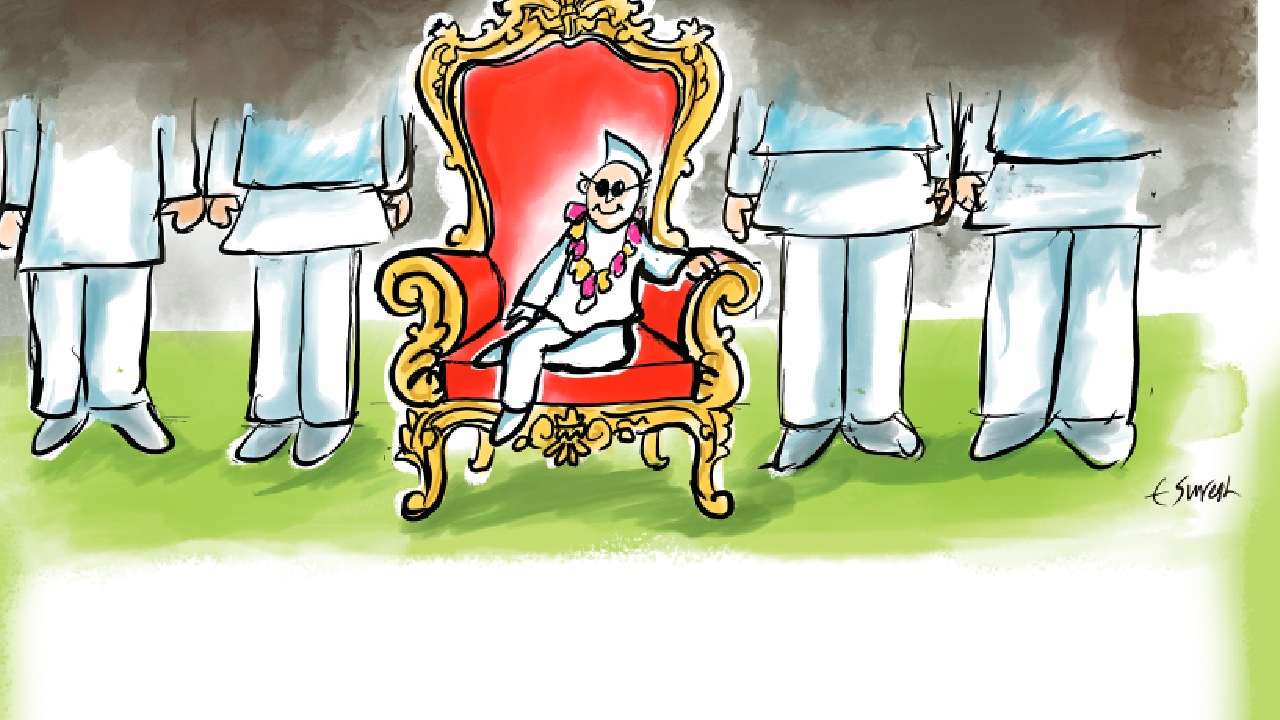
This stands in stark contrast to much of the rest of India’s political landscape, where dynastic continuities still define power. Across parties, leadership often circulates within families, with surnames functioning as political credentials. The Congress’s command structure remains bound to the Nehru-Gandhi lineage, while regional parties like the Samajwadi Party, RJD, DMK, TRS (now BRS), and Shiv Sena have internal hierarchies that resemble family-owned enterprises rather than open political systems. Entry and advancement are determined less by institutional merit than by lineage and proximity to power. This model, while electorally viable in certain regions, breeds dependence on legacy and personal networks. It weakens intra-party deliberation and discourages a new generation of leaders from emerging through experience and competence. In contrast, the BJP’s relative insulation from hereditary politics has enabled it to draw legitimacy from organisational equity-a sense that leadership is earned rather than claimed.
Observers of contemporary Indian politics often note that the BJP’s success cannot be explained by electoral strategy alone. It rests equally on deeper organisational system where leadership is not a reward for visibility but a responsibility entrusted after prolonged observation. Authority here is viewed as functional, not ornamental.
This approach has important consequences for governance. Leaders shaped by organisational systems tend to approach power with a custodial mindset. They are accustomed to working within constraints, coordinating across levels, and subordinating personal preference to collective decision-making. Authority is exercised less as personal capital and more as delegated trust. While this does not guarantee flawless governance, it does anchor leadership in process rather than impulse. It also reduces the volatility associated with personality-driven politics, allowing for continuity and calibration even during transitions.
Such a model also subtly reshapes how representation functions. When leadership emerges from structured organisational pathways, diversity becomes an outcome rather than a declaration. Individuals from different social and regional backgrounds rise through the same demanding processes, making their presence in high office appear normal rather than exceptional. The elevation of leaders from Scheduled Castes, tribal communities, and backward regions is seen less as symbolic inclusion and more as an organic reflection of the party’s social depth. This quiet normalisation avoids the pitfalls of tokenism and lends legitimacy to authority.
Critics sometimes describe this model as overly centralised. There is some truth in that observation. Decision-making power is indeed concentrated, especially at the national level. But centralisation here serves coordination rather than arbitrariness. It binds a large and diverse organisation together, ensuring that leadership transitions do not become moments of rupture. Succession, instead of being destabilising, becomes routine. This is institutionalisation at work-the transformation of what could have been personality-based politics into a disciplined, process-bound system.
In an age driven by immediacy, social media metrics, and constant performance, this long-view politics stands out. It resists the temptation to equate leadership with noise. Instead, it builds continuity through discipline and renewal through trust. A party that invests in patient cultivation rather than spectacle inevitably produces leaders whose authority is quieter but more stable.
Whether one agrees with the BJP’s ideology or not, this organisational ethic is difficult to ignore. Its consistent willingness to elevate workers who were once largely invisible reflects a belief in institutions over individuals, systems over personalities, and preparation over projection. At a time when Indian politics is still crowded with dynasties and theatrical visibility, that belief has become quietly consequential and perhaps, its most enduring contribution to the political culture of modern India.