India-Vietnam reaffirm a strategic convergence
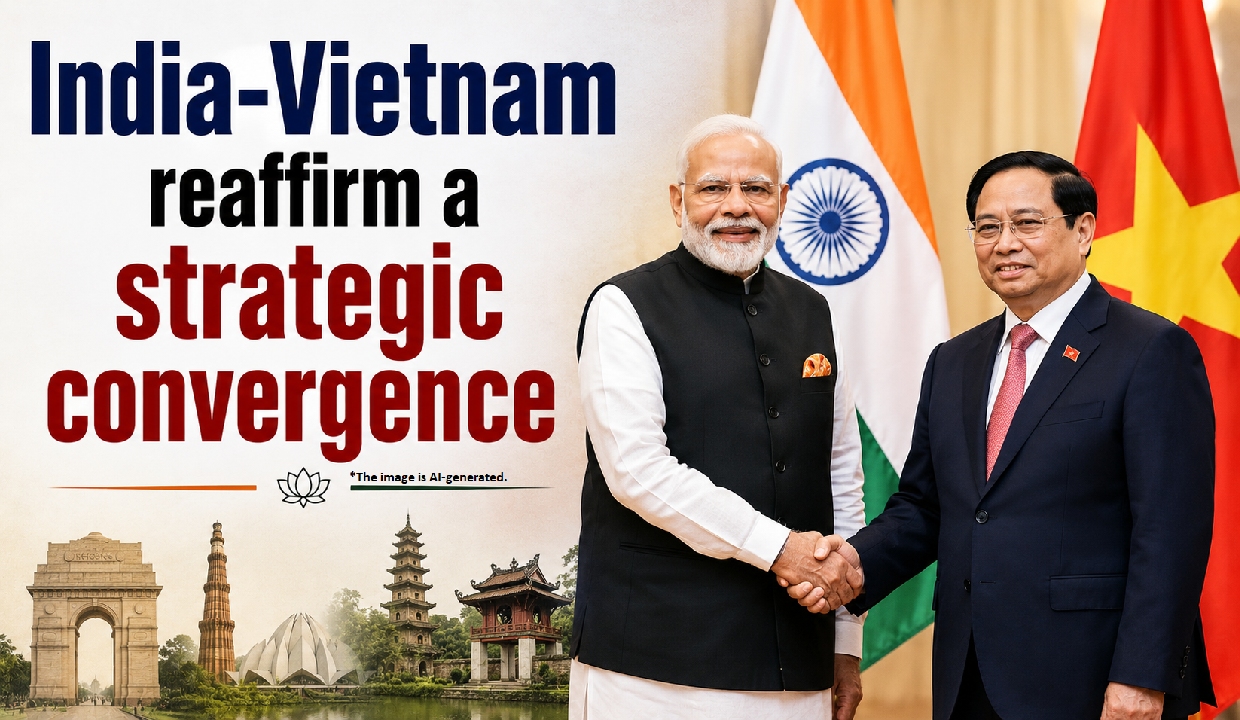
As India seeks a greater role in Southeast Asia and Vietnam looks to diversify its strategic partnerships, the convergence of interests is unmistakable
Lately, India has started focusing on Southeast Asia, the region traditionally dominated by China. The region has seen rapid strides in economic development, but many countries here are vulnerable to external pressures and succumb to the power play in the region, as development in the region has not been uniform. Since 1991, India has engaged with Southeast Asian nations under the ‘Look East Policy,’ which was given a fillip by Prime Minister Narendra Modi, who upgraded it to the Act East Policy in 2014. It now encompasses strategic and economic shifts aimed at deepening India’s engagement with Southeast Asia and the broader Indo-Pacific region through trade, connectivity, defence cooperation, and cultural ties. This has indeed increased Indian influence in the region and provided a counterweight to China’s influence, which treats this region as its backyard.
In this framework, Vietnam occupies a pivotal position as one of India’s most trusted partners in the region. Over the years, India and Vietnam have expanded cooperation in defence, energy, digital connectivity, and trade, while also strengthening people-to-people and civilisational links rooted in Buddhism and historical exchanges.
Vietnam and India have cooperated for a long time and have a convergence of interests and strategic outlooks - their goals align in keeping the South China Sea open for navigation and ensuring maritime security. Vietnam is officially recognised by the India as a ‘key pillar’ of its ‘Act East Policy.’ The relationship has gone a notch up, as it has been elevated to an “Enhanced Comprehensive Strategic Partnership.”
The visit of Vietnam’s President in India is as symbolic as it is strategic. As both nations commemorate a decade of their Comprehensive Strategic Partnership, the visit offers an opportunity to assess how far the relationship has evolved and in what direction should it move forward. Indeed, India and Vietnam have quietly built one of the most dependable partnerships in Asia in the last ten years.
At the heart of the engagement lies defence cooperation. Vietnam remains one of India’s closest security partners in Southeast Asia. New Delhi has offered credit for defence procurement, assisted in the capacity-building of Vietnamese armed forces, and stepped up naval exchanges. Bilateral trade has crossed the USD 15 billion mark, but remains modest relative to the scale of both economies. The visit is expected to push forward cooperation in sectors such as pharmaceuticals, renewable energy, digital infrastructure, and supply chain diversification. India and Vietnam are well-positioned to emerge as complementary manufacturing and innovation hubs. Equally significant is the cultural and civilisational connect. Expanding tourism, academic collaboration, and diaspora engagement could add depth to this relationship. Yet, the challenge is that it should not provoke an undue response from China, and so it must be kept below the threshold. President To Lam’s visit, therefore, is all about cementing partnership through trust and purpose. The challenge now lies in converting that trust into transformative cooperation.