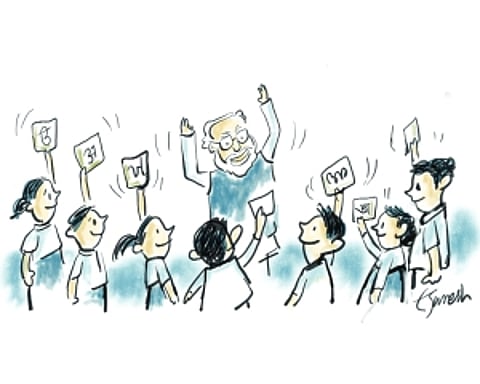

Celebrating India’s linguistic diversity, the Modi Government promotes inclusion and empowerment — rejecting divisive politics and elevating regional languages as pillars of national unity and pride
In a country as richly diverse as India, home to hundreds of spoken languages and countless dialects, language has always been more than a means of communication. It is identity, heritage, and culture. But in the wrong hands, it can also become a tool for division. The Narendra Modi Government has firmly rejected the politics of linguistic discrimination and instead adopted a unifying, inclusive approach that celebrates every regional tongue as a national treasure.
Time and again, PM Modi has demonstrated that India’s linguistic plurality is not a challenge to manage but a strength to cherish. From beginning his speeches in the local language of the state he visits to honouring classical languages like Tamil on global platforms such as the United Nations, his Government has made language a symbol of national pride. This is not accidental. It is central to the ethos of a government that believes in ‘Sabka Saath, Sabka Vikas, Sabka Vishwas, Sabka Prayas.’
Linguistic Heritage
The Modi Government has taken historic steps in recognising and preserving India’s linguistic and cultural richness. Classical language status has been granted to Marathi, Bengali, Assamese, Pali, and Prakrit in 2024, adding to the existing list of Telugu, Tamil, Kannada, Malayalam, and Sanskrit. Eleven Indian languages now enjoy this status, a testament to the government’s commitment to preserving linguistic heritage.
Initiatives like ‘Ek Bharat-Shreshtha Bharat’ have fostered cultural exchanges. Kashi-Tamil Sangam, Kashi-Telugu Sangam, and Kashi-Saurashtra Sangam are prime examples of language being used to connect regions, not divide them. Over 200 PM e-Vidya channels under the One Class, One Channel scheme have also been launched to broadcast school education in regional languages, ensuring linguistic inclusion from a young age.
Empowering Indians in Their Own Language
The Modi Government’s landmark National Education Policy (NEP-2020) is a transformative initiative that underscores this linguistic commitment. For the first time in independent India’s history, students are now encouraged to learn in their mother tongue or regional language, especially in primary and technical education. Engineering and medical courses are being translated into multiple Indian languages including Hindi, Tamil, Telugu, Malayalam, Gujarati, and Bengali, ensuring that no student is excluded from opportunity due to language.
The policy is not about imposing one language over another but about creating access so that learning is not hindered by the medium of instruction. This stands in sharp contrast to the colonial-era education model, which privileged English and alienated generations from their native cultural context. The Modi Government’s vision doesn’t stop at the classroom. Competitive examinations like SSC, JEE, NEET, and UGC-NET are now being conducted in 13 to 15 Indian languages with a roadmap to expand this to all 22 Scheduled Languages. The Staff Selection Commission has unveiled its format to allow aspirants to take exams in their mother tongue, addressing long-standing demands from various states and improving the prospects of lakhs of youth.
Three-Language Policy
Much controversy has been generated largely by the Opposition around the Three-Language Policy proposed under NEP. Let us be clear. This policy is not about imposing Hindi or any other language. It is about encouraging Indians to learn more Indian languages, just as English became popular because it was widely taught and available.
The three-language formula, first introduced in the post-1956 era after states were reorganised on linguistic lines, was meant for administrative convenience and national cohesion, not coercion. The Modi government is simply giving it a modern, inclusive interpretation. Encouraging linguistic diversity is not the same as enforcing uniformity. In fact, the policy provides the flexibility to choose languages based on regional preference and practical utility.
This is a step toward healing the damage inflicted by colonial and post-colonial policies that prioritised English over native languages. India is now building a digital, educational, and administrative ecosystem where no citizen feels left behind due to language.
The Dangerous Game of Division
In stark contrast to the Modi Government’s inclusive approach, the Opposition, especially the Congress party, has consistently indulged in divisive rhetoric. Be it stoking fear of “Hindi imposition” or promoting North-South binaries, their strategy hinges on weaponising language to fuel identity politics. For instance, a Congress MP recently suggested that South India should demand a separate country, blaming the so-called “Hindi region” for economic imbalance. Such statements are not just irresponsible. They are dangerously seditious.
This is against the Rahul Gandhi’s political outreach titled “Bharat Jodo”. Historically, Congress has presided over linguistic agitations, favoured certain regions, and neglected the preservation of Indian languages. Even now, when the Modi Government launches policies to promote education in regional languages, the Opposition distorts the narrative, calling it “majoritarian” or “regressive.” Nothing could be further from the truth.
A Call for Unity, Not Uniformity
The Modi Government’s language policy is rooted in a deep respect for India’s cultural diversity and a firm belief in empowerment through inclusion. It rejects the old model of top-down imposition and embraces a bottom-up approach, one that strengthens regional identities while weaving them into the national fabric.
During the 75th anniversary of the Constitution in Parliament, the Prime Minister remarked that celebrating India’s diversity would be the greatest tribute to Babasaheb Ambedkar. He underscored that the government’s policies aim to unify the nation — not divide it — and to reverse the long-standing neglect of linguistic pride that past decades have caused.
India’s future lies not in homogenisation but in harmonisation. A ‘Viksit Bharat’ can only be built when every Indian, regardless of their language, feels heard, respected, and included.
PM Modi’s vision is not to replace one language with another but to build a society where every language is a vehicle of progress. Let us reject divisive politics that seek to pit one region against another and one language against another. Let us embrace the idea of unity in diversity not just as a slogan but as a shared national mission.
(The author is a freelance journalist)