India-South Korea ties: From trade to trust
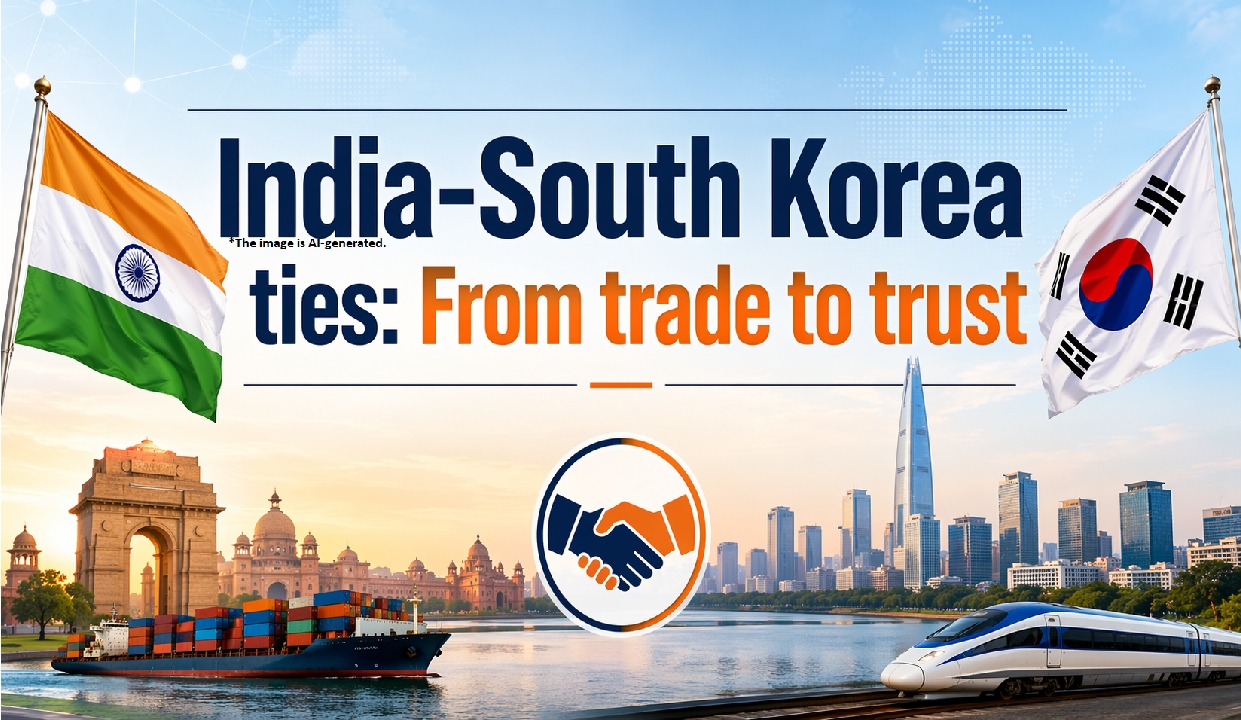
South Korean President Lee Jae-myung’s visit offers a chance to reset bilateral ties, positioning the partnership as a stabilising force in an uncertain world
The visit of South Korean President Lee Jae Myung to India is being seen in New Delhi as an important state visit that could catapult relations between the two countries to the next level. It is both timely and strategic, coming at a moment when South Korea is exploring partnerships beyond the United States in a changing world order. While South Korea is a relatively recent diplomatic partner for India, their historical connections run much deeper. Buddhism reached Korea between the 4th and 8th centuries, laying an early cultural foundation.
However, it took a long time for the two nations to formalise diplomatic ties after South Korea and India became independent in 1945 and 1947, respectively. Consular relations were established in 1962, followed by ambassador-level diplomatic relations in 1973. These ties were elevated to a “Strategic Partnership” in 2010 and further to a “Special Strategic Partnership” in 2015. Yet, despite these historical and institutional links, the relationship has remained largely economic rather than cultural or strategic. It is high time to elevate it, and both countries appear to recognise this need.
Efforts to upgrade the Comprehensive Economic Partnership Agreement (CEPA) signals an intent to transform an economic partnership into a future-oriented alliance. Bilateral trade has indeed expanded, but it remains imbalanced. India’s exports to South Korea stood at USD 5.81 billion in 2024-25, while imports were around USD 21 billion. There is a great scope to improve market access for Indian goods such as steel, rice, and shrimp, while ensuring fairer trade policies from the Korean Government. However, reducing the relationship to trade figures alone would be short-sighted. Discussions between PM Modi and President Lee reflect a broader strategic vision.
India and South Korea possess complementary strengths. South Korea’s advanced manufacturing, electronics industry, and robust R&D base align well with India’s expanding market and growing talent pool. This synergy has the potential to create resilient supply chains that are less vulnerable to global disruptions and can sustain on its own. Equally significant is the convergence of both nations in the Indo-Pacific region. Both nations share a commitment to maintaining a rules-based order, where economic prosperity is closely linked with strategic stability. However, the real challenge lies in implementation. Previous rounds of CEPA review negotiations have often stalled due to a variance in expectations on both sides. This time, both sides must demonstrate flexibility and political will. For India, this means continuing reforms to improve the ease of doing business and attract Korean investment.
For South Korea, it involves addressing India’s concerns over non-tariff barriers and ensuring greater reciprocity in trade. Although government-level engagement has its limitations, people-to-people connections and cultural exchanges are growing steadily. From K-pop to Indian cinema, younger generations are finding common ground. This soft power potential must be nurtured and expanded to further strengthen bilateral ties.