India’s rise and the echoes of colonial mindset
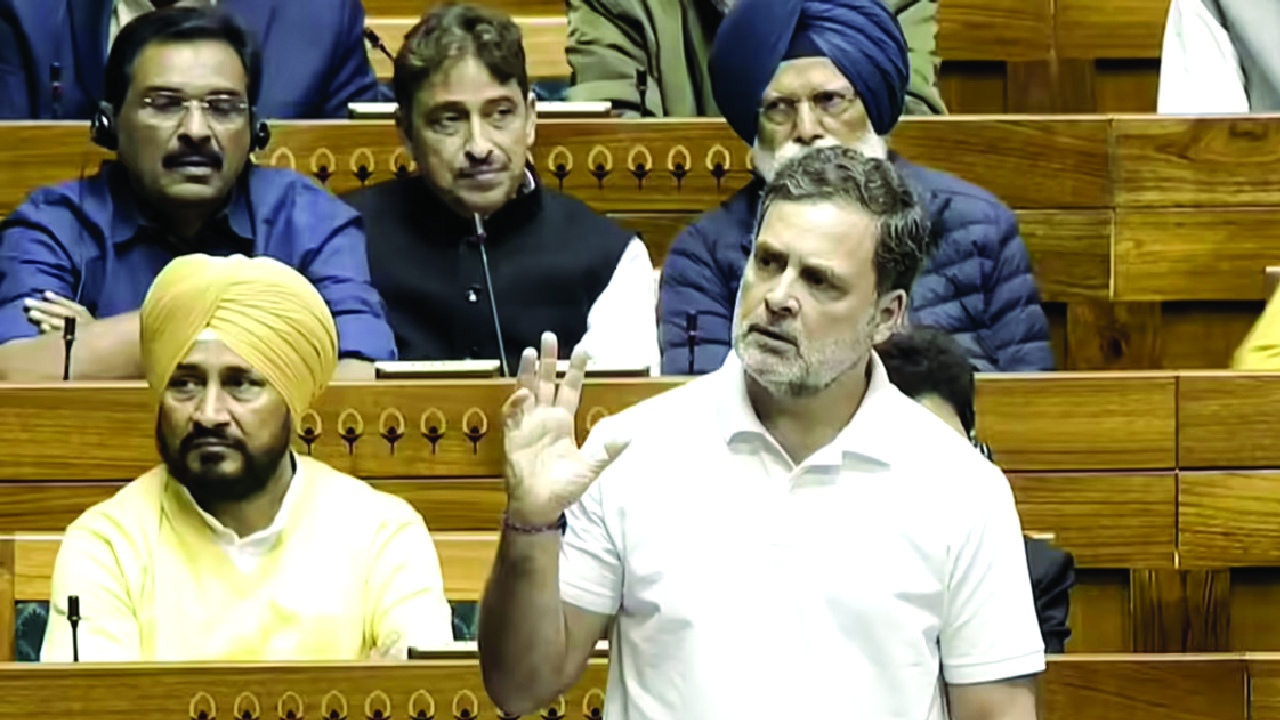
History often surprises us with impossible parallels. In today’s turbulent geopolitical landscape, two seemingly unrelated figures — US President Donald J Trump and India’s Leader of the Opposition, Rahul Gandhi —are, in their own ways, responding to a shared seismic shift: the rise of a confident, nationalist India that no longer seeks validation from old power centres, whether at home or abroad.
One individual, rooted in transactional values, speaks from the vantage point of a superpower accustomed to commanding global deference. The other, bearing the entitlement of a political dynasty that once ruled India as its fiefdom, mistook Western approval for diplomacy. Their personalities differ, their vocabularies diverge, yet beneath their words lies a shared unease — with an India that now speaks to itself and the rest of the world with confidence, free of doubts and complexes.
Last year, Trump’s remark-dismissing India as a “dead economy” — was not merely an undiplomatic misstep. It betrayed an outdated worldview that measures nations by compliance rather than capability. His advisers sharpened the attack. Peter Navarro’s charge that India was acting as a “laundromat for the Kremlin”, the insinuation that “Brahmins in India were
profiteering from Russian oil purchases”, and Howard Lutnick also took a jibe, “India will say sorry in two months”, weren’t casual observations; they reflected colonial prejudices.
Yet what raises eyebrows is not criticism from abroad. Democracies absorb that. What is troubling is the eagerness with which Rahul Gandhi chose to echo the same dismissive line-calling India a “dead economy” and endorsing Trump’s assertion as “facts”. On Trump’s false claim of brokering an India-Pakistan ceasefire after the gruesome Pahalgam terror attack, Rahul mocked the PM as “Narender-Surrender”, despite India’s official denial of third-party mediation.
This pattern is not episodic; it is cultural. Rahul Gandhi’s politics has increasingly gravitated towards spectacle over substance. Parliament has often been reduced to a theatre of optics. The recent attempt to quote from General M.M. Naravane’s unpublished memoir material, neither in the public domain nor cleared by the Ministry of Defence, was blocked under established House rules. Instead of respecting procedure, the episode became a pretext for disruption.
The symbolism of Rahul’s politics is familiar. The 2018 “hug” of the Prime Minister in the Lok Sabha-followed by a wink to party colleagues-remains emblematic. Civility is welcome; contrived theatrics erode institutional gravitas. The recent episode of publicly grabbing a Union minister’s hand to stage a joint media moment follows the same script. Serious politics have been reduced to a theatrical performance.
More troubling than style, however, is substance. During his Sep. 2024 US visit, Rahul Gandhi suggested that Sikhs in India faced existential threats to their religious freedoms. The statement was promptly weaponised by Khalistani separatist Gurpatwant Singh Pannun, who hailed it as validation of his secessionist campaign. Words spoken abroad, especially by a senior Indian leader, do not remain domestic soundbites; they travel into hostile propaganda ecosystems.
This performative impulse was visible again in the confrontation on Parliament’s steps when Rahul Gandhi publicly addressed Union Minister Ravneet Singh Bittu-a former Congressman — as a “traitor”, theatrically extending a handshake while taunting him to “come back”. Bittu’s sharp retort, calling Rahul a “desh ke dushman”, turned the exchange into a viral spectacle.
This rhetorical trajectory stretches back years. Rahul’s pattern of impulsive interventions is long-standing. On September 27, 2013, he publicly trashed his own government’s ordinance: “It’s complete nonsense. It should be torn up and thrown away.”
On February 5, 2020, he said unemployed youth would beat the Prime Minister with sticks. On October 6, 2016, he accused Modi of hiding behind soldiers’ blood after surgical strikes. At Ramlila Maidan, March 31, 2024, he warned, “If the BJP wins… the whole country will be on fire.”
Rahul Gandhi’s caste-centric pitch has been overt and repeated. In May 2024, he told youth that a caste census would reveal “where India’s wealth lies” and trigger a “new politics”. Later in the Lok Sabha, he said, “Those who call themselves Hindu only talk about violence…” reviving polarising tropes like “saffron terror”. He even questioned a journalist’s caste-and that of the channel owner-reducing public discourse to identity labels.
His 2016 visits to JNU and support for Kanhaiya Kumar-arrested on sedition charges-were accompanied by remarks: “The most anti-national people are the people who are suppressing the voice of this institution.” Each remark, taken individually, may be dismissed as rhetorical excess. Taken together, they reflect a consistent attempt to delegitimise national institutions to score political points.
The deeper issue is ideological. For decades, the Congress system drew intellectual sustenance from a toxic blend of Communism and colonial narratives that treated Indian identity as something to be diluted, not celebrated, and sovereignty as something to be balanced, not asserted. That era is over. The electorate has, three times since 2014, endorsed leadership that speaks the language of civilisational confidence, welfare delivery, and strategic clarity.
India today is not seeking permission to grow. It is building infrastructure at unprecedented scale, digitising welfare delivery, modernising defence, asserting its voice in multilateral forums, and reviving cultural self-awareness long suppressed under alien narratives. One need not agree with every policy to recognise the structural shift underway.
Those unable to process this transformation fall back on two responses: external moralising or internal delegitimisation. Trump’s comments belong to the former; Rahul Gandhi’s interventions increasingly to the latter. Both reflect difficulty in accepting that India’s choices need not mirror Western expectations, the old Nehruvian template, or dynastic validation.
The contrast in political culture is instructive. Recall June 2022. When the Enforcement Directorate summoned Rahul Gandhi for questioning in the National Herald case, what ought to have been treated as a routine legal process was converted into a spectacle of political victimhood. Senior Congress leaders, accompanied by hundreds of party workers, poured onto the streets in an orchestrated protest. The message was unmistakable: institutions are legitimate only when they conform to the expectations of a political dynasty.
This episode invites comparison with March 27, 2010, when the Supreme Court-mandated Special Investigation Team interrogated the then Chief Minister of Gujarat, Narendra Modi, in connection with the 2002 riots. There were no street demonstrations, no mobilisation of crowds, and no claims of institutional vendetta.
Modi appeared before investigators as a citizen subject to the rule of law. After hours of questioning and a prolonged judicial process, the SIT granted him a clean chit in 2012-a conclusion that withstood repeated legal challenges until the Supreme Court finally affirmed closure on June 24, 2022.
India’s rise is not merely economic; it is psychological. A civilisation once told to doubt itself has begun to rediscover continuity between its past and its future. That shift unsettles global hierarchies and domestic elites alike. The reflex to caricature this resurrection as majoritarianism or authoritarianism reveals more about the anxiety of critics than the reality of India.
Ultimately, the Trump-Rahul parallel isn’t just about personalities. One represents the waning arrogance of a unipolar world, while the other embodies a dynasty still battling to define its place in a post-dynastic India. Standing between them is a nation ever more self-assured, vibrant, and eager to shape its own destiny.
The writer is an eminent columnist, former Chairman of the Indian Institute of Mass Communication (IIMC), and the author of ‘Tryst with Ayodhya: Decolonisation of India’ and ‘Narrative ka Mayajaal’ ; views are personal