India’s Javelin Missile Deal and Its Impact on Future Battlefield Preparedness
The last short lived skirmish with Pakistan, Operation Sindoor, was essentially a display of India’s ability to destroy enemy targets over long distances with superior missile power. A conventional war with our eastern or western adversaries will not be restricted to only air power, missiles or long distant artillery. All the elements of Bharat’s war machinery will be engaged in the eventuality of a full scale war of any magnitude.
The terrain and geography of India’s western neighbour demand heavy involvement of Armoured Vehicles like Battle Tanks and Armoured Personal Carriers from both sides which is evident from the Indo-Pak battles of 1965 and 1971. Anti Tank Guided Missiles (ATGM) play a very important role against enemy Battle Tanks and Armoured Personal Carriers. It is in this aspect that the recent India-USA deal for procuring Javelin missiles has garnered so much attention.
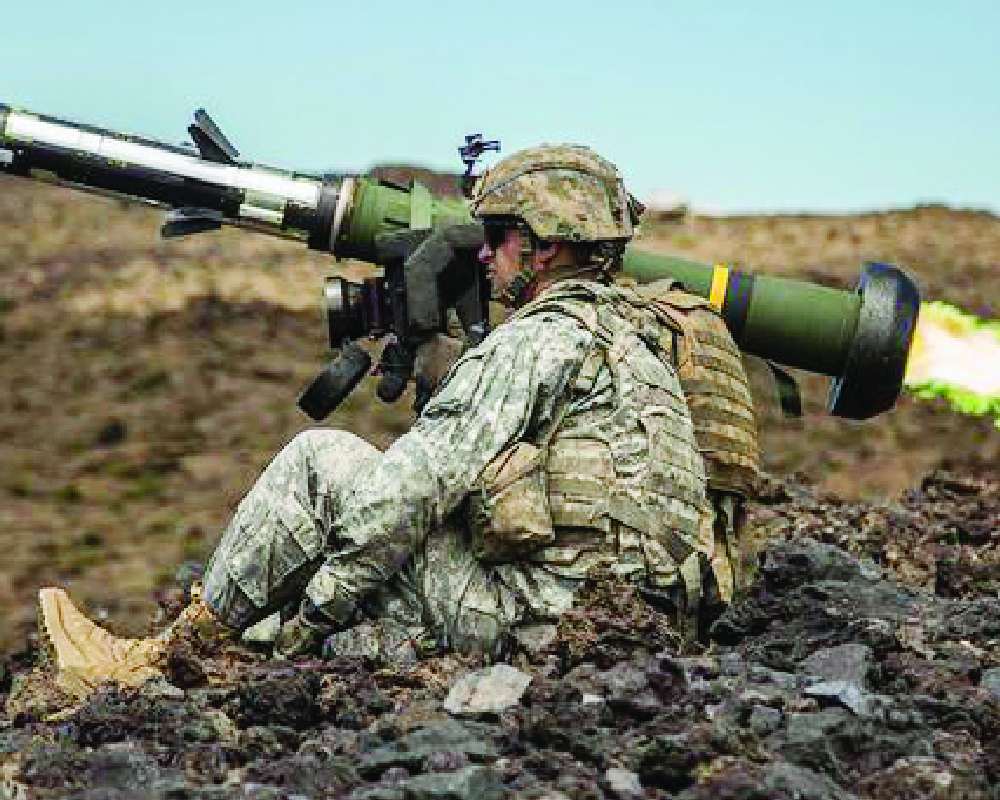
Developed by Raytheon and Lockheed Martin of USA, the latest variant of Javelin missile is one the most potent and lethal ATGMs that the world has ever seen. It has a fantastic 94 per cent hit probability and has exhibited its efficacy in the ongoing war between Russia and Ukraine. The missile system is man-portable and can be carried by one trained soldier because of its light weight. An Armoured Vehicle or any other target can be effectively engaged upto a distance of 2500 metres with the optical sight or thermal imaging (for low light and night conditions).
The distance can be extended upto 4750 metres with a different launcher. Once the target is locked on, the missile is fired and it homes on to the target with the help of an inbuilt Infra Red Imaging seeker. In the case of Armoured Tanks, there is an option for Top Down attack wherein the missile takes an upward trajectory and comes down aiming at the top or turret of the enemy Battle Tank which is the most vulnerable part and has less armour protection than the rest of the tank. The tandem charge of the missile consists of a precursor charge to cater for reactive armour protection and then is a lethal main charge which destroys the Battle Tank. The Javelin ATGM also has a Direct Attack mode for targeting bunkers, buildings, helicopters and other targets. For safety of the operator from a backblast, the Javelin has a soft launch, that is, the missile is initially ejected to a safe distance by a small gas charge and thereafter the rocket engine gets fired and take the missile to its target. It is a ‘Fire and Forget’ missile which allows the firer to immediately disengage and move away to a safer location or engage another target. The soft launch also allows the missile to be safely fired from bunkers, buildings and constricted spaces.
Bharat will be able to equip only limited troops for engaging enemy armoured elements with this initial deal of 100 Javelin missiles and 25 Command Launch Units (launchers for the missile). Negotiations are being carried out for producing the Javelin missiles in India. The critical requirement of Anti Tank Missile systems is presently being catered by the latest version of Carl Gustav Rocket Launchers (of Swedish origin but being produced in India since long) and the Konkurs and Kornet missiles of Russian origin (also being produced in India).
India’s efforts for indigenous ATGM systems has been successful and the man portable variant of Nag missile, a third-generation, fire-and-forget, all-weather anti tank guided missile developed by DRDO, would be India’s answer to Javelin. The Nag ATGM and its variants have successfully undergone user trials and will be inducted after the necessary technical formalities.
The Javelin ATGM can be a very effective force multiplier for India in the eventuality of a war with Pakistan. During armour engagements in the deserts of Rajasthan or in the plains of Punjab, the Javelin missiles can be used to hunt and destroy enemy battle tanks and other armoured elements.
They can also be used against low flying attack helicopters and to blow up command bunkers, ammunition and fuel dumps. In the mountains they can be used to counter movement by targeting enemy troop convoys and replenishment vehicles besides carrying out stand-off attack on important headquarters. The Fire and Forget capability of the Javelin missiles can help the firers to Shoot and Scoot for escaping or engaging other targets. Modern movement of heavy equipment and logistical capabilities allow armoured tanks to be moved up the mountains. Though they have limited maneuverability in the mountains, the battle tanks are used as mobile pill boxes with lethal and enhanced fire power. After the Galwan incident, India and China deployed armoured tanks on both sides of the borders in eastern Ladakh and Arunachal Pradesh, where the flat stretches of land and cold desert plateaus can be potential arenas for intense and concentrated tank battles. The Javelin ATGMs will be very effective in such situations.
Javelin Anti-Tank Guided Missiles can be part of the arsenal for parachute battalions and special forces units. Once these forces are launched behind enemy lines, they can wreck havoc by using these Javelin missiles on vital installations and enemy bases.
With India making a deal with USA for Javelin ATGMs, chances are almost nil that Pakistan too will get the same missile from USA. However, Pakistan can bid for the Chinese HJ-12, nicknamed China’s Javelin, at their on peril. While Javeline has been the cynosure of all the militaries during the initial phase of Russian Ukraine war and form a part of the arsenal of more than 20 countries, like most of the Chinese military armament, not much is known about the efficacy of the HJ-12 missile.
After the Javelin ATGMs are received and necessary familiarisation and training is carried out on simulators and otherwise, the authorities in charge will know best how to deploy and utilise them while India’s adversaries may, at best, keep guessing.
Colonel Sanjoy Banerjee (Retd) is an Indian Army veteran with over three decades of service in the Corps of Engineers, with combat experience in J&K and Northeast; views are personal