IFFI 2025: A closing night written in cinema’s language
One question was asked on 28 November at IFFI 2025. What did a festival’s last day mean when cinema extended far beyond the moment of its closing ceremony? After nine days of screenings,
conversations and artistic exchanges, the 56th International Film Festival of India ended with a
reflective mood.
This edition showed how cinema explored the way people remembered, interpreted and negotiated their worlds, whether through shifting memories of the past or the layered realities of a small Himalayan town. The day opened with discussions that framed how filmmakers respond to memory and identity. Japanese director Kei Ishikawa spoke about adapting A Pale View of Hills for the Country Focus: Japan section, shaping Kazuo Ishiguro’s novel through cultural and emotional nuance.
Later, Sikkimese filmmaker Tribeny Rai engaged with audiences about Shape of Momos under Indian Panorama, describing the work of building cinema in a young regional industry and the responsibility of portraying everyday Sikkimese life with accuracy. Her participation added to the festival’s ongoing conversation on regional filmmaking.
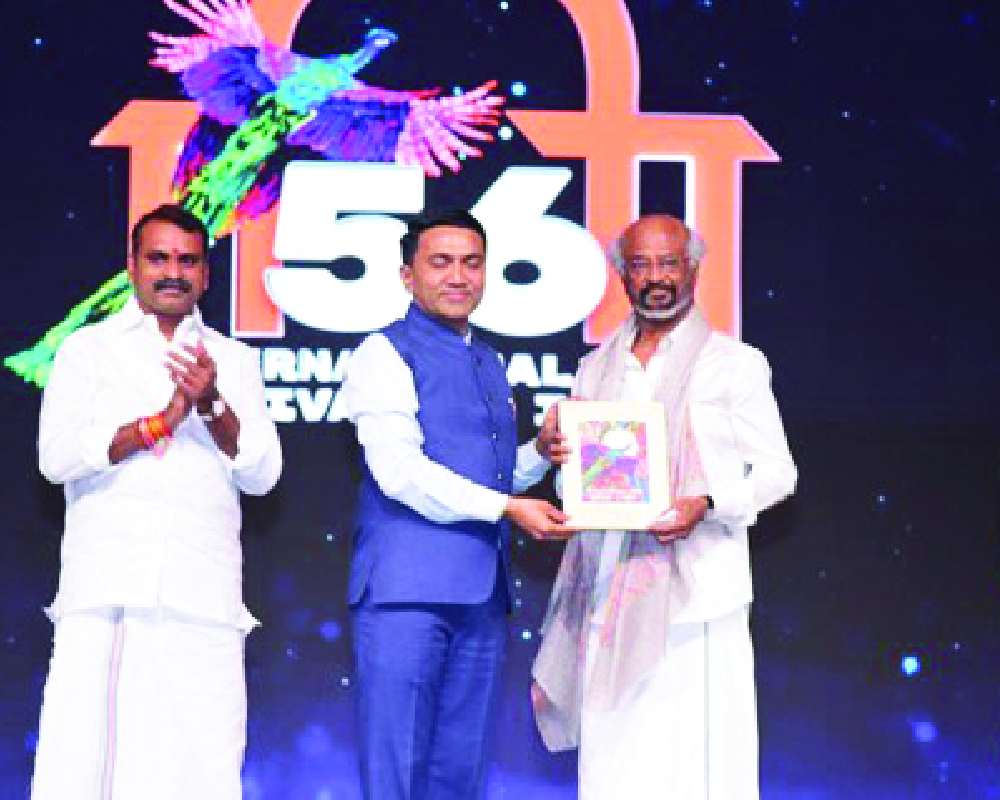
The closing ceremony at the Shyama Prasad Mukherjee Indoor Stadium was hosted by Jay Bhanushali and Tisca Chopra, with dignitaries including Goa Chief Minister Pramod Sawant, Minister of State for Information and Broadcasting L Murugan, Secretary Sanjay Jaju and Festival Chairman Shekhar Kapur present. The evening featured a measured Ganesh Vandana that set the tone for the ceremony, and at another moment during the event, Ranveer Singh took the stage to share the first look of Dhurandhar. His presence drew strong enthusiasm and reflected the connection between popular cinema and evolving
storytelling practices.
A concise cultural segment followed, spotlighting the Northeast through a showcase curated by Ranjit Gogoi. The performance honoured the musical legacy of Bhupen Hazarika, SD Burman, RD Burman, Zubeen Garg and Papon, underscoring the region’s deep imprint on India’s artistic history. The ceremony then turned to Karnataka’s heritage with an expressive Yakshagana performance.
Director Rishab Shetty reflected on the form’s influence, saying, “My acting journey began back in 6th standard through Yakshagana, an art form that brings India’s ancient stories to life through all-night performances. I was deeply inspired by these artists and by Yakshagana itself. That is why I wanted to take a small story from this tradition and bring it to the world and that is exactly what I tried to do.”
Additional performances by Manganiyar artists from Rajasthan and moving presentations by divyang performers added to the ceremony’s textured cultural landscape, supported by Indian Sign Language interpreters who underscored the festival’s inclusive spirit.
One of the evening’s most affecting moments honoured Rajinikanth for fifty years in cinema. His words, “Even if I have a hundred births, I want to be born as Rajinikanth,” captured the emotional continuity of a half-century in front of the camera. Apart from this, the festival also screened its closing film, A Useful Ghost by Ratchapoom Boonbunchachoke, a work noted for its surreal and contemplative storytelling.
Awards were presented with attentive focus. Santosh Davakhar received the Silver Peacock for Best Director for Gondhal, praised for its striking narrative shaped through tradition and dramatic tension.
Ubeimar Rios won the Silver Peacock for Best Actor (Male) for the Spanish film A Poet, recognised for a deeply moving portrayal of an artist confronting crisis and survival. Jara Sofija Ostan earned the Silver Peacock for Best Actor (Female) for Little Trouble Girls, celebrated for the precision and emotional depth she brought to her character. The Special Jury Award was presented to Akinola Davies Jr for My Father’s Shadow, a film commended for its intimate approach to family, memory and emotional inheritance.
Hesam Farahmand for My Daughter’s Hair and Tõnis Pill for Fränk were declared joint winners of the Best Debut Feature Film of a Director Award. Karan Singh Tyagi received the Best Debut Director (Indian Feature Film) Award for Kesari Chapter 2. Bandish Bandits Season 2 earned the award for Best Web Series (OTT) for expanding classical music into wider public engagement. The Norwegian film Safe House won the ICFT UNESCO Gandhi Medal for its examination of humanitarian struggle in a conflict-zone hospital. The Golden Peacock for Best Film was awarded to Ash Mayfair’s Vietnamese feature Skin of Youth, a work that explored identity and resilience through the story of San and Nam with remarkable sensitivity.
Young performers across several films were also acknowledged, highlighting the next generation of global talent. The red carpet saw the presence of Raat Akeli Hai’s team, along with film icons such as Ramesh Sippy, Nawazuddin Siddiqui, Niharika Konidela, Omprakash Mehra and GV Prakash Kumar. This year’s edition introduced the AI Film Festival and CinemAI Hackathon, while the WAVES Film Bazaar generated business worth over Rs 1,050 crore, and 50 films directed by women marked a significant step toward strengthening Nari-Shakti in cinema.
As IFFI 2025 came to its close, the festival reaffirmed why cinema continues to matter. It provides spaces where experience and imagination meet, where individuals recognise themselves in unfamiliar lives, and where stories shape how societies understand memory, identity and aspiration. This final night confirmed that festivals do more than conclude a season of screenings. They preserve the creative momentum that ensures the stories of today continue to influence the way the world sees tomorrow.