How a Christmas celebration marks an elephant calf’s fight back from a train tragedy
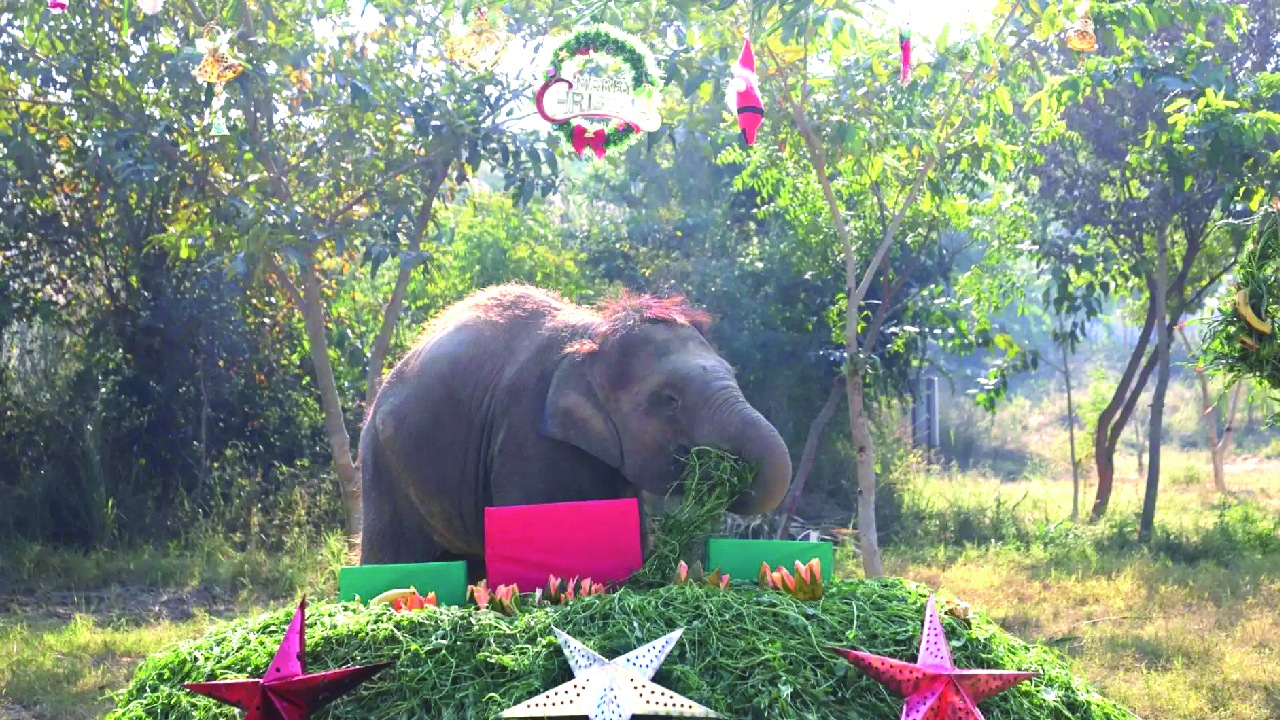
The trees are decorated with bells, stars, and miniature Santa ornaments. Maya, Phoolkali, Emma, Tara, and Suraj wait patiently nearby. But little Bani cannot hide her excitement. The moment she is given her surprise box with her favourite nutritious and colourful fruit feasts, there is no stopping her. The Christmas party has begun for the rescued elephants at India’s first Elephant Hospital run by Wildlife SOS, a not-for-profit, in Mathura, Uttar Pradesh.
The idea behind these celebrations is to support both the physical and psychological well-being of rescued animals, both at the Elephant Hospital and the Elephant Conservation and Care Centre, while creating a nurturing environment, says Kartick Satyanarayan, co-founder, Wildlife SOS. Just how important this fostering environment is for the elephants can be seen in the remarkable progress made by Bani, the two-year-old who defied all odds to stand up on her own feet, 18 months after she was hit by a speeding train in Uttarakhand, leaving her with severe spinal injuries and little chance of survival.
Train hits have been the second-highest cause of the death of elephants, the first being accidental electrocution, according to the Ministry of Environment, Forests and Climate Change. On 21 December 2025, seven wild Asian elephants, including four calves, were tragically killed when a high-speed express train collided with a herd crossing the tracks in Assam. Already classified as endangered, the number of elephants in India has been on the decline, according to a 2024 assessment by the Wildlife Institute of India and various State Forest Departments, with over 200 elephants killed in train collisions between 2010 and 2020. Though 150 elephant corridors have been validated by the government across 15 elephant-range states, train collisions caused the death of more than 50 elephants in the last four years.
In Uttarakhand, where a train collision critically injured Bani and instantly killed her mother, the population of elephants has shown a decline of 2.6 per cent between 2017 and 2023, many of whom have died due to critical injuries and a lack of adequate medical care.
Bani, too, was precariously close to becoming another statistic on the death list. In January 2024, when Uttarakhand forest officials found Bani, then a nine-month-old elephant calf, lying with grievous multiple injuries near her dead mother, they were convinced the orphan wouldn’t survive. However, they were unwilling to give up. Determined to take their chances, officials reached out to Wildlife SOS, running a state-of-the-art Elephant Hospital in the neighbouring State of Uttar Pradesh. This was to be a life-changing decision for Bani.
When the Wildlife SOS team led by Dr Ilayaraja Selvraj, Deputy Director, Veterinary Services, assessed Bani’s condition, they found she was unable to stand, with complete loss of movement in her right hind limb. Her condition was critical. Unless she received more intensive and long-term treatment, it was clear to the team that Bani was unlikely to survive. Uttarakhand forest officials also agreed that this would only be possible collaboratively at the Wildlife SOS hospital. So, after all transfer protocols were completed and the team ensured she was stable enough to travel, their ambulance was specially modified in keeping with her severe injuries. The floor was layered with soft hay for cushioning. Gunny sacks filled with hay served as pillows to support her legs to prevent sores. Blankets to keep her warm and bananas, papaya, and sugarcane leaves, along with milk and water bottles, were stocked to ensure she remained nourished during the 10-hour journey to Mathura.
Based on the advice of orthopaedics, neurosurgeons, and Ayurveda practitioners, Bani’s initial treatment at the hospital included photobiomodulation therapy, laser therapy, hydrotherapy, and Ayurvedic hot-oil massages. However, it was the brainwave to provide acupuncture that led to the breakthrough. Dr Porrakote Rungsri, veterinary acupuncture specialist from Thailand’s Chiang Mai University, flew in to share expertise and give hands-on training to the hospital team. Interestingly, a stuffed toy of the exact size and shape of Bani was used to demonstrate the exact points to insert the needles.
Given for the first time to any elephant in India, the innovative acupuncture therapy has been administered to Bani over the past 20 months as part of a comprehensive veterinary care programme tailored to Bani’s specific paralytic condition. Acupuncture needles are gently put in to stimulate nerve function, reduce pain, and support the healing of her hind legs. Electro-acupuncture therapy promotes nerve regeneration, diminishes inflammation, and speeds up the healing process after injuries through electrical stimulation. The two-hour electro-acupuncture therapy, reduced now to once a fortnight for 120 minutes, varies in intensity under close supervision and monitoring to ensure it doesn’t cause any discomfort or pain.
Bani’s tenacity, resilience, and determination to stand on her feet surprised the hospital team. Now they are hoping that the success of electro-acupuncture in Bani’s inspiring recovery will help to save the hundreds of others of this endangered species, critically injured in train collisions.
The writer is journalist writing on development and gender; views are personal