Greenland: America’s open claim on the Arctic prize
Approximately 58 years ago, on January 21, 1968, a United States Air Force B-52 bomber carrying four thermonuclear weapons crashed on the ice near Thule Air Base in Greenland. The plane had been on a routine Strategic Air Command mission when a fire in the heating system forced the crew to abandon it. The impact caused the conventional explosives in the bombs to detonate, scattering plutonium-contaminated debris across miles of ice.
According to declassified National Security Archive documents, the contamination extended over five miles, and US teams faced darkness, extreme cold, and ice storms that made recovery nearly impossible. Over 10,000 cubic metres of radioactive snow and ice were collected and shipped to Savannah River, South Carolina. A critical fissile component, the ‘spark plug’ from one thermonuclear weapon, was never recovered despite underwater searches in North Star Bay.
The US had never disclosed nuclear flights over Greenland or storage at Thule to the Danish government, although Denmark had given tacit consent in 1957. Secretary of State Dean Rusk had to negotiate with Danish officials to reconcile the crash with Denmark’s declared no-nuclear policy, which applied in peacetime but allowed US deployments in emergencies. Danish Ambassador Torben Rønne noted that the agreement would be ‘less than binding,’ but US negotiator John M Leddy insisted that the
written agreement ‘would be the governing instrument.’ The crash exposed the structural contradiction between Denmark’s public nuclear stance and its tacit acquiescence to US strategy.
The Thule incident is an extension of a much longer history of control imposed over Greenland. The Indigenous population suffered forced relocations, cultural suppression, and social disruption under Danish rule, which extended from the eighteenth century well into the twentieth. In 1953, the Inuit community of Thule was moved to Qaanaaq to make way for the US air base. Over 130 villagers lost their ancestral hunting grounds and traditional food sources. There was no massacre in the conventional sense, but the effects were immediate and enduring. Familial structures were broken, access to essential resources was severed, and a foreign administration dictated new patterns of living.
In the 1960s and 1970s, Danish authorities carried out a systematic campaign of reproductive control over Greenlandic women and girls. Thousands were subjected to contraceptive devices or hormonal injections without informed consent, often while still in their early teens. Some girls were as young as twelve when fitted with intrauterine devices. Estimates suggest that around 4,500 women and girls were affected, representing nearly half of all fertile Greenlandic women at the time. Many suffered long-term physical pain, infections, infertility, and psychological trauma. This campaign, justified as population management, demonstrates another layer of coercion under Danish authority: the subordination of Indigenous autonomy to state priorities. The Danish government and the Government of Greenland have since formally apologised, acknowledging the harm caused and establishing compensation schemes. Personal testimonies describe lasting suffering and silence around these interventions, reflecting a legacy of control that extends beyond relocation and military exploitation.
Intergenerational effects of these policies included the loss of language, erosion of traditional knowledge, and increases in suicide and substance abuse. These measures were framed as development but were coercive, systematic, and implemented without consent.
US military ambitions in Greenland date back to the early Cold War. The 1951 US Denmark Defence Agreement allowed the United States to operate bases, deploy personnel, and later station nuclear weapons with minimal restriction. NSA documents show that planners considered Greenland essential for missile early warning systems and as a base from which to project power across the North Atlantic. In 1957, the Joint Chiefs of Staff even proposed purchasing or leasing Greenland for 99 years. The State Department rejected the idea, noting that it “could well be regarded as an insult by the Danes and could be seriously damaging to US-Danish relations.”
Nevertheless, US officials treated strategic control as if it were implicitly theirs. Strategic Air Command flew daily nuclear-armed missions over Greenland, and weapons were stored near Inuit settlements without disclosure. The Thule crash made secrecy impossible, but the response prioritised containment of contamination over consultation with local communities. Danish scientists demanded ‘zero contamination’ to protect subsistence hunting, yet US plans included shipping irradiated ice and debris to American facilities. One official from the United States Atomic Energy Commission observed, “The Danish Government has a very paternalistic policy toward the Greenlanders and appears determined to look out for their interests as much or more than they would for themselves.”
Today, Donald Trump has articulated the stakes publicly; otherwise, such discussions and decisions have been made behind closed doors for decades. Trump’s approach follows the ‘Shylock’ logic, reflecting the belief that protectionism is more effective than mutual sharing. He framed Greenland as essential to US national security, saying, “Greenland is very important for national security… and the problem is there’s not a thing that Denmark can do about it if Russia or China wants to occupy Greenland, but there’s everything we can do.” He claimed that “NATO becomes far more formidable and effective with Greenland in the hands of the UNITED STATES” and declared that “anything less than that is unacceptable.” When confronted with Greenlandic leaders affirming loyalty to Denmark, he dismissed them, stating, “I don’t know who he is,” signalling that the United States intends to assert control over Greenland regardless of local governance or existing agreements.
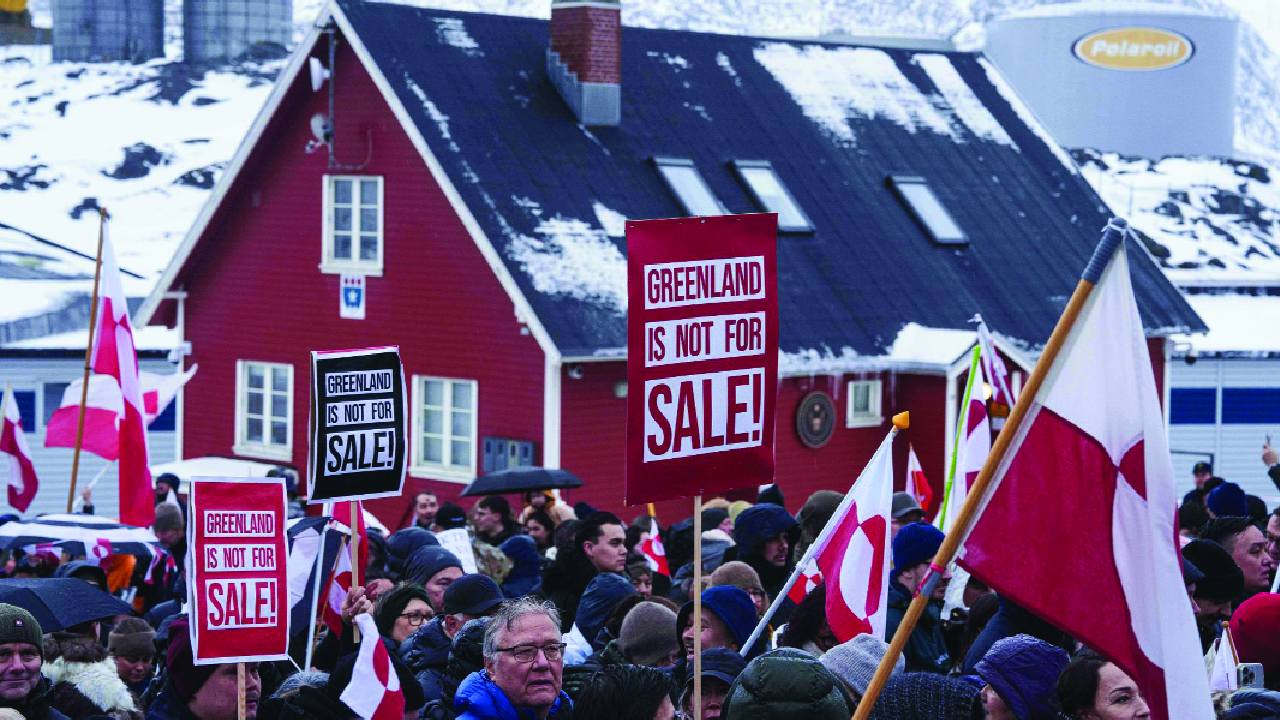
However, Danish and Greenlandic officials have resisted these pressures. The Danish foreign minister described a ‘fundamental disagreement’ with American positions, and Greenlandic leadership has repeatedly emphasised autonomy and adherence to agreements with Denmark. Nevertheless, power imbalances make resistance provisional. Geography, global alliances, and US military capability create conditions in which American ambitions are difficult to counter. Historical memory offers no leverage sufficient to override a nation with global reach. NSA records show that even in 1957 and 1968, Greenlandic voices were secondary in decisions determining nuclear deployments, base construction, and the allocation of critical resources. Present-day statements reproduce this dynamic on a larger scale.
Trump’s statements indicate that the United States intends to pursue control over Greenland openly. Historical precedents reinforce this expectation: the 1951 defence agreement allowed US bases, the 1957 Joint Chiefs of Staff proposal envisaged territorial acquisition, and the 1968 nuclear accident prompted secret arrangements that subordinated Greenlandic welfare to military priorities. Statements such as ‘anything less than that is unacceptable’ signal that the pattern of prioritising strategy over local agency is likely to continue. European allies have limited leverage, and global strategic imperatives, particularly concerning NATO and Arctic security, are expected to override objections from Denmark or Greenland.
The historical record is unambiguous: Greenland has endured colonial governance, coerced relocation, environmental risk, and strategic exploitation for centuries. The United States’ ambitions today follow this trajectory. Indigenous suffering, documented in the 1953 relocations, the forced contraception campaigns, and the 1968 nuclear incident, is neither forgotten nor compensated. The continuity from Danish colonial policy through Cold War deployments to contemporary American declarations shows that Greenland has been treated as a
territory to be managed rather than as a community with rights and agency.
The powerful watch the prize, the subjugated watch the powerful, and the vulnerable watch only what is within immediate reach. As the Ethiopian proverb says, “The eye of the leopard is on the goat; the eye of the goat is on the leaf.” Greenland has occupied the position of the goat for centuries, caught between global ambitions and local survival, observed, managed, and constrained by forces whose calculations determine the fate of its land and people. Trump’s ambition over Greenland is a matter of time.
The writer is a columnist based in Colombo; views are personal