The myth of rules and reality of power
When I listened to Charles Kupchan, former adviser to President Barack Obama, speak at a political conference in Hamburg, Germany, in August 2025, I could not stop myself from asking him what I believed was a very fundamental question. Kupchan’s talk briefly touched upon how globalisation was no longer working. However, after several days of discussions, I came to a different understanding. It seemed to me that what was being presented as a failure of globalisation was, in fact, a discomfort with the reality that America and Europe were no longer the manufacturing hubs of the world. The problem, in my view, was not globalisation itself, but the loss of Western dominance within it.
When the question-and-answer session began, I put this thought directly to him. I said, “Charles, when you say that globalisation is not working, I wonder why you believe that. From where I stand, globalisation seems to be working perfectly well for the world. What I infer is that it is no longer working for America because America no longer dominates it. The United States had no problem with globalisation, a system it largely created to dominate global markets, as long as it remained at the top. Now that China has emerged as the world’s manufacturing hub, overtaking Europe and America, and India is rapidly catching up, globalisation has suddenly become a problem.” To my surprise, Charles openly agreed. He accepted that globalisation is indeed working for India, China, and many other developing countries, but not for the American public. During a conversation with him, I had spoken at length about why I believe the BJP is the most liberal party in India’s democratic system, and how Hindu society is the fundamental reason India remains the only stable democracy in the Indian subcontinent.
America built global institutions and systems to maintain its dominance over the world. Now, as these very institutions are becoming more democratic and more countries are beginning to assert their voices, America appears eager to dismantle the systems it once championed. The so-called global rules-based order, as I came to see it, was never truly about rules. It was about power, and the overwhelming might of the American administration.
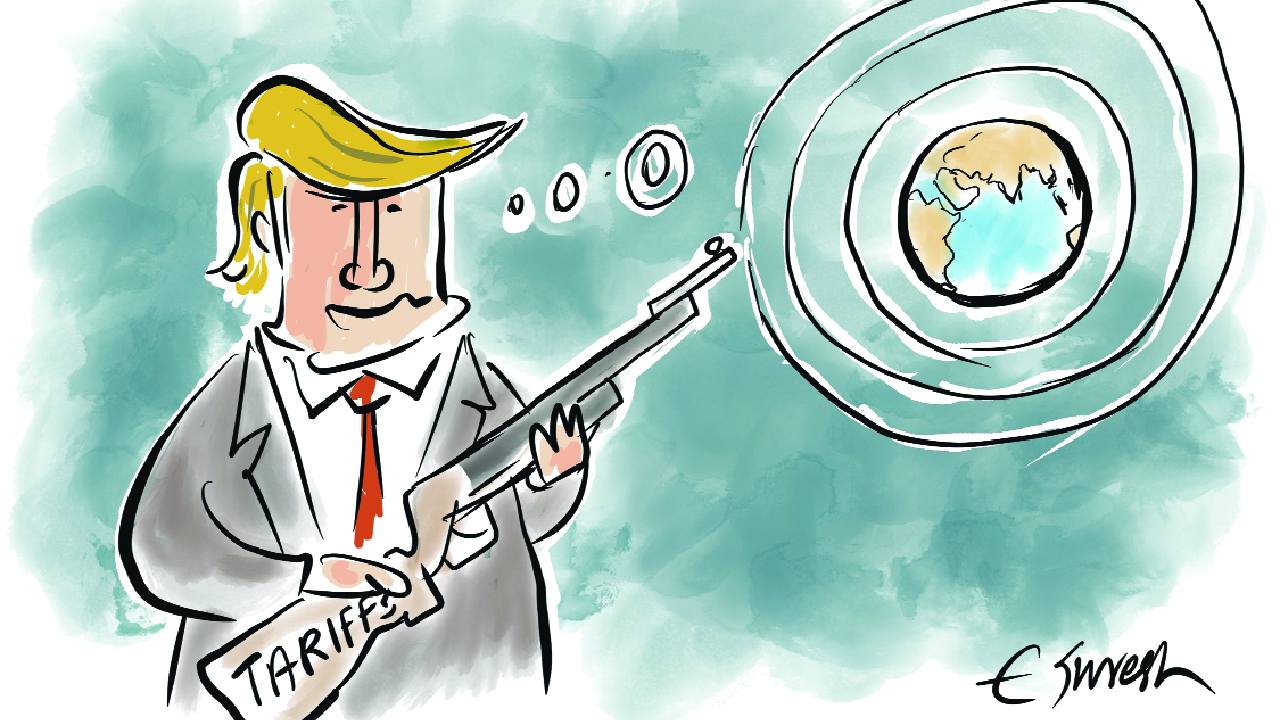
The real question for me is what India can learn from this moment in history. What systems can we create that serve India’s interests not just for the next election cycle, but for decades and centuries to come? Donald Trump’s presidency, when viewed through this lens, appears far less erratic and far more strategic than it is often portrayed. His attacks on the World Trade Organization were not a rejection of free trade, but a rejection of a system that no longer guaranteed American supremacy. The WTO, once a mechanism through which the United States could shape global trade rules, has gradually become a platform where emerging economies can challenge American interests using the very rules America once authored. When power could no longer be exercised through rules, Trump chose to exercise it through force, tariffs, and unilateral action, including unilateral tariffs on India, Brazil, China, the European Union, and even close allies under the broad pretext of “national security”. The same logic explains his hostility towards the World Health Organization. COVID-19 exposed the uncomfortable truth that global institutions were no longer instruments of American command but arenas of contested influence. With competing powers gaining institutional legitimacy and narrative space within the WHO, America chose to delegitimise the institution itself rather than accept parity. Trump’s decision to withdraw was not about public health; it was about control. If America could not dominate the institution, the institution had to be weakened.
NATO too became a target for similar reasons. For decades, Europe enjoyed American military protection while gradually pursuing strategic autonomy in trade, technology, and diplomacy. Trump’s repeated threats to withdraw from NATO were designed to remind Europe that security, like trade, is ultimately underwritten by power, not ideals. His message was blunt: alliances exist only as long as they serve American interests. When they stop doing so, they become liabilities. Tariffs on imports were another expression of this same worldview. Trump was willing to break the spirit of the global trading order to protect American manufacturing and strategic industries. The objective was clear. If the system no longer delivered outcomes favourable to America, America would bypass the system and rebuild leverage on its own terms. Even his proposal to annex Greenland fits neatly into this pattern. The Arctic is emerging as a new theatre of strategic competition, rich in resources and critical for future trade routes. Trump’s interest in Greenland was not eccentricity; it was a recognition that geography still matters in geopolitics. When institutions fail to secure influence, territory still can.
Another stark example of this same principle is what the world has watched unfold in Venezuela. In January 2026, U.S. forces captured Venezuelan leader Nicolás Maduro and his wife in Caracas and transported them to the United States to face American criminal charges. Here was the world’s most powerful state using direct force to seize a foreign head of state and his spouse, and the so-called international community could do little beyond statements and legal debate. That is what power looks like when it stops pretending. Taken together, these decisions reveal a single, coherent idea: global systems are tools of national interest, not moral constructs.America created them when it had the power to control them. When that control weakened, America moved to undermine them.
This brings us to a truth that is uncomfortable but undeniable: the global order has always rested on the principle that might is right. Throughout history, at both the international and domestic level, it has been the most powerful empire, the most dominant state, or the strongest authority that decided how rules would be written and enforced. For a brief moment in history, Western powers managed to convince the world that the system they created was rooted in morality, universal rules, and shared values. In reality, this moral framing was a veil that concealed a far older instinct: domination.
What we are witnessing is not the collapse of a rules-based order, but the collapse of the illusion that such an order ever truly existed. As American dominance weakens, so does the pretence. Under Trump, the United States is not retreating but reasserting power more directly-tariffs over treaties, sanctions over negotiations, coercion over institutions. The aim is simple: restore American might, because power remains the only lasting currency in global affairs.
India must read this moment clearly. This is not about endorsing any model, but about understanding how empires behave when challenged. Morality and institutions have never guaranteed fairness. Strength shapes systems.
India must therefore build its own institutions, trade corridors, financial mechanisms and security architecture while its power is rising. Once power plateaus, the chance to shape rules fades. History shows that rules are written by the strong, not the just. India’s window is open-but not forever.
The writer is an Advocate at the Supreme Court of India and a legal and political commentator. His work focuses on Indian politics, national security, and international affairs; views are personal