
- HOME
- INDIA
- WORLD
- BUSINESS
- STATES
- LAW & JUSTICE
- ENTERTAINMENT
- SPORTS
- VIEWPOINT
- LIFESTYLE
- TECH
As the Strait of Hormuz stalls Indian tankers, a South American lifeline grows in strategic importance, opening a high-stakes diplomatic chapter
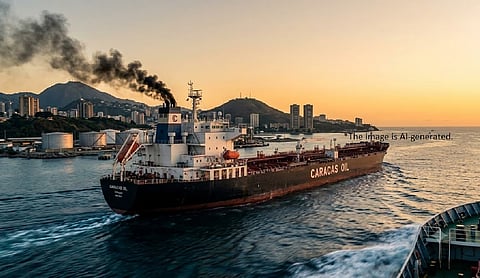
The visit of Venezuelan Acting-President Delcy Rodríguez is good news for Indian households, as she brings with her the promise of an alternative to Gulf oil that can keep Indian cars running and the wheels of industry turning. Venezuela’s Acting President, heading a high-powered delegation that includes her finance, science and transportation ministers, arrives at a moment when India’s energy calculus has been upended. The near-closure of the Strait of Hormuz — a corridor that once handled over 40 per cent of India’s crude imports — has forced Indian refiners into a scramble for alternative supplies. Venezuela, sitting atop the world’s largest proven oil reserves, has stepped decisively into that breach. The numbers are striking. India imported 427,000 barrels per day from Venezuela in May alone, making it the second-largest buyer of Venezuelan crude globally, trailing only the United States. Reliance Industries has emerged as one of Caracas’s three largest customers worldwide. Bilateral trade stands at $678.94 million — modest by global standards, but a number that carries momentum and direction.
Diversification is meaningless without reliable alternatives. Venezuela, once sidelined by US sanctions, re-entered India’s supply map after sanctions were eased in February under a Washington-Caracas oil pact. The timing was fortunate: it gave Indian refiners a viable Western Hemisphere alternative precisely when the eastern routes tightened. New Delhi — with at least tacit American encouragement — has moved with unusual swiftness to secure the relationship.
What makes this partnership structurally attractive is price. Venezuelan heavy crude trades at a significant discount to Brent benchmarks, helping India moderate its import bill at a time of fiscal pressure. Three takeaways deserve particular attention. First, supply-chain resilience now demands geographic diversification, not just source diversification. India cannot afford a repeat of the Hormuz shock; Venezuela offers a supply route across the Atlantic, entirely decoupled from West Asian chokepoints. Second, the bilateral agenda — stretching across pharmaceuticals, renewable energy and transportation —suggests India intends to offer Venezuela a development partnership, not merely a transactional crude contract.
Third, Rodríguez’s visit comes five months after President Nicolás Maduro’s dramatic detention by U.S. forces, a fact that places India in a diplomatically delicate position - one it is navigating with characteristic pragmatism, keeping Washington engaged while preserving access to Caracas.
Diplomatically, the trajectory points towards a structured long-term energy agreement — possibly involving rupee-bolívar settlement mechanisms, equity participation by Indian PSUs in Venezuelan oilfields, and joint ventures in refining. India has walked this road with Russia, Iraq and the UAE. Venezuela is the next chapter. The risk is political volatility in Caracas. New Delhi will seek contractual architecture that hedges against it. If this visit delivers even a framework agreement, it will mark a significant step in India’s quiet but relentless effort to build an energy supply network that no single geopolitical crisis can unravel.