Epstein files: The collapse of Western moral pretence
Every civilisation carries within it certain self-images — stories it tells itself, and others, about what it stands for. The West, particularly after the Second World War, fashioned for itself the role of the world’s moral tutor: the guardian of human rights, the champion of the rule of law, the protector of the vulnerable, and the standard-bearer of liberty and equality.
This self-appointed moral authority of the West was not merely rhetorical; it was aggressively exported to the rest of the world, often accompanied by economic pressure, political intervention, cultural domination, and even military force.
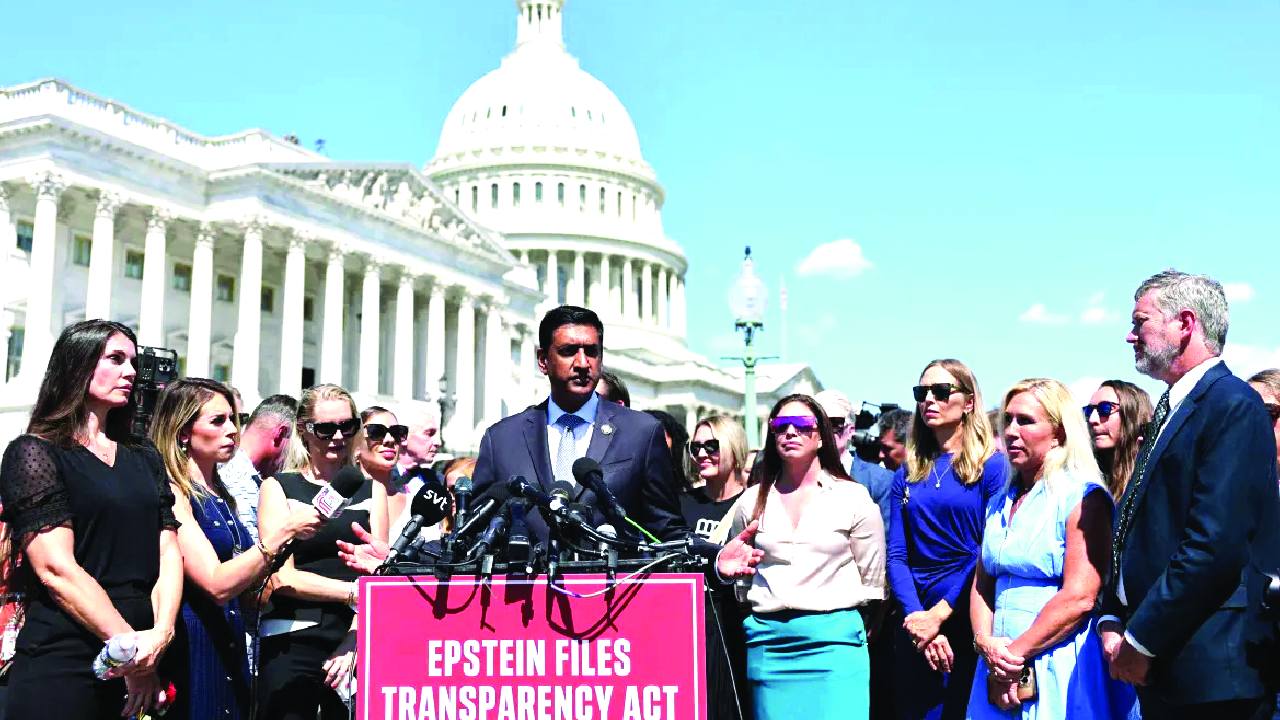
The Epstein Files, whose latest tranche - more than three million pages, 2,000 videos, and 180,000 images — was released by the US Department of Justice on January 30, 2026 under the Epstein Files Transparency Act, have torn this carefully constructed façade to shreds.
To understand the significance of the Epstein Files, one must first understand how and why they came into existence. Jeffrey Epstein was not a marginal criminal operating in the shadows. He was a systemic predator, enabled and protected by the system.
First charged in 2006 for sexual abuse of minors, Epstein received an extraordinarily lenient plea deal in 2008 — an early demonstration of elite immunity within the American justice system. He resurfaced in 2019, charged with federal sex trafficking, only to be found dead in a New York jail under circumstances officially ruled a suicide but widely questioned.
The files themselves emerged primarily from court-ordered disclosures linked to a defamation lawsuit filed by Virginia Giuffre against Ghislaine Maxwell, Epstein’s closest associate and recruiter. After Epstein’s death and Maxwell’s subsequent conviction, sealed documents — flight logs, contact books, testimonies, depositions, and internal correspondence — began to surface between 2024 and 2026, despite sustained institutional resistance.
These documents were meant to answer one central question: Who enabled Epstein’s sin enterprise, and why was it protected? Jeffrey Epstein was a financier without a transparent business model, a social climber without clear credentials, and a benefactor to powerful institutions without accountability. Yet he moved effortlessly through the highest corridors of Western power. His aircraft, infamously known as the ‘Lolita Express’, ferried some of the world’s most powerful individuals to his private island and residences.
Epstein was embedded in US political culture, not as an outsider but as an insider — hosting presidents, funding universities, advising billionaires, and socialising with royalty. His role was that of a connector — a facilitator within a system where influence trumped ethics.
The files mention political figures like Bill Clinton, Donald Trump, Prince Andrew, Bill Richardson, and Ehud Barak. Business elites: Bill Gates, Elon Musk, Peter Thiel, Steve Bannon, Howard Lutnick. Cultural and intellectual figures: Michael Jackson and Stephen Hawking. Royalty: Norway’s Crown Princess Mette-Marit and Britain’s Prince Andrew Mountbatten-Windsor.
Appearances and names in the files do not necessarily imply criminal guilt. Yet the sheer density of power surrounding a known sexual predator exposes a disturbing normalisation of proximity to evil within Western elite culture.
One of the West’s most loudly proclaimed virtues is equality before the law. The Epstein Files demolish this claim. Perhaps the most chilling revelation of the Epstein Files is the ease with which predatory behaviour coexisted with respectability.
This normalisation did not occur in a vacuum. It emerged from a broader cultural trajectory in the West — one that increasingly divorces freedom from responsibility, desire from restraint, and rights from duties.
Biological gender itself has been problematised. The commodification of the human body — especially the female body — has been repackaged as liberation. When such values are normalised, the result is not emancipation but exploitation. Epstein is not a deviation from Western modernity; he is its logical consequence.
The corruption uncovered by the Epstein Files exemplifies the widespread decay within the US socio-political fabric. Around 40 per cent of young Americans today struggle with isolation, depression, and loneliness, contributing to an alarming rate of 400-600 mass shootings annually. In 1960, only 13 per cent of Americans lived alone; by 2022, the number had surged to 29 per cent. Divorce rates oscillate between 40 and 80 per cent, and one-third of American youth reportedly prefer to avoid living with their parents, leaving the care of the elderly to the state. In 2019, the US government spent nearly $1.5 trillion on elderly care, a figure projected to double by 2029.
The West is undeniably caught in a moment of hubris, facing its own moral reckoning. History taints its reputation with bloodshed and coercion, from the brutal executions during the Inquisition — where millions were burned alive, tortured, or condemned as heretics or witches by the Church — reminding us of a dark past that still echoes today.
Across the Americas, Australia, and New Zealand, rich Indigenous cultures were systematically destroyed. Dalits and Tribals in India and Black people in the US were often stripped of their identities and traditions through missionary campaigns that promised dignity but delivered cultural erasure. The Epstein Files belong to this long continuum of moral hypocrisy.
The Epstein scandal fits into a long pattern of institutional protection of sexual predators, most infamously within the Christian Church. The 2004 John Jay Report, commissioned by the US Conference of Catholic Bishops, identified 4,392 clergy accused of sexually abusing minors between 1950 and 2002.
Even more damning was the finding that Church authorities repeatedly chose concealment over accountability — transferring accused priests instead of reporting them. Similar revelations emerged from Ireland, Germany, France, Australia, Canada, and Latin America. The mechanism was always the same: silence, intimidation of victims, destruction of evidence, and moral evasion.
Unfortunately, many countries — including India — have long been trapped in this Western moral framework, mistaking it for modernity. Colonial conditioning taught elites to view Indic civilisation as ‘backward’ and Western norms as universal.
It is therefore significant — and heartening — that India is slowly reclaiming its Sanatan civilisational compass, not as nostalgia but as ethical clarity.
If Indian civilisation can be distilled into a single organising principle, it is the Bhagavad Gita’s doctrine of Karma Yoga: Karmanye Vadhikaraste Ma Phaleshu Kadachana (You have the right to action alone, never to its fruits).
This is not fatalism; it is moral discipline. In Indic thought, duty precedes entitlement. Rights are not demanded; they emerge naturally when duties - ‘dharma’ — are fulfilled.
A fundamental misunderstanding - often encouraged by Western categories — is the equation of dharma with religion. Dharma is not a ritual system; it is the inherent duty of beings and institutions. The sun’s dharma is to give light; fire’s is to burn; water’s is to sustain life. Similarly, a father, mother, teacher, ruler — each has a dharma. In fulfilling these duties, the rights of others are automatically protected. The Epstein Files are not merely about a criminal network; they are a civilisational indictment. They reveal the hollowness of a moral order that speaks incessantly of rights but neglects duty, celebrates freedom but detests restraint, and preaches virtue while nurturing vice.
India need not gloat. It must learn — and remember — that civilisations do not collapse only from external attacks; they decay from internal paradoxes and hypocrisy. The West today stands exposed not by its enemies but by its own contradictions. India’s task is unambiguous: not to imitate the West but to build on its own civilisational inheritance — rooted in karma, dharma, restraint, and moral accountability.
The writer is an eminent columnist, former Chairman of the Indian Institute of Mass Communication (IIMC), and the author of ‘Tryst with Ayodhya: Decolonisation of India’ and ‘Narrative ka Mayajaal’; views are personal