
- HOME
- INDIA
- WORLD
- BUSINESS
- STATES
- LAW & JUSTICE
- ENTERTAINMENT
- SPORTS
- VIEWPOINT
- LIFESTYLE
- TECH
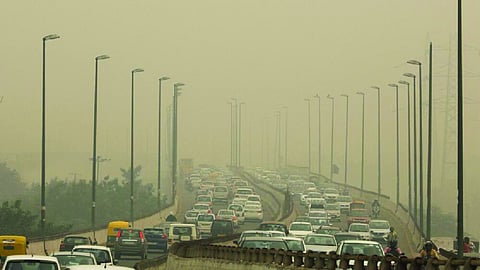
Every winter after Diwali, the National Capital Region (NCR) slips into a silent public health emergency. Pollution spikes begin with the bursting of firecrackers-whether officially permitted “green” crackers or illegal ones, where “green” is often only a label-and are followed by stubble burning in neighbouring states. Public discourse then predictably shifts into a blame game, frequently singling out resource-poor farmers.
As temperatures fall, winter meteorological conditions-characterised by low wind speeds, high moisture, and overcast skies-trap pollutants near the ground and intensify exposure. Sluggish winds and rising moisture form dense smog; the denser the smog, the worse the Air Quality Index (AQI). Under these stagnant conditions, industrial and vehicular emissions blanket the air with toxic pollutants, further aggravated by construction dust, biomass burning, and other sources, leaving the NCR struggling to breathe.
Governance responds each year with a burst of emergency measures, such as smog towers, chemical water sprinkling, and episodic controls, including GRAP, many of which are cosmetic or gimmick-driven. These interventions operate on a minimal scale and cannot meaningfully improve air quality across a region of tens of millions. Pollution monitoring is at times compromised, further eroding public trust. Judicial interventions follow, directives are issued, and committees are formed to recycle well-known recommendations, often announced just as winter recedes and natural atmospheric dispersion sets in. Pollution levels dip marginally but remain unsafe for most of the year, improving only during rainfall; the same cycle repeats, winter after winter.
It is not that solutions are unknown. The core principle-simply put, not to pollute-is well understood, including by governance. However, translating this into action requires strict measures, initial inconvenience for all, and substantial investments in building pollution-control infrastructure. To avoid accountability and difficult choices, governance often defaults to populist measures, gimmicks, and temporary fixes.
Predominantly Toxic Pollutants
A December 2025 assessment by the Centre for Science and Environment (CSE) confirms that air pollution in the Delhi-NCR region is becoming increasingly toxic, particularly in the early winter months. Pollution levels remain high from October to November, with air quality deteriorating across the region, including smaller towns, and recent gains at risk of reversal. CSE highlights the daily synchronised rise of PM2.5 with toxic gases such as nitrogen dioxide and carbon monoxide (CO), mainly from vehicular and combustion sources, forming a dangerous mix that has received inadequate policy attention. Long-term trends indicate a plateau rather than improvement, suggesting a structural failure and underscoring CSE's warning that only sustained, long-term measures-not seasonal fixes-can reverse the decline.
Last week, the Commission for Air Quality Management (CAQM) informed the Supreme Court that vehicular emissions are the largest contributor to Delhi-NCR's air pollution (41%), followed by construction dust (21%), industry (19%), power plants (5%), residential sources (3%), and others (11%). While stubble burning is seasonal, most major sources persist year-round, together generating consistently high levels of toxic air.
A Silent Health Epidemic: Officially Denied
Severe air pollution in the NCR during winter has become a slow-moving medical epidemic. AQI, PM2.5, and other pollutants often reach hazardous levels. When the AQI exceeds 400, even healthy individuals are affected. Infants, children, the elderly, and those with chronic lung diseases such as COPD (Chronic Obstructive Pulmonary Disease) suffer the gravest and often lasting harm.
The scale of this crisis is highlighted by the Lancet Countdown on Health and Climate Change, prepared with the World Health Organization (WHO), which estimates that 1.7 million deaths in India in 2022 were attributable to PM2.5 exposure, with fossil fuel combustion accounting for the largest share finding also echoed by CAQM.
Despite this evidence, a July 2024 Lok Sabha reply by the Ministry of Environment, Forest and Climate Change stated that no deaths were reported due to air pollution, citing the absence of conclusive data linking deaths exclusively to it, and noting that health outcomes are influenced by multiple factors such as diet, occupation, socio-economic conditions, medical history, immunity, heredity, and the environment.
More troublingly, the Ministry of Health and Family Welfare issued an identical, word-for-word response in the Rajya Sabha in early December 2025, despite a gap of nearly 17 months. This verbatim repetition by two lead ministries reflects a troubling lack of seriousness and an evasion of accountability, underscoring the persistent apathy of governance towards a deadly menace that warrants recognition as a public health epidemic.
Air pollution in the NCR is not a rhetorical or seasonal inconvenience; it is a slow, deadly epidemic, particularly for infants, the elderly, and those with chronic respiratory diseases. Nonetheless, due to the growing outcry, CAQM has recently formed a committee to promote “evidence-based policy action for improving air quality and safeguarding public health in Delhi-NCR.” The 15-member committee, chaired by an electrical engineer specialising in electric vehicles, is expected to submit its report in two months.
As happens every year, by the time winter recedes, atmospheric conditions improve, and pollution levels fall. The crisis then appears resolved, attention drifts, familiar recommendations resurface, and the annual cycle resumes with the reassurance that “all is well”.
When the committee releases its recommendations, it is unlikely that they will contain anything new. They will reiterate familiar points already known to all. In short, it will be business as usual fundamental innovation, and none expected or feasible.
Learning from Beijing's Experiences
India does not need to reinvent solutions; they are already well known. As a pointed reminder, a Chinese Embassy official in India recently tweeted how Beijing-until not long ago facing a similar crisis-successfully curbed air pollution through decisive and sustained action. What India now needs is the holistic implementation of that proven approach.
Beijing demonstrated that decisive, evidence-based policies backed by firm enforcement can rapidly reduce urban air pollution. Its multi-pronged strategy focused on cutting emissions at the source, particularly from vehicles and industry, through ultra-stringent emission norms, phasing out older high-emission vehicles, curbing unchecked private car growth, expanding clean mobility via metros, buses, rail, and electric vehicles, and relocating polluting industries away from dense urban centres. These hard choices delivered measurable and sustained improvements in air quality.
Real improvement in India similarly depends on preventing pollution at its source: strict control of vehicular and industrial emissions, cleaner construction practices, sustained investment in clean energy and public transport, a planned transition to electric mobility across all segments, and decongestion of the NCR through decentralised economic planning.
Conclusion
The lesson is clear. Governance must move beyond appointing routine committees to restate known solutions and instead establish task-oriented bodies to assess feasibility, estimate costs, define timelines, and move swiftly towards execution. What is urgently required is implementation on a war footing-not another cycle of reports and delays.
Breathable air can be achieved only through genuine prevention, cleaner mobility, strict emission control, and accountable governance. It will not come from rhetoric, gimmicks, optics, or committees that delay action. Addressing air pollution is neither ideological nor political; it is a scientific necessity and an urgent public health imperative.
The author is a former professor of Computer Science at IIT Kharagpur, IIT Kanpur, BITS Pilani, and JNU, and a former scientist at DRDO and DS; views are personal