Cash in hand, capacity in retreat?
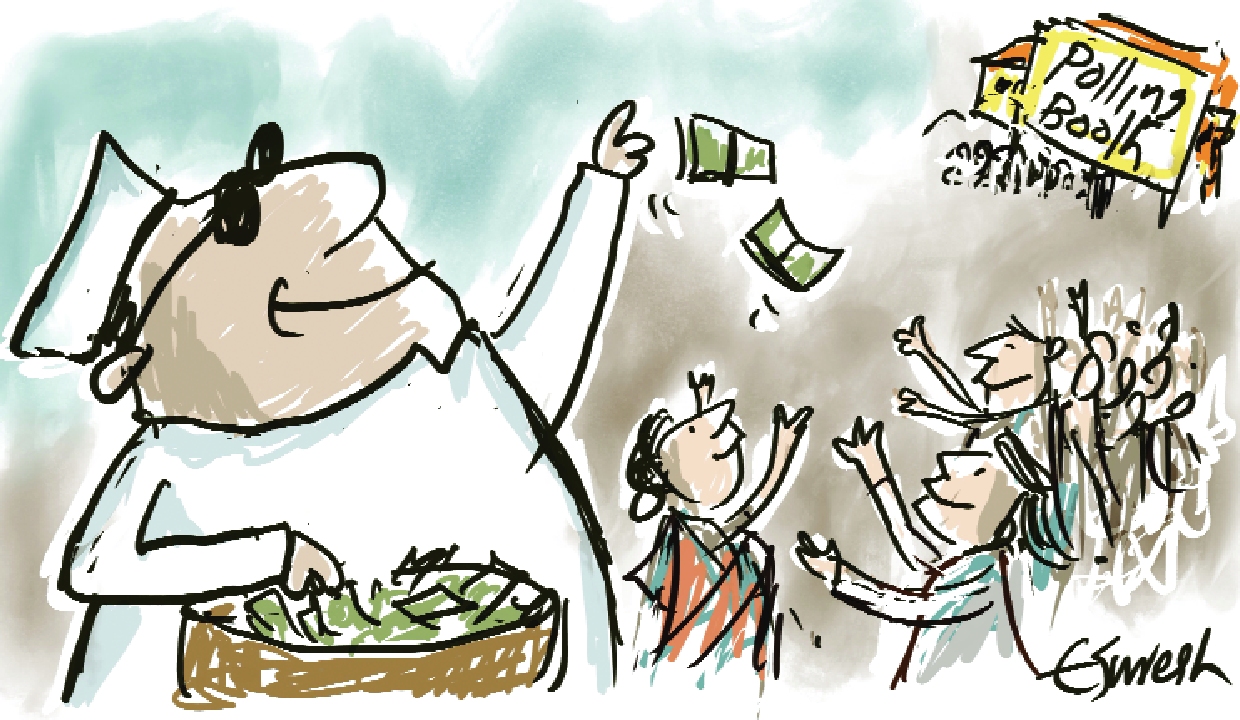
As states commit ever larger sums to recurring transfers, a more difficult question is emerging: what happens to the long-term investments that build human capability and public capacity? The debate must move beyond the simplistic contest between welfare and “freebies” to examine whether today’s cash transfers are coming at the cost of tomorrow’s schools, hospitals and infrastructure.
The argument over welfare in India is still framed as a morality play: cash transfers are either social justice or "freebies". That binary misses the harder public-policy question. The issue is not whether states should put money directly into citizens' hands. It is whether recurring transfers are beginning to compete with the schools, health systems, nutrition networks and infrastructure that make welfare durable.
The numbers now make that question unavoidable. The Economic Survey 2025-26 estimates that states will spend about Rs 1.7 lakh crore on largely unconditional cash transfers, particularly to women, in FY26. PRS puts the corresponding estimate at Rs 1.68 lakh crore across 12 states, up from only two states in 2022-23; six of the 12 budgeted for revenue deficits. In individual states, these schemes are no longer marginal: PRS estimates they absorb 12.1 per cent of revenue expenditure in Jharkhand, 9.2 per cent in Karnataka and 8.9% in West Bengal in 2025-26.
The trend has not disappeared in the newest budgets. West Bengal has budgeted Rs 36,000 crore for Annapurna Bhandar in 2026-27-about 11 per cent of projected revenue receipts. Madhya Pradesh has allocated Rs 23,883 crore to Ladli Behna, while Maharashtra has set aside Rs 26,500 crore for Ladki Bahin. Karnataka’s five guarantee schemes are budgeted at Rs 51,286 crore in 2026-27, roughly 12 per cent of expenditure excluding debt repayment. These are large, politically salient and often socially valuable commitments. But they operate inside budgets that are already tight.
That fiscal context matters. PRS notes that states collectively devoted 53 per cent of revenue receipts in 2023-24 to salaries, pensions and interest payments, while outstanding state debt remained about 27.5 per cent of GDP in 2024-25. At the same time, the average allocation across states in 2025-26 was about 14.5 per cent of expenditure for education and 6.2 per cent for health. A rupee committed recurrently to one purpose is therefore a rupee whose alternative use deserves scrutiny.
This is not evidence that cash transfers are inherently wasteful. The Economic Survey cites estimates that such transfers equal 11-24 per cent of monthly income for female casual labourers and 11-87 per cent for self-employed women across seven studied states. Cash can smooth consumption, reduce distress and give recipients agency in ways that in-kind programmes sometimes do not. The policy error begins only when cash is treated as a substitute for public capacity rather than a complement to it.
There is some evidence that the trade-off can become real. In Karnataka, PRS cites the CAG’s observation that expansion of the guarantee schemes increased revenue expenditure and the revenue deficit, while infrastructure spending in 2023-24 was Rs 5,229 crore lower than in the previous year. That does not prove that every transfer crowds out every public investment. It does show why the opportunity cost can no longer be dismissed as theoretical.
The political economy is straightforward. A monthly transfer has an identifiable beneficiary, a predictable payment date and immediate visibility.
A better Anganwadi network, a functioning primary health centre, more teachers or safer hostels produces benefits that are slower, dispersed and less electorally legible. Governments therefore face a structural incentive to prefer welfare that can be credited to a scheme over welfare embedded in institutions.
The answer is not to prohibit transfers. It is to make their opportunity cost visible. Every state introducing or substantially expanding a large recurring cash programme should publish a Social Investment Displacement Statement with its budget. It should show the scheme’s five-year liability, financing source, beneficiary incidence and measurable outcomes, while disclosing whether real per-capita spending on education, health, nutrition, maintenance or capital formation is being compressed. It should also specify when the scheme will be independently reviewed.
This would improve the debate because "freebie" is an economic label pretending to be an analytical category. Some transfers may be powerful redistributive instruments; others may become fiscally difficult to sustain.
The distinction cannot be made from the mode of payment alone. It requires evidence on outcomes, fiscal durability and what the expenditure displaces.
India does not have to choose between cash and public services. Poor households often need both. A welfare state should ultimately be judged not by how efficiently it transfers money, but by whether it builds the capabilities citizens cannot purchase individually.
A bank transfer can reach a household. It cannot by itself staff a school, prevent malnutrition, run a hospital or build a functioning State.
Conclusion
The debate, therefore, is not about abandoning cash transfers but about restoring discipline to welfare policy. Direct payments can provide dignity, security and economic agency, especially to those living with persistent vulnerability. Yet no transfer can replace the public institutions on which lasting social mobility depends. States must make transparent what large recurring schemes cost over time and what other investments they may constrain.
The political economy is straightforward. A monthly transfer has an identifiable beneficiary, a predictable payment date and immediate visibility. A better Anganwadi network, a functioning primary health centre, more teachers or safer hostels produces benefits that are slower, dispersed and less electorally legible
The writer is Professor at Department of Economics, Director, Centre of Excellence (CoE) for Public Policy, Sustainability, and ESG advances research, Alliance University, Bengaluru; Views presented are personal.