Bonded to dollar, gold is on hold
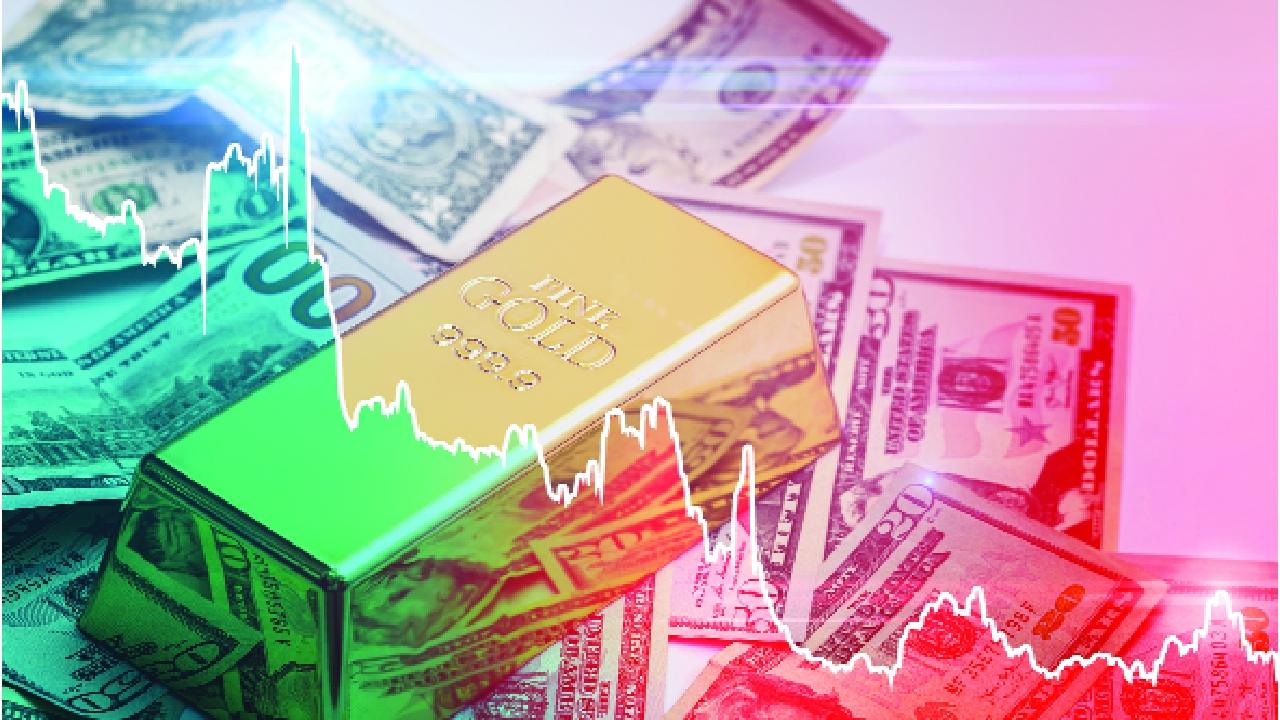
For more than a decade, experts noticed a peculiar trend. Contrary to belief, both equities and gold went up, as if in a tango. Now, the opposite is true. In a similar step-by-step fashion, both are down. Normally, gold, as a safe hedge, moves up when stocks are down, and vice versa. This is especially true during the war periods, when investors rush to seek safe-havens for their money. The inverse relation is no longer true. More importantly, apart from the dollar, and a few other currencies, and the US treasury bonds, most asset classes, including housing, silver, metals, and commodities are spiraling down. There are few secure options, and most investors, including institutions and high net-worth individuals, seem clueless. For example, no one knows how high crude oil prices will rise, or how low will the equities tumble. One is not sure if the dollar will remain strong for long.
However, one can think of several reasons for the ongoing trends that seem mysterious and inexplicable. The first is that the money is getting out of equities for obvious reasons such as low growth in global economies, high trade deficits due to more expensive imports and lower exports, currency volatility, and corporate earnings. But instead of flowing into gold or silver, as expected, it is being invested in dollars, and US securities. The dollar is strong because America seems to be the only economy that can withstand the vagaries of war, and emerge as the real victor, not just militarily but economically. According to some estimates, a 0.1 per cent increase in the dollar index depresses gold by $8-12 an ounce. Silver is more sensitive to dollar swings. Hence, the recent fall in silver is more severe than the yellow metal. Other precious metals like platinum, and even non-precious ones like copper are down.
Investors’ shift towards the dollar implies a penchant for the US treasuries, and the yield on 10-year treasury bond bonds rose to more than 4 per cent. For investors, such a return linked to dollar terms is quite lucrative during a period of extreme uncertainties. It takes the attention away from gold and silver, which are the default options. Indeed, money may flow out of the precious metals into treasuries, which causes short-term selling pressures in the former assets. The ongoing trade tensions, with the US imposing a 10 per cent tariff, and threatening to hike it to 15 per cent, inflation risks, and low growth rates may prompt the central banks to hike interest rates. If the US Federal Reserve goes slow on rate cuts, or even hikes them, the dollar and American treasuries become more attractive. Such interest rate expectations force the investors to hold their moves vis-à-vis gold.
According to some experts, the more cautious institutional investors like the large pension funds may seek to sit on cash rather than invest the money. Hence, they withdraw money from most asset classes such as equities, precious metals, and commodities, and wait for the new opportunities to emerge in an across-the-board fall in most assets. At some stage, when the positive signs appear that the ongoing war tensions may end, and the asset prices are ridiculously low, these funds come back as buyers with a vengeance. They convert cash holdings into investments, as the prices begin to shoot up. Obviously, no one can time the markets perfectly, but the large investors can enter lower-than-expected ranges, and ride the upward momentum with aplomb. For many, including middle-class investors, cash is king in times of war, and other disruptions. It will remain so till the scenario changes.
Some jewelers, like an Indian tycoon in Dubai, whose 200 stores in the UAE, India, and the US hold an inventory of 16,000 kg of gold, believe that this is a short-term blip in gold, which is bound to rise in the future. Other optimists contend that what is happening now is more of “profit-taking (in gold) rather than panic buying (selling).” Once the war de-escalates, as it eventually will, bullion prices will shoot up. They add that “gold and silver are experiencing short-term volatility rather than a structural decline with macroeconomic forces dominating safe-haven demand.” In the future, as the recent past indicates, gold, silver, and equities will continue their upward march together. This is evident from the technical charts, as gold futures trade above the technical support levels, despite the recent dips. More importantly, gold is neither in an overbought or oversold situation, which indicates stability.
One needs to remember that while we still talk about gold and silver as hedges to economic tensions, this is only true during the tensions. For example, gold was purchased in huge quantities after the Great Recession in 2008. The same was true in the post-pandemic period. In normal scenarios, when there are no tensions, gold is not considered a hedge but a crucial ingredient in investors’ portfolios. In effect, bullion is an independent asset class, like equities and real estate, and needs to be a part of any portfolio based on risk appetite. In such situations, gold purchase is not limited to safety and security, but based on possible returns, as is the case with the other assets. So, the buying is continuous rather than in bursts, and during specific periods. This is one of the reasons why gold and equities moved in tandem over the past decade or so, and the same is likely to happen in the future.
Hence, the medium-case rationale for another bull phase in gold, say some experts, remains intact. “Central banks globally are buying gold at near-record rates. The Iran conflict, even if it shortens, leaves structural supply disruptions, and elevated geopolitical uncertainty embedded in energy markets. The Federal Reserve will cut rates eventually. When it does, non-yielding assets like gold and silver will benefit directly, and immediately. Today’s (Thursday) decline is noise inside a longer-term signal that still points higher,” states a report. If the Middle East war intensifies and continues, there are more reasons that despite the dollar strength, gold will re-emerge as a safe-haven choice. In this respect, it does not matter whether the conflict intensifies, or there is a ceasefire. In either case, there is likely to be buying pressures in gold and silver. “For now, the metals market is a tug-of-war between geopolitics and macroeconomics. Geopolitical risks are supporting gold in the long-term, while a strong dollar and higher (bond) yields are limiting immediate gains,” states a report.