Blistering heatwave: Delhi-NCR temperature spike to 45°C
Delhi-NCR continues to reel under intense heatwave conditions as of April 26 afternoon, with maximum temperatures soaring between 41 degrees Celsius and 45 degrees Celsius across the region. Residents are experiencing one of the harshest spells of summer so far, with hot winds, dry conditions, and very high daytime temperatures.
Delhi recorded a maximum temperature of 42.1 degrees Celsius on Sunday, 3.1 degrees above the seasonal average. The India Meteorological Department (IMD) said maximum temperatures between 42 and 44 degrees Celsius were recorded across the city, but heatwave conditions were not declared as the readings remained close to the prevailing normal levels. However, there is some relief in sight. According to the latest weather updates, the heatwave in Delhi is expected to ease from April 28 onwards, bringing a noticeable drop in temperatures.
“The normal temperature is updated every five days to reflect seasonal changes, and for Safdarjung it has increased to 39.0 degrees Celsius for April 26-”30 from 37.7 degrees Celsius during April 21-25, which reduces the gap needed to classify a heatwave,” the IMD said.
The minimum temperature was recorded at 26.2 degrees Celsius, 2.4 notches above normal, at the Safdarjung observatory, the city’s primary weather station. Delhi has been witnessing continuous heatwave conditions for the past three days, with temperatures significantly above normal levels. The weather department notes that maximum temperatures are currently markedly above normal by 5°C or more, while minimum temperatures are also higher than usual, ranging between 25°C to 27°C.
Among other monitoring stations, Palam recorded a maximum temperature of 41.8 degrees Celsius and a minimum of 27.4 degrees Celsius, while Lodhi Road registered 42.2 degrees Celsius and 24.6 degrees Celsius, respectively. Ridge recorded the highest maximum temperature at 43.5 degrees Celsius, with a minimum of 26.5 degrees Celsius, while Ayanagar logged 43.1 degrees Celsius and 27.1 degrees Celsius, respectively. The weather department has issued a yellow alert for heatwave-like conditions in the city for Monday, with the maximum and minimum temperatures expected to reach around 44 degrees Celsius and 27 degrees Celsius, respectively. Relative humidity was recorded at 23 per cent at 5.30 pm.
Hot westerly winds blowing at speeds up to 18 kmph, gusting to 30-40 kmph, have further intensified the discomfort. These dry winds are a key reason behind the persistence of heatwave conditions across Delhi, Noida, Gurugram, Ghaziabad, and surrounding areas.
IMD said a Western Disturbance is currently active in the upper atmosphere (around 5.8 km altitude). This system is known to bring changes in wind patterns and can lead to cloud formation, light rain, or thunderstorms, which help reduce temperatures. A shift from hot, dry westerly winds to relatively cooler easterly winds at lower levels (up to 1.5 km altitude) is expected. This change will play a major role in lowering daytime temperatures.
The air quality was recorded in the ‘poor’ category at 4 pm, with an Air Quality Index (AQI) reading of 222, according to the Central Pollution Control Board (CPCB) data.

Delhi gears up for summer with enhanced action plan
New Delhi: As Delhi stares at another severe summer, the city Government has ordered stricter and more scientific enforcement of its heatwave action plan, with Chief Minister Rekha Gupta directing officials to focus on identified thermal hotspots, protect schoolchildren and labourers, and ensure uninterrupted electricity as demand is expected to exceed 9,000 MW.
The fresh instructions were issued after a detailed review of heat preparedness, as temperatures continue to rise sharply across the Capital. Officials have been told to move beyond routine advisories and ensure visible field-level action in areas most vulnerable to extreme heat.
Under the revised strategy, the government has identified several high-risk thermal pockets through satellite mapping and scientific assessment. Among the most heat-stressed locations are Ayanagar, which has earlier recorded 45.5 degrees Celsius, Najafgarh, Safdarjung, Wazirpur, Jahangirpuri, Khayala, Shastri Park, Vishwas Nagar, Harkesh Nagar, Hari Nagar, and Delhi Gate.
Densely populated outer settlements such as Sawda, Mubarakpur Dabas, Bhalswa, Nand Nagri, Gokulpuri, and Bakkarwala have also been marked as zones facing severe heat island impact. Officials said these locations will receive additional water tankers, higher ORS stocks at health centres, and deployment of quick response teams.
Chief Minister said this year’s plan has been made more robust with a scientific approach and stronger on-ground monitoring. She said vulnerable groups will receive special protection, and departments have been instructed to respond quickly to all heat-related emergencies.
One of the major areas of concern is the safety of school children. The Government has directed that if heat conditions worsen, children may be given ORS solution before leaving school to prevent dehydration during travel. Schools have been asked to remain alert and coordinate with local authorities if emergency intervention is needed.
Construction workers and outdoor labourers have also been brought under a stricter safety net. During severe heatwave conditions, outdoor work may be stopped between noon and 3 pm. Employers will be required to provide drinking water, caps, cloth head covers, ice packs, and first-aid support at worksites.
In an unusual but significant expansion of the plan, departments have also been directed to ensure water and shade arrangements for birds and stray animals. Water bowls and dedicated drinking points are being installed at parks, depots, and school campuses.
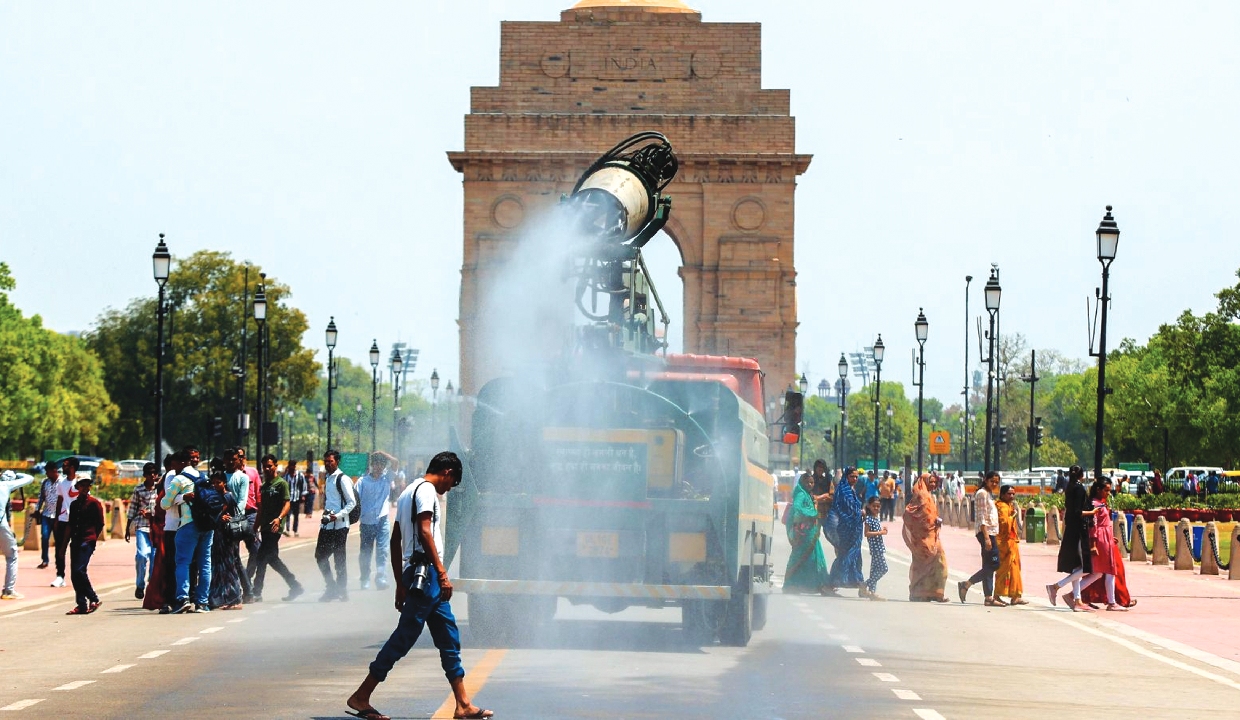
The government is also introducing infrastructure-based cooling measures. Reflective cooling treatment under the proposed Cool Roof Policy has already been applied over nearly 28,674 square feet at Kashmere Gate ISBT. This is expected to reduce indoor heat levels. High-pressure misting systems are to be installed at bus stops, while anti-smog guns will be used in congested built-up areas to bring down surrounding temperatures.
On the medical front, 339 health centres in all 13 districts have been put on alert. More than 30 hospitals have established five-bed cool rooms for patients suffering from heatstroke or dehydration.
A total of 39 quick response teams and trained ASHA workers have also been placed on standby. Residents facing heat-related distress can seek help through the round-the-clock helpline numbers 1077, 1070, and 112.
The government’s concern is not limited to health alone. With air conditioners and cooling appliances expected to push consumption to record levels, Delhi’s peak power demand this summer is projected to exceed 9,000 MW, well above last year’s maximum of 8,442 MW.
The Chief Minister said power discoms have been clearly told that outages will not be tolerated. Special priority supply arrangements have been ordered for hospitals, water treatment plants, and mobile towers. Additional mobile transformers and emergency technical teams are also being kept ready to restore supply immediately in case of faults.
The Chief Minister has asked all departments to treat the heatwave as a full-scale public safety challenge and ensure that relief measures are visible on the ground, not just on paper.