Bangladesh: A country in turmoil — dangerous game of betrayal and sabotage
Bangladesh came into being in 1971 with critical support from India, which helped liberate it from Pakistani oppression. For nearly five decades, the two nations enjoyed robust bilateral relations built on shared history, economic interdependence, and cultural affinity. However, the political upheaval of August 2024 has dramatically altered this landscape, raising troubling questions about Bangladesh’s future trajectory and the
stability of South Asia.
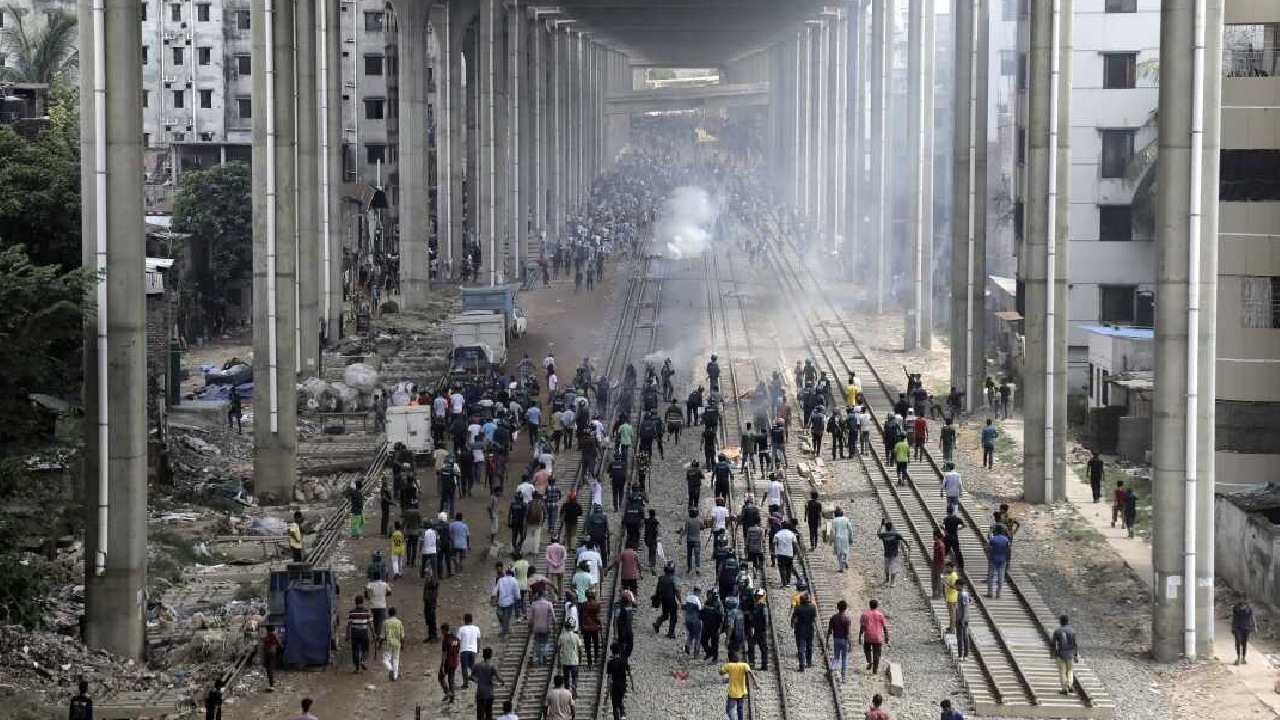
In August 2024, student-led protests that initially focused on quota reform in government jobs escalated into a full-fledged uprising after violent government crackdowns. According to a United Nations report, up to 1,400 people may have been killed during the protests between July 15, and August 5, 2024. Prime Minister Sheikh Hasina was evacuated to India on August 5 ,2024, after protesters surrounded her residence, ending her 15-year rule. The present spate of violence following the death of a radical youth activist, Osman Hadi, has a disturbing anti-India pattern which is further complicating the situation.
The immediate aftermath saw Nobel laureate Muhammad Yunus assume leadership of an interim government. While Yunus’s international reputation initially inspired hope, the subsequent months have witnessed concerning developments that threaten regional stability. The narrative that external powers orchestrated
Hasina’s ouster to punish her for resisting Western pressure is contentious and lacks definitive evidence.
However, analysts note that Washington viewed Yunus’s appointment as an opportunity to enhance US presence in the Indo-Pacific, capitalising on his openness to collaboration with the West. The US moved quickly after the transition, with officials holding talks to support Bangladesh’s economy and USAID signing an agreement to provide over $202 million in aid. Former Prime Minister Hasina has made serious allegations. She claims there is forensic evidence suggesting foreign mercenaries acted as provocateurs during the protests, though she maintains she does not believe the US government was directly involved. The truth likely lies in a complex interplay of domestic grievances, institutional failures, and shifting geopolitical interests rather than simple external conspiracy.
The most alarming development under Yunus’s interim government has been the systematic violence against religious minorities, particularly Hindus who comprise approximately eight per cent of Bangladesh’s population. The Bangladesh Hindu Buddhist Christian Unity Council reported that between August 4 and 20, 2024, a total of 2,010 incidents of attacks on minorities occurred, including attacks on 69 temples. Between January and December 2025, the Institute for Conflict Management recorded at least 34 cases of minority persecution, including killings, lynching, abduction, land seizures, and attacks on places of worship. These are not isolated incidents but part of a disturbing pattern.
Yunus’s response has been inconsistent. While he initially acknowledged persecution in interviews with NPR and others, he later dismissed allegations of Hindu persecution as "baseless" at the UN General Assembly. He has claimed that attacks on Hindus were political rather than communal, occurring while targeting Awami League supporters. This explanation rings hollow when temples are destroyed and minorities face systematic targeting. Whether Yunus lacks the capacity to restore order or is allowing instability to delay elections remains debatable, but what is clear is that his government has failed to protect vulnerable communities. Elections expected in late 2025 or early 2026 now appear increasingly uncertain, raising fears of democratic backsliding. Perhaps most disturbing is Bangladesh’s warming relationship with Pakistan - the very nation whose military committed genocide, mass rape, and atrocities in 1971. Reports suggest Pakistan’s ISI has re-established a presence in Dhaka, alongside renewed defence exchanges. Three million Bangladeshis died in 1971, and countless women were raped. For Bangladesh to now tilt towards Pakistan and adopt an anti-India posture is not merely ungrateful — it is strategically reckless.
These shifts signal a drift away from secular democracy and towards Islamist politics, echoing rising influence of Jamaat-e-Islami and other radical groups. The deteriorating India-Bangladesh relationship carries severe economic costs for both nations. Cross-border trains have been suspended, Bangladesh has banned imports of 33 Indian product categories, and India withdrew transshipment facilities in April 2025. Bilateral trade, worth $13-15 billion annually,
faces disruption.
Major connectivity projects — including transit agreements that benefited Bangladesh’s landlocked access — are at risk. For Bangladesh, antagonising India is economically suicidal. India is Bangladesh’s largest trading partner in South Asia, its primary electricity supplier, and the gateway to markets in Nepal and Bhutan. Meanwhile, the Trump administration imposed a 37 per cent tariff on Bangladeshi products, forcing Yunus to plead for tariff suspension. Bangladesh cannot afford to lose both Indian cooperation and favourable Western trade terms simultaneously.
For India, an unstable Bangladesh represents security threats: refugee flows, terrorism, and Chinese military encroachment near strategic corridors. A Bangladesh aligned with Pakistan and China fundamentally alters South Asian strategic calculations. Bangladesh stands at a critical juncture. The interim government must prioritise three urgent actions: first, immediately end violence against minorities through decisive law enforcement, not mere rhetoric. Prosecute perpetrators and provide reparations to victims. Constitutional protections for religious freedom must be enforced, not merely proclaimed. Second, conduct free and fair elections without further delay.
Democratic legitimacy cannot be indefinitely postponed under the guise of reforms. All major parties, including the Awami League, must be allowed to participate to ensure political legitimacy. Third, recalibrate foreign policy pragmatically. Bangladesh’s geography, history, and economic interests demand constructive relations with India. The Pakistan embrace must be abandoned before irreparable damage occurs. Balance relations with Western powers while maintaining independence, but recognise that India remains indispensable for Bangladesh’s prosperity and security.
For India, strategic patience is essential. While protecting its interests firmly — including demanding justice for minorities and opposing anti-India activities — New Delhi should maintain economic ties, support Bangladeshi civil society, and engage with all political stakeholders, including the Bangladesh Nationalist Party. Overreaction could push Bangladesh further towards Pakistan and China.
Bangladesh’s current trajectory threatens to squander the gains of five decades. The student protesters who courageously demanded democracy deserve better than violence, instability, and dangerous geopolitical realignments. The blood shed in 1971 for Bangladesh’s independence should not be forgotten in 2025 through ill-conceived partnerships with historical oppressors.
The stakes transcend bilateral relations. Bangladesh’s choices will determine whether South Asia moves towards integration and prosperity or fragmentation and conflict. The interim government must recognise that Bangladesh’s future lies not in embracing Pakistan’s ISI or playing great-power games beyond its capacity, but in honouring its democratic aspirations, protecting all citizens regardless of faith, and maintaining the strategic partnerships that enabled its birth as a nation. Time is running out to choose the right path.
The author is a retired Additional Director General of the Indian Coast Guard and a defence and strategic-studies expert. He is an alumnus of the United States Naval War College, Rhode Island; views are personal