Ayodhya Flag Hoisting Marks a Civilisational Turning Point for India
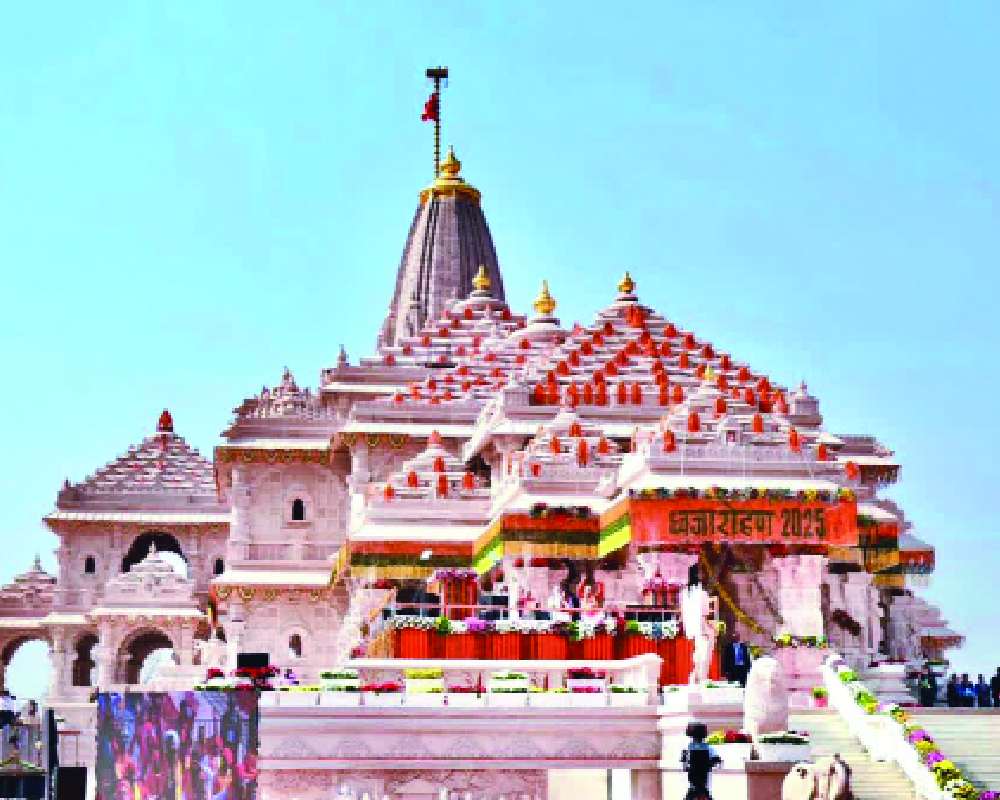
Ayodhya’s flag hoisting marks a rupture in India’s civilisational timeline. It is not a ceremonial ascent of cloth over stone; it is a declaration that Indian civilisation, after centuries of subjugation, distortion, and hesitation, has resumed authorship of its own story. The moment becomes even more defining when placed alongside the speeches delivered today by Prime Minister Narendra Modi and RSS Sarsanghchalak Mohan Bhagwat, both of whom articulated a clear shift in India’s civilisational self-understanding.In mainstream political discourse, speeches often function as commentary. Today’s addresses were different. They belonged to the category of foundational articulation, the kind that frames eras and redirects national consciousness. The Prime Minister spoke not as an administrator of the present but as a custodian of a long civilisational arc. He placed Ayodhya not merely in the domain of faith or national sentiment but in the deeper continuum of historical recovery—an India reclaiming its civilisational confidence after generations of deliberate erosion.
The PM invoked Thomas Macaulay’s 1835 speech, the blueprint of colonial psychological engineering. Macaulay had argued that Britain must detach Indians from “all that is Indian and all that is spiritual,” replacing inherited identity with a colonial mindset. By referencing this, the PM signalled that the struggle for the Ram Mandir was not only about a disputed site; it was about reversing the civilisational disorientation imposed upon India. The flag atop the temple stands as a rejection of that colonial project. It asserts that a civilisational people can reclaim their axis even after centuries of attempted deracination.PM Modi’s emphasis on removing “symbols of slavery” from the national psyche extends this argument. He pointed out that civilisations decline not only through military defeat but through acceptance of imposed inferiority. His message was clear: India must cleanse its public life, public spaces, and public imagination of frameworks that once justified its subjugation. Ayodhya becomes the counter-symbol—not of triumphalism, but of recovered self-respect.The PM framed Ayodhya as a civilisational centre, a point around which national memory, ethical order, and cultural purpose realign. He did not present the Ram Mandir as an achievement of his government. He cast it as a civilisational correction, a return of a people to their foundational narrative, interrupted by invaders, colonial administrators, and post-colonial elites. This framing ensures that Ayodhya transcends electoral politics and becomes a civilisational reference point meant to outlast governments and eras.Mohan Bhagwat reinforced this civilisational framing. He emphasised continuity: how generations of swayamsevaks, saints, devotees, and scholars held firm to the belief that the Ram Janmabhoomi must be restored.
He located the movement within a long tradition of sacrifice—civilisational, not partisan. Bhagwat reminded the nation that the Ram Mandir movement was not born recently; it was the cumulative expression of India’s cultural memory, preserved by saints, akharas, and ordinary people who never let the idea fade.Together, the speeches formed a dual narrative: one rooted in historical memory, the other in institutional continuity.
Modi spoke to psychological recovery; Bhagwat acknowledged the structural labour that preserved the memory through decades.This moment also demands remembrance of those who carried the burden in earlier decades. L.K. Advani transformed cultural yearning into political articulation. Mahant Paramhans Ramchandra Das embodied the spiritual insistence on the sanctity of the site. Mahant Digvijaynath and Avaidyanath ensured the movement stayed on course. Ashok Singhal provided strategic clarity and national mobilisation. The Sangh Parivar sustained the civilisational claim when the political establishment dismissed it.Their contributions created the foundation for the present moment. Without the saints, swayamsevaks, and leaders who shaped the movement’s vocabulary, Ayodhya’s restoration would have remained unresolved. The flag hoisting is therefore not a standalone event; it is the endpoint of a civilisational relay.In this sense, the leadership of the present era delivered the final consolidation. By aligning legal, administrative, infrastructural, and national sentiment into one direction, the current government ensured that centuries of civilisational aspiration materialised.
What makes the moment civilisational is its effect on collective self-understanding. The temple is more than a building; it is a centre of gravity. It signals that Indian civilisation has re-entered public life with clarity, unafraid of its past and unapologetic about its identity. It marks the end of the idea that Indian identity must be diluted to modernise.The PM’s speech recognised this shift. He described Ayodhya as a site where India reclaims “virasat” (heritage) and “vikas” (progress), rejecting the colonial binary between roots and modernity.
His invocation of Macaulay underscored that the civilisational correction is also psychological. India must no longer see itself through colonial eyes.The flag rising above the Ram Mandir declares that a civilisation long denied its centre has restored it.
This moment will be remembered not as a religious event or political accomplishment, but as a civilisational turning point when India regained ownership of its narrative, memory, and future.
The writer is commentator on socio-political issues; views are personal