Assam’s Elephant deaths expose a systemic failure
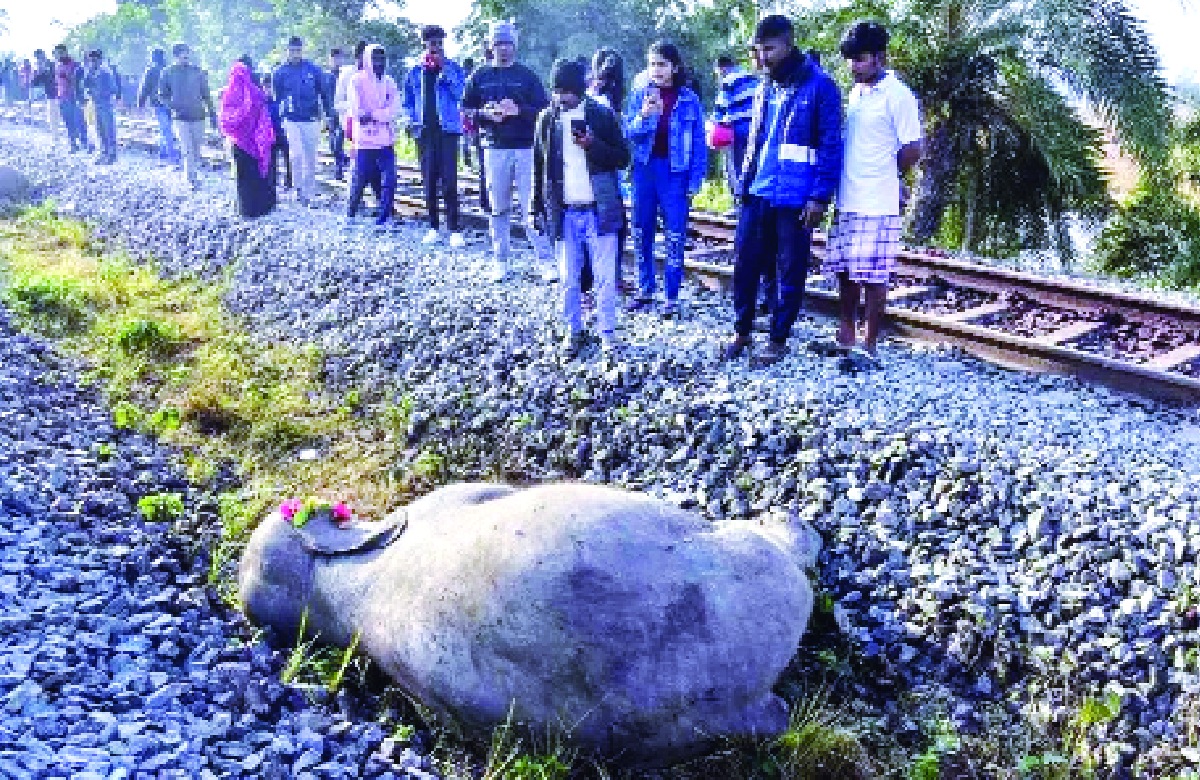
In the wee hours of Saturday, eight elephants were knocked down by the Mizoram-Delhi Rajdhani Express in Sangjurai village, Hojai district of central Assam, killing seven of them on the spot and injuring one. The injured elephant also died the next day while undergoing treatment. Five of the killed elephants were calves. Visibility was very poor due to heavy fog when the train struck the elephant herd. The loco pilot did apply the emergency brake to avert the accident; testimony to this is the derailment of the locomotive and the first five bogies of the train. The train could only be started four hours later, when the derailed bogies were replaced.
The Forest and Railways departments blamed each other for this. Though Sangjurai village is not in the recognised elephant crossing corridor, movement of elephant herds in the paddy fields as well as through the cluster of houses in the village is quite common. The Forest Department has already recognised several corridors for the movement of elephants crossing the rail tracks in the state. I spoke to Assam’s Chief Wildlife Warden, Dr Vinay Gupta, who says that the recognised corridors are many, where trains move with an upper speed limit of 20 km per hour and are monitored with an array of gadgets, but it may not be practical to recognise all rail tracks in the state as corridors. He further added that the track running through the paddy fields of Sangjurai village is elevated and the elephants on the track would not have sufficient time to move out, even after the locomotive whistle or sound was heard. He is hopeful of finding a solution to the problem in a forthcoming brainstorming session with Rail officials.
The Range Forest Officer, Kampur, has informed the press that the place of collision is three-fourths of a kilometre from the potential crossing spot at pillar number 125. Further, AI-enabled intrusion detection systems (IDS) are installed at several places. The nearest system to the accident site is 32 km away, located between Hawaipur and Limdung towns, linking central Assam to the Barak Valley and Mizoram. Locals at the accident site feel that a similar system at Sangjurai could have avoided the accident. They also said that elephants regularly move out of forests from November to February and come to the village for food (paddy and sugarcane), and the authorities have been pleaded with to recognise it as an elephant route.
Ninety-four elephants are said to have been killed in Assam since 2019-20 in train collisions. Elephants in the Jalpaiguri belt of West Bengal are even more vulnerable to train accidents. The last two train collision cases were recorded there. A report, “Suggested Measures to Mitigate Elephant and Other Wildlife Train Collisions on Vulnerable Railway Stretches in India”, has identified 127 stretches spanning over 3,452 km. Seventy-seven railway stretches over 1,965 km in 14 states have been prioritised for mitigation measures. Clearly, there has been laxity on the part of the Railway and Forest departments, as despite such measures being in place, accidents continue to happen.
Linear infrastructure such as roads, railways and canals fragment forests and wildlife reserves as well as corridors for their movement. Although widening of roads and converting single rail tracks into double lines are necessities of growth and development of the country, at the same time, proper mitigation measures must be in place. Development projects such as mining, industries and expanding agriculture also lead to deforestation and degradation of natural forests, and in the process, forests get fragmented. As forest fragments, wild animals have no option but to stray out of reserves.
If the size of forests or reserves is large enough to hold a viable population of wild animals and also provide enough food and water, animals can probably be contained within the reserves. Assam’s forests have been sufficiently fragmented owing to development projects and expanding agriculture. The Bodo agitation also took its toll on forests, and there was massive deforestation during that period. North-eastern states, in general, practise shifting cultivation. Forests are cleared and burned for growing agricultural crops, and after a few years, when productivity falls, villagers clear fresh areas and burn tree growth for cultivation again. Fifteen years later, when forests revive and produce enough humus on the forest floor, villagers return to the original area and again clear the tree growth and burn it. These areas are perpetually cleared for cultivation. What remains as natural forest is on hilltops, which are spared as agriculture is not viable there. The practice of shifting cultivation is quite harmful to forests and wildlife conservation.
Forest-dwelling communities and tribals claim rights over forest land under the Forest Rights Act, 2006. The Act has been grossly misused in the North-east and several other states in central India and along the coast. This has provided a tool for local communities to occupy forests after clearing tree growth and burning. The Act has created a tendency among communities to grab land. It has been the biggest driver of deforestation in post-Independence India. Officially, communities are to claim rights over forest land only if they were in occupation of the land as on December 13, 2005. More than 20 years have passed since the cut-off date; it is high time the Act is repealed.
Central Coalfields Limited, Ranchi, once came up with a proposal to lay a railway line through forests in Jharkhand. During scrutiny of the proposal in the Ministry of Environment and Forests, I found that the line had been deliberately aligned through forests to save costs, as the user agency would have had to pay heavily for the acquisition of private land. I turned it down, but after my transfer, the proposal was accepted. Similarly, the Daitari-Banspani single railway line project through the forests of Keonjhar district of Odisha was turned down by me but approved later. This has led to an increase in wildlife conflict, and collisions of elephants with trains have gone up manyfold. Now the doubling of this rail line has been proposed.
The Hubballi-Ankola rail line through the best forests and wildlife-rich areas of Uttara Kannada district of Karnataka has been turned down by several officers during the last two decades, but the user agency, with the support of some politicians, continues reopening the file every time a new person takes charge. Despite being rejected many times in the past, the file of the Sharavathi pump storage project, requiring the sacrifice of 200 ha of pristine forest in the same district in the Western Ghats, is being reopened repeatedly. These projects will have disastrous consequences for the lives and livelihoods of people in Karnataka and will further aggravate human-wildlife conflict.
Land is a scarce commodity and is required for development projects. If any project is to be permitted, land has to be acquired or forests diverted. The need of the hour is to minimise diversion of forest land, and wherever it is necessary, proper mitigation measures must be built in. Highways and railway lines must have sufficient underpasses for the movement of wild animals. New rail and road projects in elephant areas must be made elevated.
Wildlife and forests protect each other. Since we are not able to transition away from fossil fuel consumption at scale, we must keep our forests intact, which have the potential to absorb one-third of the greenhouse gases we emit.
The writer is a Retired Head of Karnataka Forest Force and presently teaches Economics in Karnataka Forest Academy; views are personal