Ancient Indian Environmental Consciousness and the Path to Forest Revival
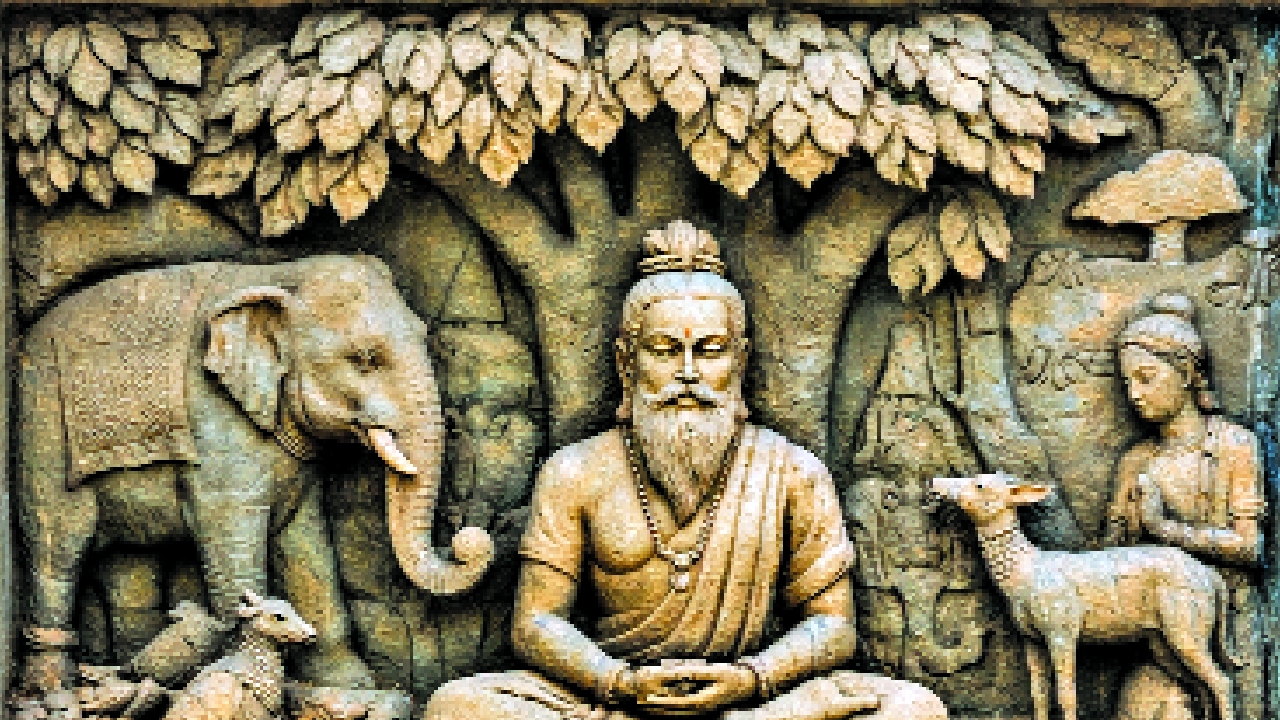
Bharat is not only a modern nation-state. It is a civilizational nation, with a continuum of ethos that entails all aspects of life and existence, including the environment. The Vedas, as our oldest literature; the Epics, Ramayana and Mahabharata; the Dharmashastras, as the compendia on social and individual conduct, and texts of distinct authorship, like Kautilya’s Arthashastra, have shaped our civilisation’s profoundly interconnected and sacred worldview of forests. The Vedic tradition depicts nature in divine terms, portraying trees as guardians-like protectors, forests as living entities deserving of respect and Prithvi as our nurturing mother.
Vedic Genesis
The Aranyani Sukta (10.146) of the Rigveda, composed more than three millennia ago, praises the forest goddess Aranyani for her abundance and beauty while warning against the careless felling of trees, as they are essential to life. In its Prithvi Sukta, the Atharva Veda expresses a desire for fertile lands and peaceful surroundings by invoking the Earth’s forests, mountains and waters as sources of wellbeing. In a similar vein, the Yajurveda acknowledges the Earth as a kind protector of life and sees her as a nurturing force, enhanced by pure air, water and vegetation.
The Taittiriya Upanishad (2.1.1) highlights a fundamental interdependence between life and nourishment, which comes from plants and forests. These ideas celebrated the worship of trees and the preservation of sacred groves (Devavanas), where cutting of trees as well as hunting were forbidden. By protecting the biodiversity and water systems, the Devavanas set the template of early Indian conservation circuits, centuries prior to the emergence of the contemporary ecological theory.
Ancient Indian Textual Milieu
Interestingly, the Arthashastra, primarily a treatise on statecraft and political economy, offers a practical paradigm for environmental governance by dividing the land into specific categories: elephant forests (strictly protected for royal use, with severe penalties for killing elephants), timber forests, game reserves and grazing lands. It also prescribes the appointment of forest superintendents, supported by guards, responsible for maintenance, mapping routes and preventing illegal logging.
Wild zones were kept separate from timber-producing areas, with boundaries often defined by natural features. The state did harness forest resources, but it also stressed sustainability through measures such as planting appropriate species and developing water reservoirs. To discourage and curtail poaching, strict penalties are stated to be imposed. At the same time, Kautilya advises incentives for reporting the deaths of elephants that died naturally and for bringing their tusks. This foregrounds a balance between use and conservation.
Forests are depicted in the Epics with a variety of meanings, like Dandakaranyas, which combine elements of challenge and learning; Vrindavanas, which are rich in fruit-bearing trees and water bodies, and Tapovanas, which are places for ascetic practice. The Bhagavad Gita portrays Lord Krishna (7.7-8) as the quintessence of nature, including the heat of fire and the fragrance of the Earth. It also underlines the profound interconnectedness of all the facets of nature, which is disrupted when the forests are destroyed.
The Manusmriti, also known as Manava Dharmashastra, frowns upon environmental damage as Adharma and assigns rulers the responsibility to protect both animate and inanimate beings. It treats Devavanas as protected ecological spaces, considers plants to be living beings and imposes fines for harming wildlife and vegetation. Consider these examples: “Cutting fruit trees, shrubs, creepers or flowering plants requires muttering 100 Rik verses (i.e. Vedic recitation)”, “General tree injury follows: high fine for fruit trees, moderate for flowers, low for shade providers; offenders also compensate owners.”
The Present Forest Crisis
With roughly 1.5 million hectares of forest area lost between 2001 and 2020 due to the pressing forces of urban expansion, agriculture, mining etc., our country today confronts haunting deforestation! This significant loss has led to increased wildfires and rising human-animal conflicts, further aggravated by the climate change. Globally, nearly 420 million hectares of forest have vanished since 1990, putting biodiversity, water systems and livelihoods at risk. This scary picture has emerged from linear economic models, shaped by capitalism and consumerism that view forests primarily as commodities.
The Way Forward
As a specialised judicial body tasked with enforcing environmental laws and delivering prompt and effective environmental justice, we have the National Green Tribunal. Its numerous functions include ordering restoration of degraded ecosystems, imposing fines, penalties and compensation on violators. Yet, there is a lot that needs to be done and can be done, drawing from the Indian civilizational wisdom. The following are certain suggested action plans:
- Vedic-inspired ecological revival must now move beyond symbolic plantation drives to become a living, community-driven movement. Authorities, semi-government bodies and the masses have to come together. A nationwide network of “Devavana Sanctuaries” may be developed as micro-forest zones managed by local communities and guided by Vedic ecological principles of Rita (cosmic order), Dana (charity) and Karuna (compassion).
- Eco-Gurukulas/Eco-Ashramas could function as training hubs where scientists, students and forest communities co-develop regenerative forestry models anchored in ancient wisdom and modern science. The Vedic hymns of reverence for forests must be woven into lived ecological practice, not limited to classrooms alone.
n Building on the Ayurvedic tradition, certified sustainable harvesting of plants with medicinal value and significance via forest-dwelling cooperatives (Vanacharin groups), thereby strengthening conservation in the process of empowering rural livelihoods.
Conclusion
As we have seen, the perception of forests and the natural world, so beautifully illustrated in our civilizational legacy, has been constituted by a spiritual sanctity and fused with pragmatic rules to safeguard them. There is no denying the fact that Bharat is facing a severe forest crisis. But, taking cues from ancient Indian texts as blueprints, we can reverse the situation, from this ecological setback to environmental stewardship.
R K Pachnanda Director, Bharat Ki Soch; Former Chairman, Haryana Public Service Commission, DG-ITBP, DG-NDRF and Commissioner of Police, Kolkata/ Dr. Abhishek Anand Senior Research Fellow, Bharat Ki Soch ; views are personal