Academic Research Readiness to Market Ready Product - A boost for Make in India Readiness Level
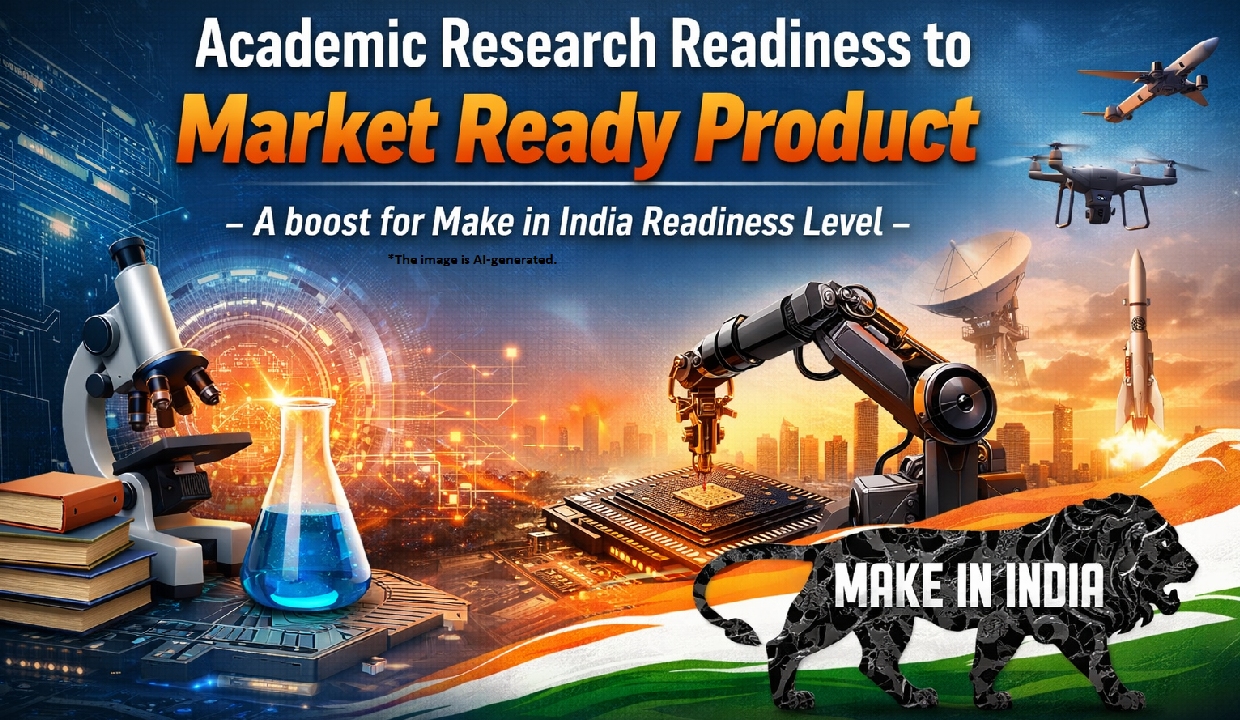
India’s Research Readiness to Market
India’s 21st century, especially the present decade, is marked as a historic achievement in transforming laboratory innovations, translational-Responsible Research to market-ready customized products. The milestones achieved in the past decade have created stepping stones for our nation to climb the ladder from a service-based industry to technological market-ready products. The ideology and icon behind this success is our unique educational policy, strong research, credit and skilling framework, digital public infrastructure, investments and funding from Government of India like Nidhi Prayas, SIDBI, Public Private Partnership [PPP] like Texas Instruments, technological tools and techniques like Cadence, Synopsis, Xilinx in semiconductor, Param Rudra super computers [low cost CPU core per Unit, GPU card per unit], large data base especially the genome in biotechnology are prominent examples created by Government of India in collaboration with academia, industry and startups. India’s homegrown recent breakthrough design of 2nm chips, which shows the strength of local to global design, talent, and research ecosystems of our nation.
Indian institutions, industries, and training partners like C-DAC, NIELIT are equipping students to reskill and upskill their knowledge and create brainchild products, which is need of the hour for our national economic growth. The Government of India initiatives
like Production Linked Initiative and Design Linked Initiative acts as a catalyst to be a blueprint for design and production of products in India that cater locally and globally.
India has successful and notable examples, case studies of transforming academic research to startups leading to manufacturing of swadeshi products in our homeland enabling to achieve the vision of Prime Minister of India Narendra Modi: Innovate, Patent, Produce and Prosper Research innovation systems: A Snapshot Indian institutions are successfully adapting the best practices of National Educational Policy 2020, National Credit Frameworks (NCrF) and National Skill Qualification Framework (NSQF) to train the students on cutting edge technologies such as Unmanned Aeriel Vehicle, Block Chain (Smart contract) and Artificial Intelligence for precession farming, 3D additive manufacturing for leather, designing chips forautomotive and healthcare applications.
Additionally, the educational and research practices are pushing our nation’s industrialisation and globalisation through the research and innovations funds and schemes such Anusandhan National Research Foundation, initiative of Department of Science & Technology, Government of India, BIRAC (Biotechnology Industry Research Assistance Council), Visvesvaraya PhD Scheme for Electronics & IT’ which promotes research and development in Electronic Design and Manufacturing [ESDM], Prime Minister’s fellowships for Doctoral Research, Academy of Scientific and Innovative Research (AcSIR), has given unique identity for the students and faculty members to carrying out research in various real-time projects and translating into product developments from the laboratory thereby facilitating the concept of Lab to Market.
The present spectrum of research ecosystems paves the way for academic institutions to function as pivoting tools to develop ‘swadeshi’ and ‘vocal for local’ products for our nation, leading to build a product nation.
Research into Product Readiness Level (PRL): Lab to Market
Indian institutions are working on emerging real-time problem statements, especially through doctoral research, thereby making a change in thinking from turning their laboratory research- Research Readiness Level [RRL] to develop market-ready products. The academic institutions are adapting the best practices of investing research funds through Investment Readiness Levels [IVL], leading to achieve distinct levels of matrices such as Technology Readiness Level [TRL], Manufacturing Readiness Level [MRL], Market Readiness Level [MRL] and finally end-to-end Product Readiness Level [PRL] meeting the Customer Readiness Level [CRL].
Additionally, many institutions are creating startup ecosystems in their workspace for undergraduate, postgraduate, doctoral, and post-doctoral research students, enabling students to create an opportunity for their research and product ideas converted to Startup Readiness Level [SRL] and Industry Readiness Level [IRL].
Case Studies-SRL-IRL: Impactful Research Initiative to Market Ready Products
1. Nanosafe Solutions, head quartered at New Delhi, is an outcome of Doctoral Research (PhD), founded by Dr. Anasuya Roy and Prof. Mangala Joshi. This startup is the first IIT Delhi-incubated startup in the healthcare applications that stood unique in developing customized antimicrobial and anti-viral healing products, such as self-reliant active advanced copper technology and self-sanitizing masks. This translational research boosts the Make in India, Vocal for Local and National Manufacturing vision of our nation.
2. Prenishq Private Limited, a flagship Indian deep-tech startup, incubated at IIT Delhi, which functions as a spin-off from the Cold Atom Quantum Technologies (CAQT). It is a prominent case study of transforming academic research into commercial technology under the initiative of the National Quantum Mission (NQM).
3. ePlane, an incubated startup founded by faculty of IIT Madras Prof. Satya Chakravarthy, stands unique in offering India’s first Air Ambulance and app-based services, is a prominent example of creating a paradigm shift of academic research to profitable swadeshi technologies in India.
4. Another best example is the Chip to Startup (C2S) supported by MeitY and the flagship initiative of All India Council for Technical Education [AICTE]-Idea Labscreates unique opportunities for the students to develop solutions for real-time problems such as intelligent traffic management and pacemakers for healthcare applications.
5. Defence Research and Development Organisation (DRDO) supported [DIA-CoE] — DRDO Industry Academia Centres of excellence established across PAN India is paving the way for student and faculty members to develop products such as Armour grade ceramic materials for body armour applications, intelligent smart soldiers using advanced plasmonic chips for defence applications.
6. The Boeing Inc., USA supported Intelligent condition monitoring of Air compressors and motors
developed by the Indian Institute of Technology, IIT Kanpur, is a classical example of Global innovations and partnership of industries with India in developing customised solutions for the aerospace industries.
The Indian research framework is also steadily focusing their responsible research values to meet the primary objectives of Quality Readiness Level [QRL].
The academic institutions are slowly, steadily, and rapidly adopting the policy framework of University Grants Commission [UGC] and All India Council for Technical Education [AICTE] promoted research-based internships in institutions, startup, MSMEs and large enterprises, which facilitate the students to work on market-ready solutions.
Also enhancing the publication and citation index and various elements of intellectual property rights [IPR] such as Indian copyrights, design registration, trademarks, and utility patents as well.
The global industry giants like Samsung and India’s NASSCOM, INUP [I2P] are also creating in-house Cohort training programs for students to enhance their experiential, firsthand learning, knowledge, and innovation base.
In addition to this, the research at the institutions is moving towards technology transfer and commercialisation to MSMEs and Startups as well.
This could be possible through the National Research and Development Organisation [NRDC], Innovation Technology Transfer Office [i-TTO] supported by BIRAC, a technology licensing organisation like Foundation for Technology Transfer (FITT), IIT Delhi and other organisations established across PAN India. These initiatives directly or indirectly give a great push for the Global Innovation Index ranking and Ease of Doing Business as well.
Way forward for Next Generation India: AI Readiness Level [AIL]
India’s present decade sees an era of Artificial Intelligence diffusion across each corner of our nation, especially the recent application Sarla bin, facilitating the dairy farmer, especially women. India has successfully organised the pioneering India Global AI Impact summit, which attracted global industry giants, startups, and academia to stand on one platform.
The outcomes of the Global AI Impact summit will confidently enhance the research and product development at the laboratory in India to Artificial Intelligence Readiness Level [AIL], leading to achieve the Next Generation India.
Head Institute Industry Interface Program Hindustan College of Science and Technology, Mathura; Views presented are personal.