A season under siege: When festivity gives way to fear
Merry Christmas to all readers! December 25 bursts into life worldwide with vibrant lights illuminating markets, festive decorations adorning public spaces, and cheerful exchanges of gifts. Crowded shopping streets, sumptuous dinners, and midnight Masses create a lively, joyous atmosphere. Today’s celebration goes beyond religion, welcoming everyone-believers and non-believers alike — to partake in its universal sense of joy and community.
This isn’t a column about theology, doctrine, or asking uncomfortable questions about the origins of the global festival. It’s written not because it’s Christmas, but because of what’s happening deep within France and several other countries of Europe — something that sends an urgent warning to the rest of the world.
Paris — the city long synonymous with champagne-soaked revelry, overflowing crowds, and unapologetic joie de vivre — is retreating behind a screen. This New Year’s Eve, the Champs-Élysées will fall silent. The roaring midnight congregation that has defined Parisian celebrations for six decades will be replaced by a pre-recorded broadcast, to be consumed from the safety of living rooms.
The French authorities have decided to cancel the massive open-air concert that once drew nearly a million people last year, opting instead for a televised event. During last year’s New Year’s Eve celebrations on the Champs-Élysées, nearly a thousand vehicles were set on fire, and 420 people were taken into custody, according to a high police source cited by the media.
This year, authorities are bracing for a repeat of that dark episode. Instead of putting ordinary citizens at risk, they’ve decided to play it safe and step back, effectively ceding ground to terror rather than fight it head-on.
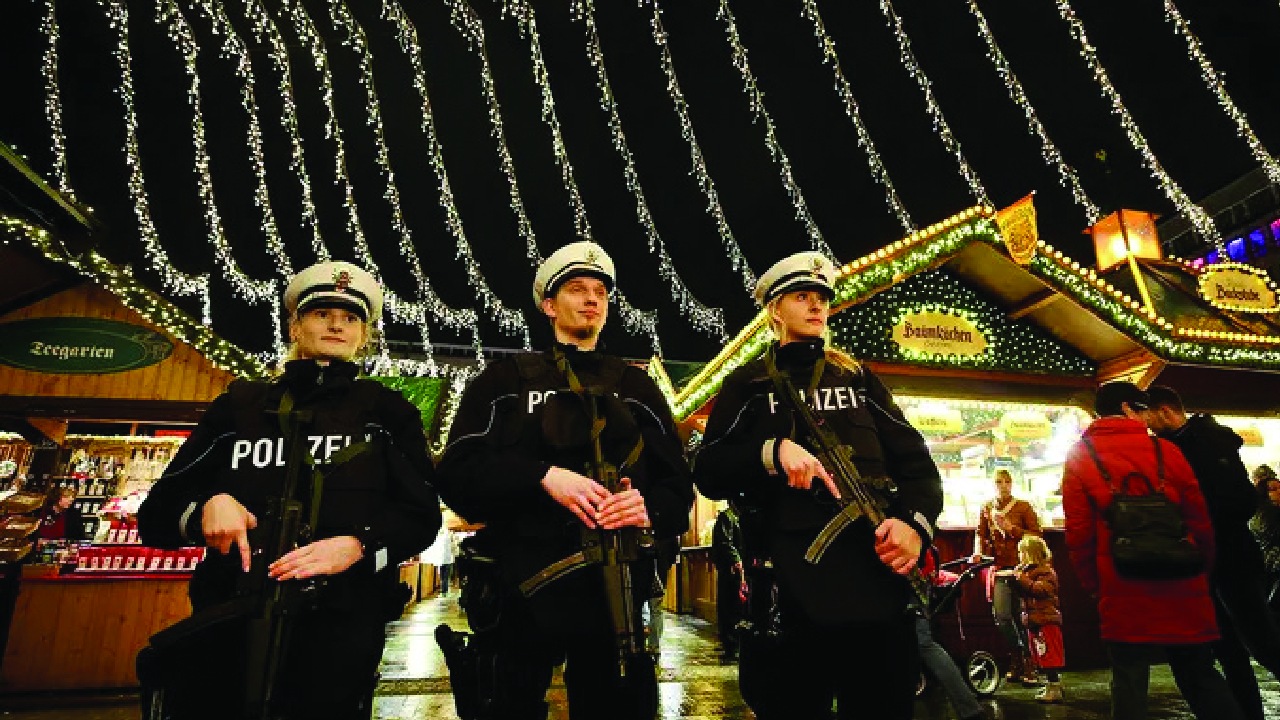
Germany’s second-largest public broadcaster, ZDF, reports that Christmas markets across Germany are being set up and will open for Advent, with police and organisers increasing security measures to make the season as safe as possible. However, some smaller markets are being cancelled because of stricter anti-terror safety requirements.
A New Year’s Eve fireworks event in Sydney has been dropped following the deadly alleged terror attack at Bondi Beach, which claimed 15 innocent lives. Waverley Council and event promoter Fuzzy have confirmed that the events planned for Australia’s most iconic landmark will no longer go ahead.
Why are Christmas celebrations being curtailed or cancelled in Europe? Who is creating this fear psychosis and forcing civil society into retreat? “It’s obvious that this is the result of massive unvetted Muslim immigration into Europe,” Daniel Di Martino, an immigration fellow at the Manhattan Institute, was quoted by the media while commenting on these disturbing developments. The sordid chain of events vividly embodies a profound underlying issue-how liberal societies can become ensnared, ultimately writing their own farewell. It also illustrates how bigoted ideologies exploit the privileges granted by liberalism, gradually gain momentum, and then set their sights on dismantling the very system that once embraced them, all as part of a calculated, strategic plan-spurred by theological beliefs.
India is no stranger to this grim history. Islam arrived in India initially through traders on the Malabar Coast, followed soon after by Islamic invaders fuelled by religious zeal and the call for jihad. Centuries of bloodshed ensued between these invaders and the local population.
In 1947, the Indian indigenous faith communities tried to achieve peace by ceding a third of their land, but their efforts largely failed. Today, what remains of India continues to be plagued by the two Islamic nations — Pakistan and Bangladesh — born from that surrender, along with countless supporters within its borders.
Capitulation to terror, as the Indian experience shows, doesn’t bring lasting peace; instead, it only fuels the terrorists’ hunger for more bloodshed. Sooner or later, France and the rest of Europe would have learnt its lessons, unfortunately the hard way.
As of 2025, Muslims number around six million, roughly nine per cent of the French population. History and contemporary events suggest a recurring pattern: when Muslims enter new lands — as invaders, guests, migrants, or refugees-over time, a significant section often seeks to reshape the host society. Indigenous cultures, social norms, and civic values come under pressure, and in many instances, there is a deliberate attempt to assert Sharia law as an overriding framework.
Most European countries have faced a sustained wave of Islam-inspired terrorist violence over the past decade. According to a study by the French think tank ‘Fondapol’, “Between 1979 and April 2024, a total of 66,872 Islamist attacks were recorded worldwide, resulting in at least 249,941 deaths.”
Britain’s Rotherham scandal, globally known as the “grooming gang scandal”, continues to resurface as a grim reminder of institutional failure.
France has long faced Islamic terror. In May 2014, Mehdi Nemmouche, a French jihadist returned from Syria, murdered four at Brussels’ Jewish Museum. In January 2015, brothers Chérif and Saïd Kouachi, and Amedy Coulibaly, carried out the Charlie Hebdo and Hyper Cacher attacks in Paris, killing 17.
The deadliest attack was on November 2015 13, when ISIS operatives, including Abdelhamid Abaaoud and Salah Abdeslam, executed coordinated shootings and bombings across Paris, killing 130. In March 2016, suicide bombers linked to the same network targeted Brussels Airport and Maelbeek Metro, killing 32.
On July 14, 2016, Mohamed Lahouaiej-Bouhlel carried out the Nice truck massacre, killing 86. Later that month, Adel Kermiche and Abdel Malik Petitjean murdered a priest in Normandy. On October 16 , 2020, in Paris, an 18-year-old refugee killed a teacher by slitting his throat.
A few days later, on October 29, 2020, Brahim Aouissaoui stabbed three people to death in Nice’s Notre-Dame Basilica and was sentenced to life. The list of such sordid incidents is long.
On December 21 , 2024, in Magdeburg, Germany, a 50-year-old Saudi doctor, Taleb Abdul Jawad, deliberately ran his BMW car into crowds engaged in Christmas shopping. The attack killed five people, including a child, and injured nearly 200 others.
In October this year, a British citizen, Jihad Al-Shamie, drove into pedestrians and stabbed a bystander at Heaton
Park Synagogue, killing two and injuring several; it was declared a terror incident by authorities.
Two years ago, coordinated attacks were carried out by local Muslim groups on Hindu homes and temples in Leicester and Birmingham in the UK. Between 1997 and 2013, in towns such as Rotherham, Cornwall, and Derbyshire, more than 1,500 minor girls — most of them white — were subjected to organised sexual exploitation. Judicial proceedings reveal that over 80 per cent of those convicted or accused in these cases were Muslims, with an average age ranging between 30 and 40 years.
This pattern is not confined to Europe alone. In the United States too, Islamist terror has emerged both from within and from across borders.
Why are there repeated instances of terror in the name of Islam? Apologists often offer two explanations: first, Muslims lack education; and second, they are cornered into doing so as part of their retaliation against injustices done to them. Neither explanation stands the test of reason and facts.
The reality is clear: violence of this kind is fuelled by a toxic mindset claiming theological sanction. When we try to examine this hate phenomenon honestly, we are often dismissed as Islamophobic. In this charged atmosphere, can any effort to combat terror succeed?
The writer is an eminent columnist and the author of ‘Tryst with Ayodhya: Decolonisation of India’ and ‘Narrative ka Mayajaal’; views are personal