Women only form 12 per cent of Bihar Assembly
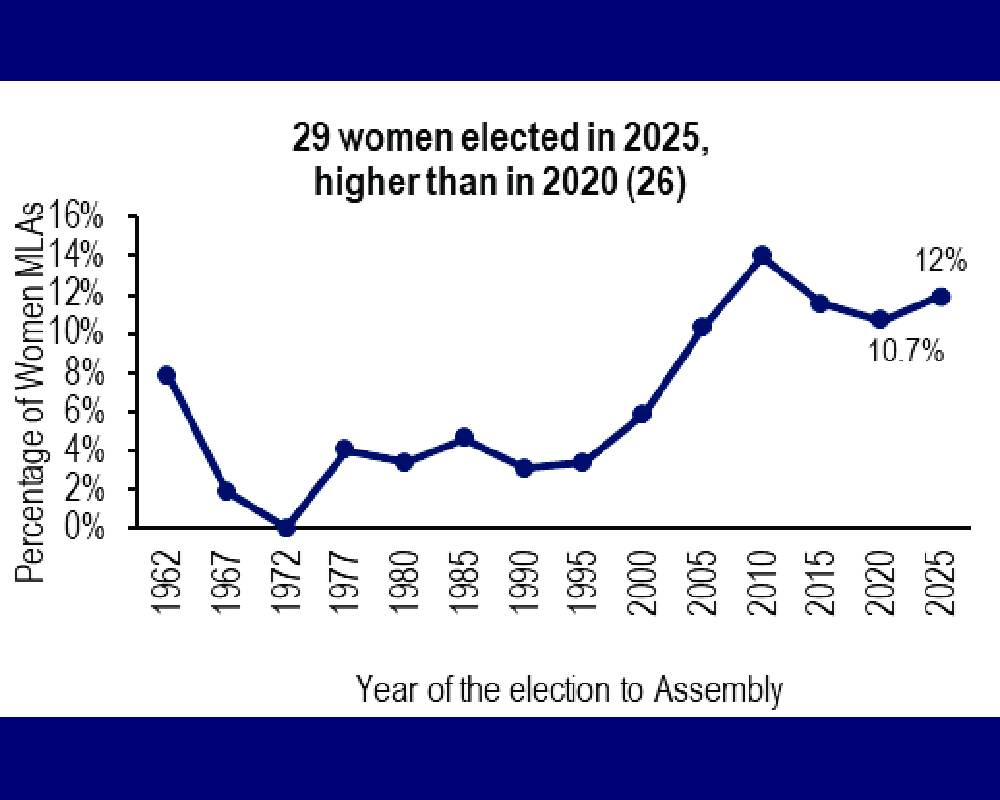
The results of the election to the 18th Bihar Legislative Assembly, declared on November 14, have not only set the stage for another term of the National Democratic Alliance (NDA) but have also revealed a distinct shift in the social and demographic profile of the State’s lawmakers, according to a fresh analysis by PRS Legislative Research.
The NDA returned to power with a sweeping majority, strengthening its position across the State. But beyond the electoral outcome, the newly elected Assembly tells a deeper story about representation, experience, and evolving political trends in Bihar. Only 12 per cent of the new lawmakers are women, reflecting a persistent gender imbalance even as parties fielded a higher number of female candidates compared to previous elections.
The age composition of the Assembly continues to shift upward, with the proportion of MLAs aged 55 or above rising from 34 per cent in 2015 to 40 per cent in 2020 and reaching 46 per cent in 2025. Analysts note that this trend underscores increasing voter preference for senior leaders or those perceived to have administrative experience.
Educational qualifications among MLAs have also risen, with a greater number of legislators holding postgraduate degrees compared to those elected in 2020. While this marks a positive development for legislative capacity, PRS noted that nearly half of the women MLAs do not possess a college degree, highlighting a contrasting divide that persists within the Assembly.
Incumbency played a significant role in shaping the new House. Among MLAs who re-contested their seats, 58 per cent succeeded in returning. Experience appears to have been a major factor for voters, as reflected in the performance of those who held ministerial portfolios during the previous term. Of the 68 MLAs and MLCs who served as ministers in the 17th Assembly, 49 chose to contest in 2025, and 39 of them emerged victorious. This strong return rate underscores the electoral advantage of ministerial visibility and administrative credentials.
Professionally, the Assembly continues to be dominated by individuals who list politics, social work, and agriculture as their primary occupations, reflecting broader socio-economic patterns in the State. The 2025 election witnessed robust public engagement, contributing to one of Bihar’s highest voter turnouts in decades.