Women of the Woods
Fifty-four percent. It’s a number that should stop you cold. That is the actual percentage of indigenous women in our rural heartlands who can’t even read their own names. Let that sit with you for a second. While the rest of the world is busy prepping grand speeches and hashtags for Women’s Day, a staggering 67 percent of young tribal girls are vanishing from their classrooms before they even see the eighth grade. It is a harsh, deeply uncomfortable reality staring right back at us.
Step off the paved highways. Walk into the quiet, deep forests where the air smells of wet earth and survival. Here, the polished illusion of modern empowerment shatters. Extreme poverty and the brutal, everyday demand of staying alive tear schoolbooks away from these girls. Heavy baskets and the heavy, quiet chains of early marriage replace their education. It makes you wonder — how liberated are we, really, when the very foundation of our rural world bleeds in total silence?
What happens to the estimated 400 million rural women globally who live entirely off the grid when the empowerment seminars end? The global data on female poverty is a bitter pill to swallow. Millions of them survive on less than two dollars a day, bearing the absolute total weight of their household’s survival. Nobody tracks their daily commutes across barren lands. Nobody records how many miles they walk just to keep their children breathing. The mainstream conversation around equality completely ignores the women fighting the ugliest wars against starvation and systemic exploitation. Real resilience is rarely glamorous. It is fought in the dust, usually with bare hands.
We clap for the loud, visible victories. But what about the victories that look like a handful of rice? We walk right past the mothers who are quietly bleeding into the soil, the women tearing themselves apart just to make sure their kids survive one more sunset. Nobody cheers for a mother pulling her family through another brutal day of starvation. The absolute heaviest courage on this planet never gets a microphone. It lives down in the dirt, held together by women who refuse to let their children go hungry. Leave the global summits behind and travel into the deep tribal heartlands of eastern India. In the Khunti district of Jharkhand, the modern infrastructure the world constantly brags about evaporates completely. Here, a specific group of ten Adivasi women live a reality defined entirely by raw grit. Many of these women are widows. Some care for husbands incapacitated by illness or chronic unemployment. They carry the survival of their families entirely alone. Smartphones bypassed them. Formal schooling evaded their generation. But they possess something else - heavily calloused hands and an ancient, generational skill.
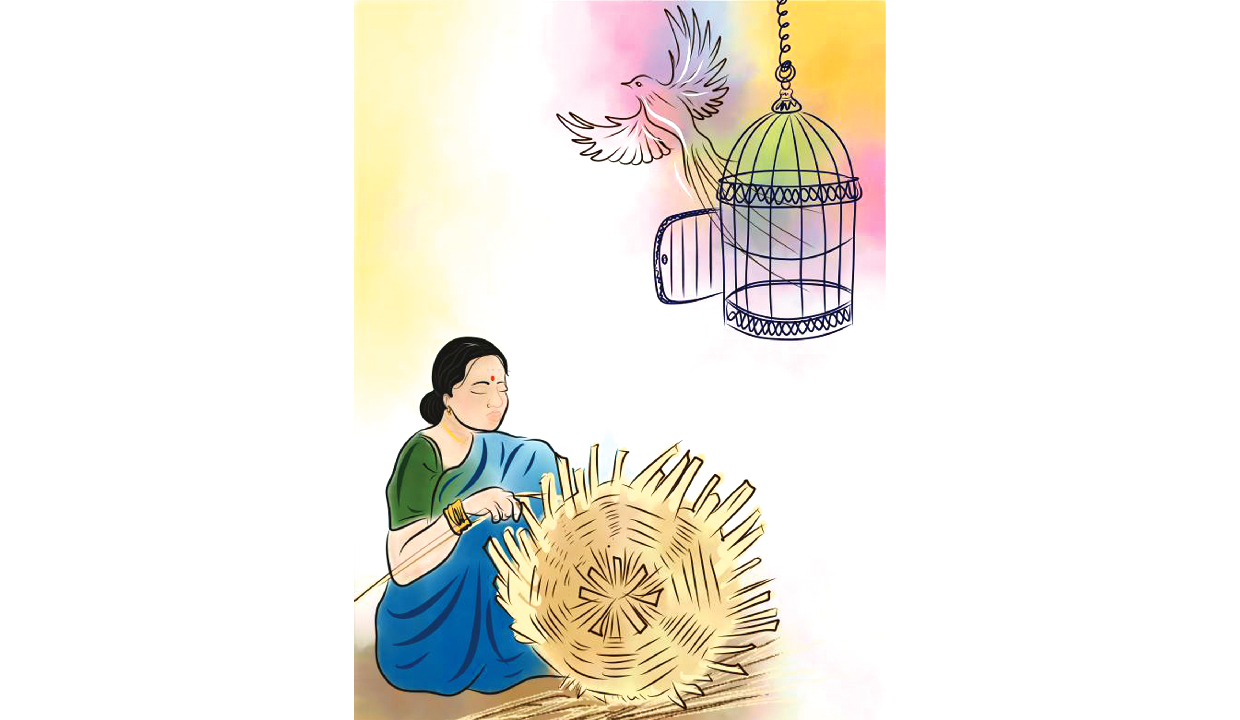
They walk deep into the forests to harvest raw bamboo. Sitting on the hard earth for hours, they weave intricate baskets, ceremonial flowers, and the traditional soop mandated for local weddings and rituals. Then comes the hardest part. They strap massive, back-breaking loads of this handiwork to their shoulders and walk. They cover miles of unforgiving dirt roads. They navigate chaotic city markets and knock on doors in neighbouring settlements, desperate to barter their indigenous heritage for a daily meal. To navigate this landscape as a single, unprotected woman brings a crushing vulnerability that would shatter most people. Yet they keep walking. Hunger leaves absolutely zero room for surrender.
And poverty like that? It brings out the worst kind of predators. Human traffickers hover around these tribal belts constantly, looking for desperate, unguarded young women and vulnerable widows. It’s happening every day. Communities are quietly losing their daughters and sisters to a brutal underground trade. Right in the middle of this nightmare, living in a forgotten village in Jharkhand, stands Bhoothmani. We talk a lot about female resilience around early March, but her life is the actual, bleeding blueprint of it. They took her at eight years old. When she finally surfaced on a quiet road, there was almost nothing left. The trauma had taken her memories and her voice. Normally, when a person goes through something that deep, they never really return.
A nine-month bridge course slowly dragged her back to the real world. She fought her way into a regular classroom, eventually married a local driver, and had two children. For a very brief window, she actually got to taste a quiet, ordinary life. Then her husband passed away. Whatever tiny safety net she had built evaporated overnight. She was completely alone again — a single mother standing face-to-face with the exact same crushing poverty and extreme vulnerability that almost destroyed her own youth.
Grief destroys people out here every day. You would expect someone in her shoes to simply give up. Bhoothmani went the other way completely. She took that entire trauma and forged it into armour. Signing up as a Paralegal Volunteer, she started walking right back into those isolated villages. She tracks down terrified parents and tells them the absolute, brutal truth about where their missing daughters actually end up. Now she sits on the Child Welfare Committee board. When a phone rings at two in the morning about a trafficker on the move or a sudden child marriage, she is theone who answers. She intercepts them herself.
Her husband is gone. Her fire is entirely intact. She has personally rewritten the fate of thousands of young girls across the district. The men hunting these villages are finally dealing with someone they failed to destroy. You sit across from Bhoothmani, ask her why she risks her life going back into the darkest parts of the district, and her answer leaves you completely quiet. She will not stop until every girl and woman in her community can step outside their homes and smile. No looking over their shoulder in absolute terror. That is her entire life’s mission. This raw, bleeding edge of womanhood rarely makes the front page. But on a day meant to celebrate power, Bhoothmani is the hero we should be talking about.
The survival of Santhal, Munda, Oraon, and Ho women directly challenges everything we casually label as progress. These women have always stood as the original protectors of Jal, Jungle, and Jameen. They still form human shields to save their forests today, tying rakhis to ancient tree trunks, ready to spill their own blood before letting a single axe touch the bark.
Their feminism was pulled barehanded from the rough red soil of Jharkhand. You see that exact fire in the heavily calloused fingers of the Khunti widows, weaving bamboo in the dust to keep starvation locked out of their homes. You see it in mothers pushing through severe anaemia every single day because stopping to rest means their children go hungry. True empowerment remains a complete lie while this massive gap exists. Offering a fleeting moment of acknowledgement once a year is a pitiful bare minimum. The grinding struggles of these matriarchs form the actual, bleeding heart of this land. Bouquets will be passed around all week. Our screens will be buried under a mountain of those perfectly polished hashtags. But we really need to pause and face a hard, jagged truth. If that woman weaving bamboo baskets can never afford to rest her scarred shoulders, and the monsters Bhoothmani spends her life fighting are still out there circling the dark woods, whose freedom are we actually celebrating?
Letters to all the women
To all the amazing women,
We know how relentless the noise gets. You are constantly expected to hold up the entire sky whilst making it look completely effortless. That weight? It’s a lonely, heavy thing to carry. But you never walk into a room with empty hands. You carry every battle you survived right through that door with you. You have yourself. That fierce, quiet instinct sitting right behind your ribs is your absolute best guide. If a choice makes perfect sense to your own heart, take the leap. Ignore the audience. And this Women’s Day, do not sit around waiting for someone else to bring you flowers. Go buy them for yourself. Better yet, realise you do not even need the bouquet. You planted the entire garden. Happy Women’s Day
- The Editorial Desk