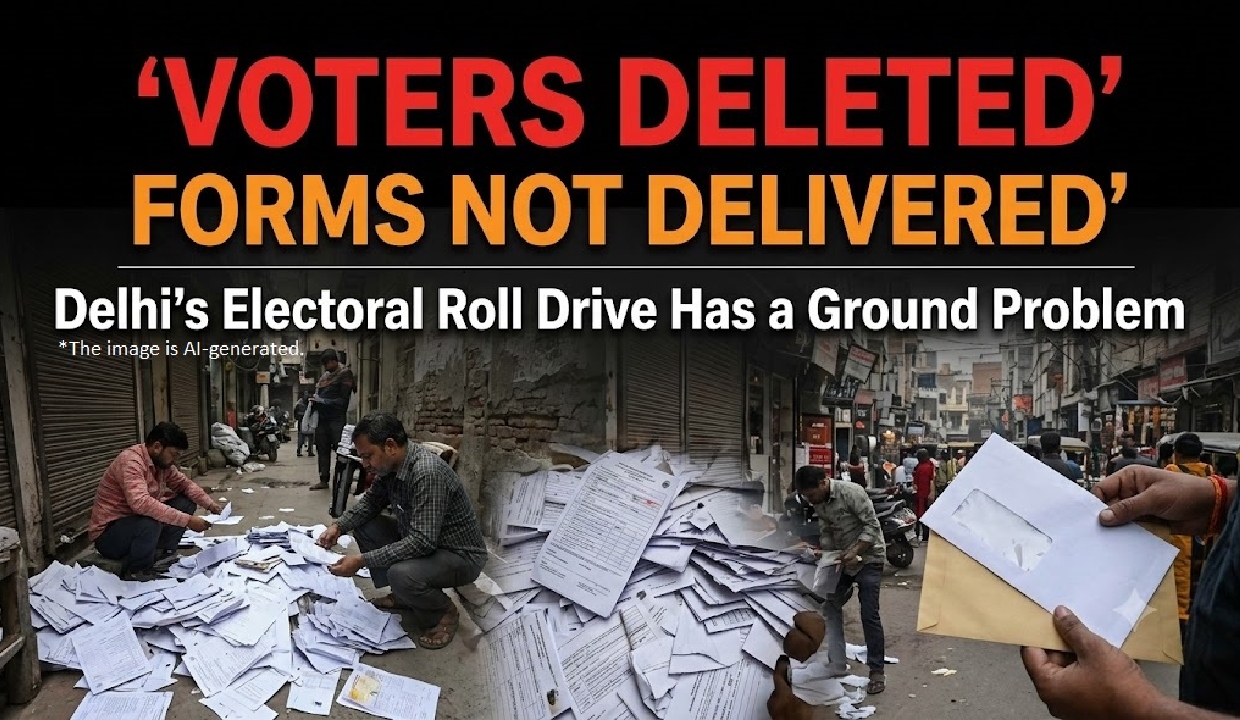
Voters Deleted, Forms Not Delivered: Delhi’s Electoral Roll Drive Has a Ground Problem
Sushil Kumar, who came to Delhi from Bihar and has been a resident of Delhi for multiple decades. In the year 2003, he was a resident of East Delhi, Pandav Nagar area. He voted in that year’s Delhi assembly election from the Laxmi Nagar booth. He had filled an enumeration form earlier, but nothing moved until a Booth Level Officer knocked on his door this month as part of Phase III of the Special Intensive Revision.
The BLO came, the form was filled properly, and his family’s voter registration is now in order. For Sushil Kumar, the system eventually worked. For his neighbours in other parts of the city, it has not. In Khajuri Khas, three residents who say they have lived in the same locality for 15 years, Jugnesh Singh, Aryan Singh, and Reema Devi, have found their names missing from the electoral roll. The reason, they allege, is BLO inefficiency. Their EPIC numbers were cancelled, and they are now outside the roll entirely.
When they contacted the election office, they were told to fill Form 6 or apply afresh for an EPIC card. In a city where 1.45 crore voters are being revisited door to door, the quality of the person doing the visiting is making the difference between being a voter and being erased as one. In Trilokpuri, residents say their BLO has been genuinely helpful, going out of the way to resolve documentation issues and ensure eligible voters are not dropped.
These ground-level experiences have now acquired political weight. The Aam Aadmi Party on Friday alleged serious irregularities in the SIR exercise, claiming that eligible voters, particularly from poor and migrant communities, are being systematically left out.
Delhi AAP chief Saurabh Bharadwaj alleged at a press conference that around 14 lakh voters had been removed during a pre-SIR exercise. However, the enumeration forms for Delhi’s SIR of electoral rolls have been distributed to 1,44,60,313 of the city’s 1,45,10,298 registered electors, covering 99.66 percent of the total electorate as of 8 pm on Friday, with five districts, Old Delhi, New Delhi, North East, and South, each achieving 100 percent distribution, according to the cumulative status report from the Office of the Chief Electoral Officer. North West District has the lowest distribution at 97.57 per cent, with 1,24,61,08 forms distributed out of 12,77,126 electors.
Outer North leads on digitisation at 36.88 per cent, followed by South West at 30.26 per cent. The overall digitisation figure stands at 30,49,330 forms, representing 21.01 per cent of the total electorate.