Tuesday rush exposes Metro planning
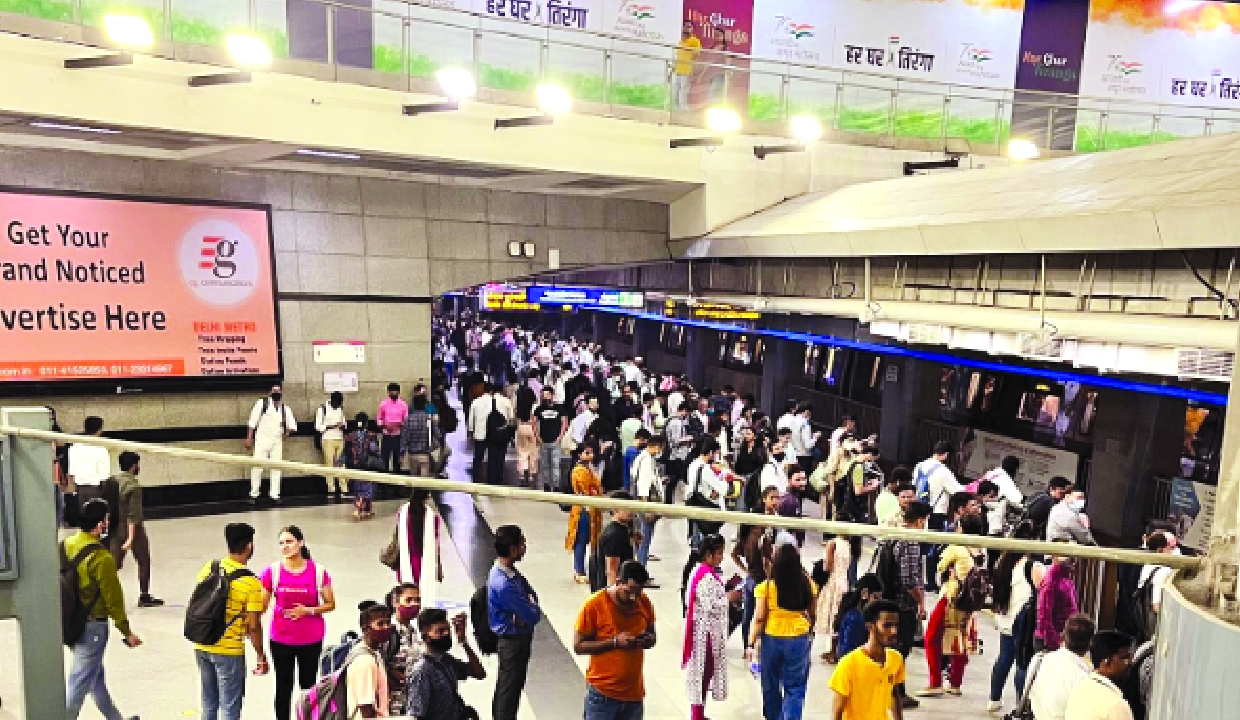
The platform at Rajiv Chowk on Tuesday morning looked the way it always does when something has gone wrong upstream. People pressed against the yellow line, a train sitting longer than it should at the platform, the announcement system repeating itself, and a quiet collective calculation spreading through the crowd: I am going to be late.
Metro Monday was supposed to be the beginning of something. The Delhi Government’s campaign to reduce fuel consumption by encouraging citizens to leave their cars at home and take the Metro had its first official day on Monday, and by all accounts it worked, in the sense that more people came. What it did not do was come with additional train frequency, expanded platform capacity, or any visible preparation for the load it was explicitly designed to increase.
On Tuesday, the consequences were still being felt. This correspondent travelled across the Blue Line and Magenta Line during the morning peak, and the conditions were consistent: packed coaches, extended halts at major interchange stations, and commuters who had made the responsible choice and were being punished for it.
At Mandi House, a Government employee waiting for a Blue Line train towards Dwarka said he had taken the Metro for the first time in several months after the Government’s appeal. “Yesterday was terrible. Today is also bad,” he said. “If they want people to use the Metro, the Metro needs to be ready for people.”
At Kashmiri Gate interchange, one of the busiest transfer points in the network, the crowd during the morning rush had spilled back from the platform onto the stairwell. A woman with a school bag and a lunch box pressed against the wall said she had been standing on the platform for three trains. “Each one was full. I could not get in,” she said. Her school, she added, had already marked her late.
At Central Secretariat, where Government employees heading to South Block, North Block, Shastri Bhawan, and the surrounding ministry complex disembark, the platform was unusually congested. A senior clerk said he had started taking the Metro following his department’s internal advisory about fuel conservation. “I support the idea. But the Metro was not prepared for extra passengers,” he said. “It felt like everyone came at once and there was no planning for it.”
The issue commuters raised was not with the initiative itself. Several said they understood the reasoning given rising fuel prices and the West Asia situation. The problem, as one passenger at Rajiv Chowk put it, was that the Government had appealed for more Metro use without first ensuring the Metro could absorb it. “The campaign told us to come. The Metro told us to wait,” he said.
On Monday, reports had emerged of trains halting longer than usual on the Magenta Line, causing platform build-up at stations like Hauz Khas and Janakpuri West. A Delhi University student had told reporters she missed exam time because of the delay. A private sector employee said he had waited fifteen minutes at a station while a train stood still, arriving late to his office.
A Delhi Metro Rail Corporation spokesperson said the corporation was monitoring ridership patterns following the Metro Monday initiative and would assess whether frequency adjustments were required on specific lines during peak hours. The spokesperson said the Metro encourages additional ridership and is committed to providing safe and comfortable travel.
That commitment will be tested in the coming days. The Government has said the Metro Monday campaign will continue and expand. If it does, the platforms at Rajiv Chowk, Kashmiri Gate, and Central Secretariat will need more than a campaign slogan to manage what arrives on them.