The Necessary Pause
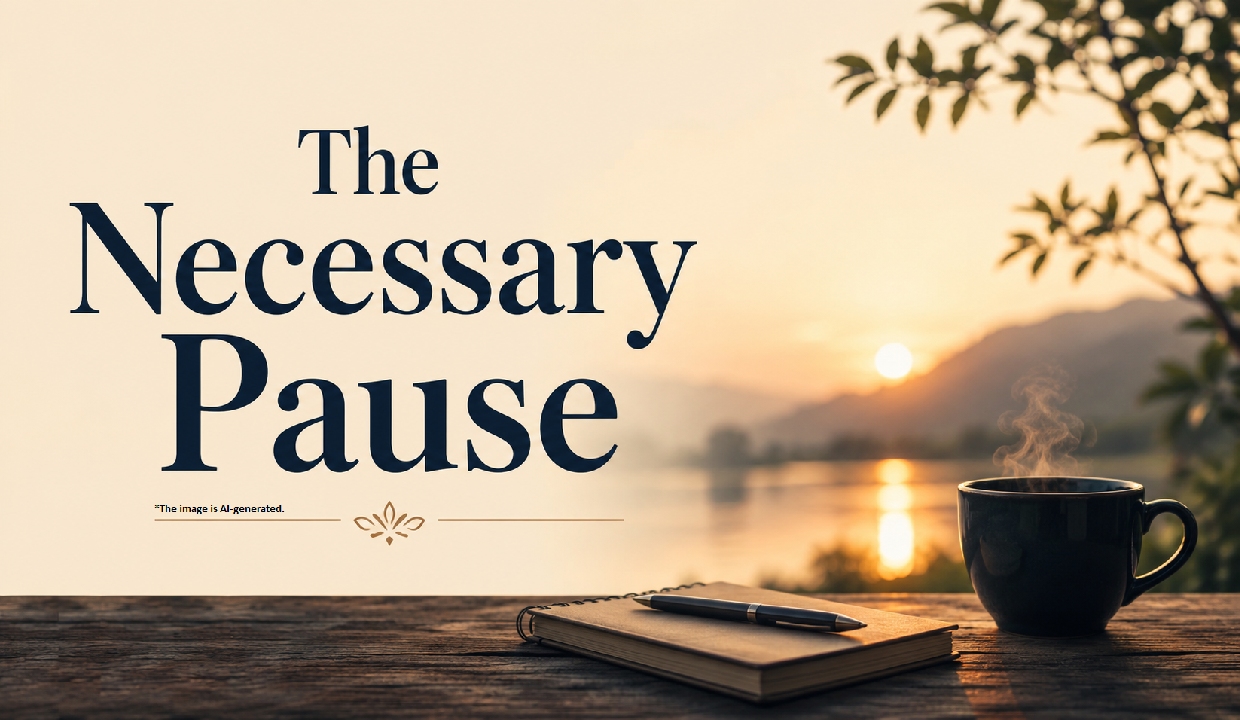
Is the year slipping away, or is it we who quietly slip through the year, unnoticed even by ourselves?
There is something pleasantly strange about the time when we move from one year to another. Fireworks fade, greetings come to rest, calendars are replaced, and the world begins to move forward impatiently. Yet somewhere within this movement, a distinct feeling anchors within us, which is a sort of a personal ritual of turning inward.
It arrives while opening an old notebook and finding a sentence highlighted with unusual conviction or during a late-night scroll through photographs in our phones, when the early months begin to look distant, as if they belonged to another version of ourselves. Sometimes it comes simply as an uneasy feeling that time may have moved with greater sincerity than we ourselves managed to.
The promises we made at the beginning of the year, be it to live with more discipline; to become calmer; to write regularly; to be less distracted and more available in the moment, now stand, more like questions, staring right back at us. Perhaps we make these promises because somewhere we know that a meaningful life is not always destroyed by one great tragedy. More often, it is slowly diminished through habitual inattentiveness.
Why do we make such promises each year? A “year”, after all, is not really a thing in nature. The Earth completes an orbit around the Sun and the rhythm is largely repeated. From that recurring movement, we create a unit stable enough to organise memory and expectation.
Nature keeps evolving, galaxies continue moving outward as they do but human beings gather under fireworks, trying to believe that beginnings can be scheduled.
Strangely, the closer science looks at time, the less it resembles the thing we claim to “have”, “waste”, “save,” or “lose”. It begins to look less like a possession and more like an experience. We do not feel relativity in equations. We feel it when childhood seems both yesterday or another lifetime; when a year disappears in routine but one afternoon remains vivid forever. Physics may tell us that time bends with gravity, but life teaches us that it also bends with grief, love, waiting and attention.
A shattered glass does not reassemble itself. Childhood cannot be revisited except through memory. Words, once spoken, continue living in consequence even after their sound has vanished. Physics calls this the arrow of time, i.e., the movement towards entropy and irreversibility. Life, too, has such an arrow. Moments, once lived, cannot be recovered in their original form. That is why years feel peculiar in hindsight.
And intensity is measured by questions such as, did we live the year attentively, or merely pass through it? Were we truly present, or mostly elsewhere, rushing toward some future moment which, once reached, vanished into another anticipation? Perhaps the real tragedy is not that time passes, but that so much of it passes unlived. The mind remains busy preparing for life instead of inhabiting it. This is where time is most distorted, i.e., not in clocks or calendars, but in consciousness. One part of us rehearses the future; another revisits the past. The present becomes only a corridor we cross, without ever fully arriving.
Modern life has made this disappearance easier. Every silence now arrives with discomfort. Every idle moment seeks occupation. Information accumulates, but little settles into understanding. Attention is a scare resource. What we repeatedly attend to shapes our neural pathways, strengthens habits and gradually constructs our identity. Behavioural psychology tells us that habits are not sustained by declarations, but by cues, repetitions and rewards. Resolutions fail so often not because people are insincere, but because they mistake desire for design.
That is why becoming an entirely “new person” every year feels artificial. Human beings do not transform through declarations. The self is not replaced overnight; it is carried forward. We are not erased and rewritten. We are revised incrementally.
Every time we honestly look back in time, we are greeted not by pride or regret, but by humility. Humility, not because everything goes according to plans, but because very little does. Years are not fair in their distributions. With this humility, we realise that whatever goodness has endured in life isn’t entirely a work of the self. It infact arrives through others, through their patience and forgiveness that does not humiliate, and through people who continue recognising possibility in us when we ourselves have lost faith.
Well, it is true that each pause in time brings the temptation of reinvention. New year, new self. There is nothing wrong with this impulse. It shows that the mind still wishes to rise.
So for each pause, whenever we choose to have it, I pray may we keep showing up.
And above all, may we live in a way that feels true from within. Because in the end, truth is the only measure that does not fluctuate. It is the only evidence that remains when applause fades, when plans fail, when calendars change and when the noise of the world grows quiet enough for us to finally hear ourselves.
Disclaimer: The views expressed are personal and are intended only as reflections on life, time and human experience.